
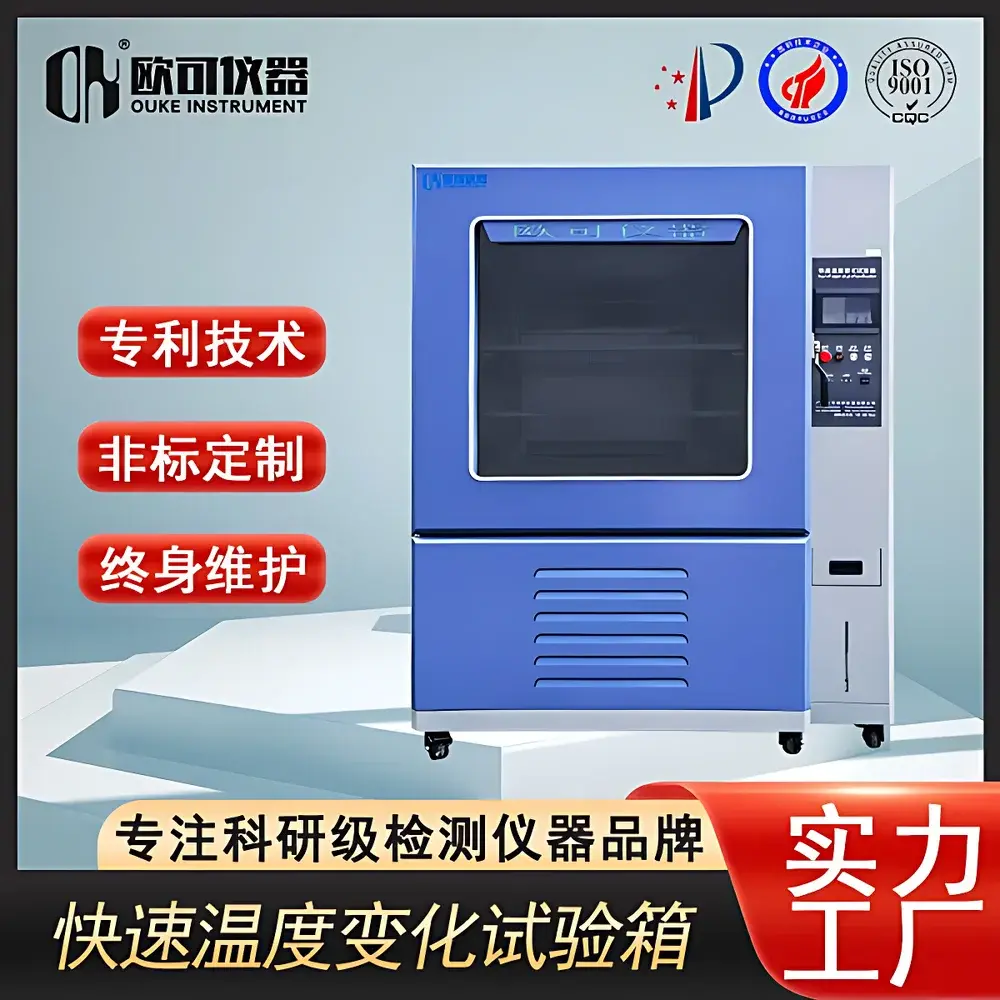
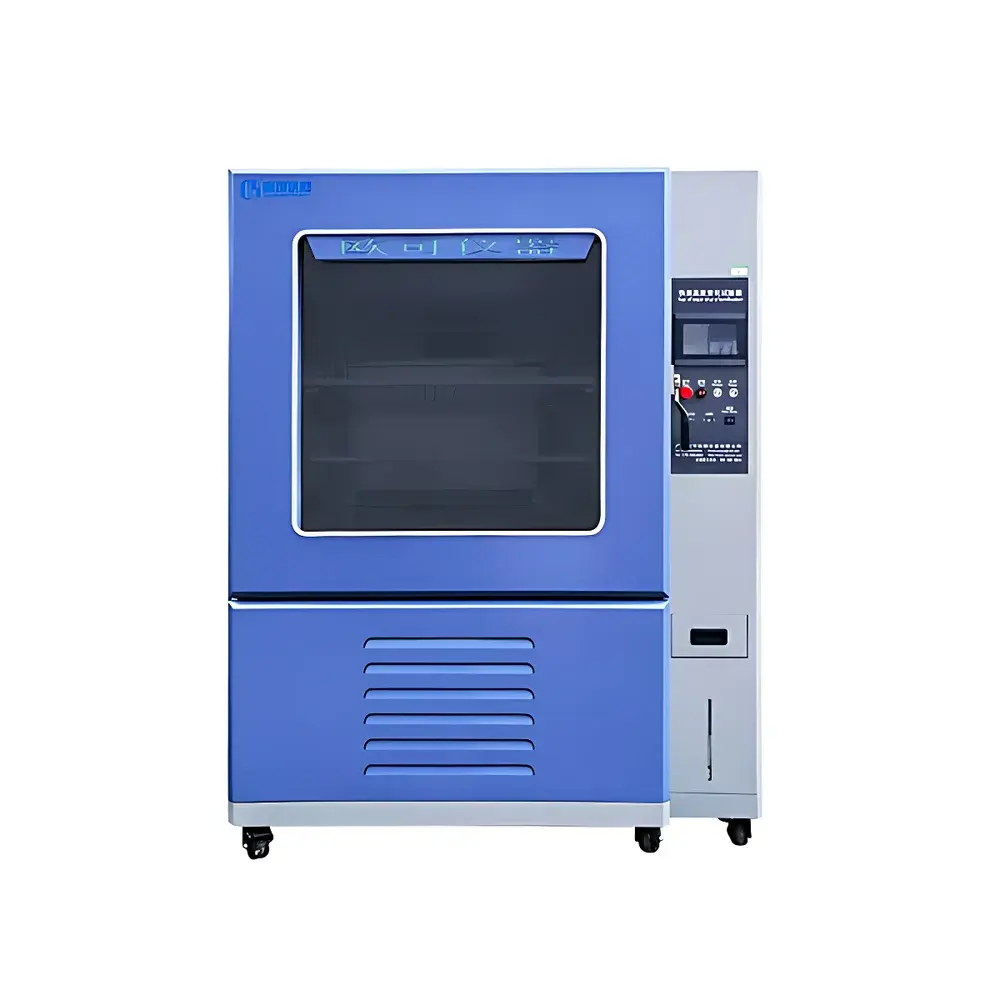
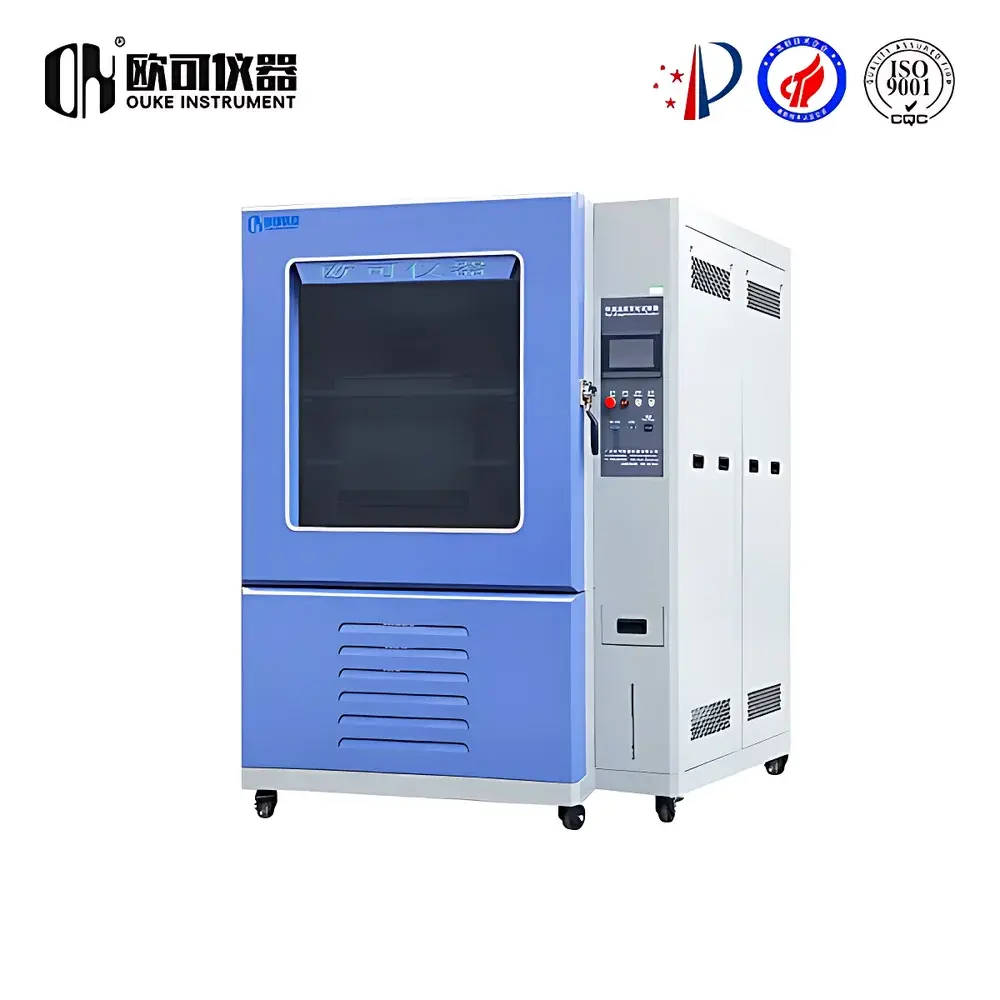
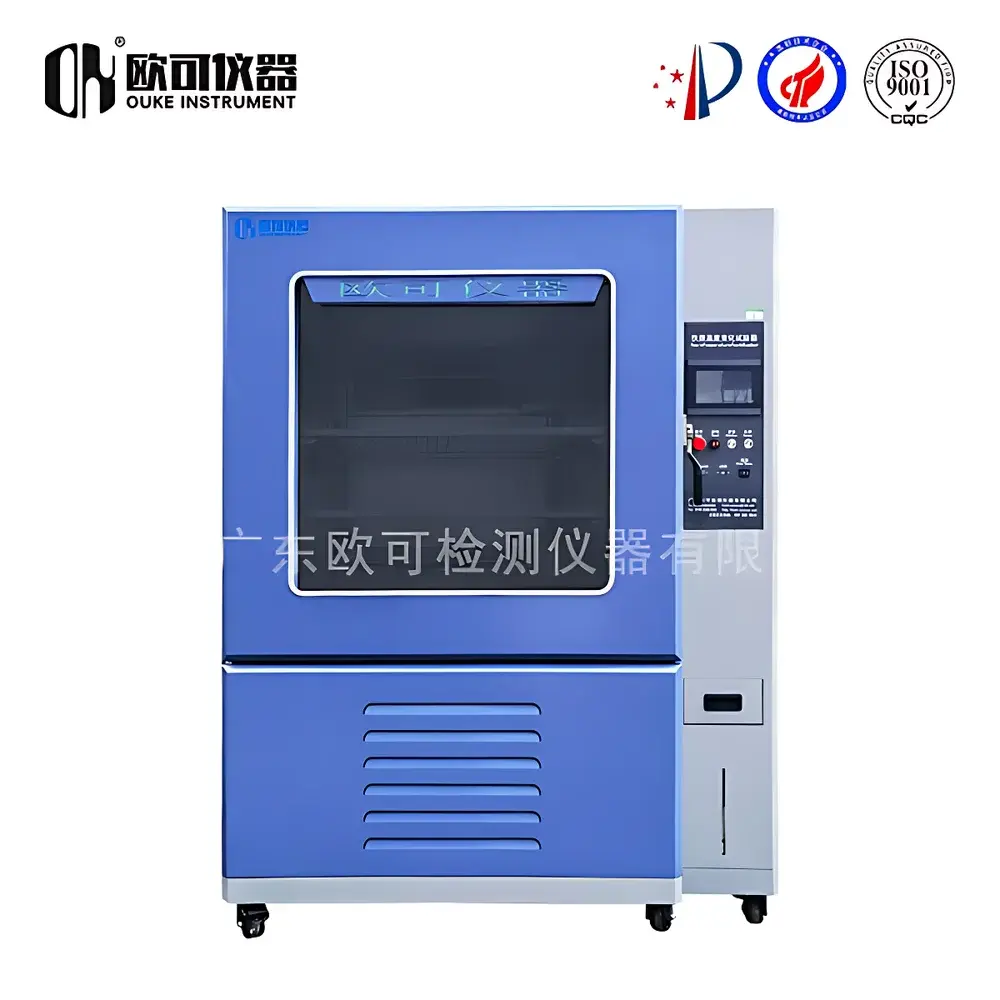
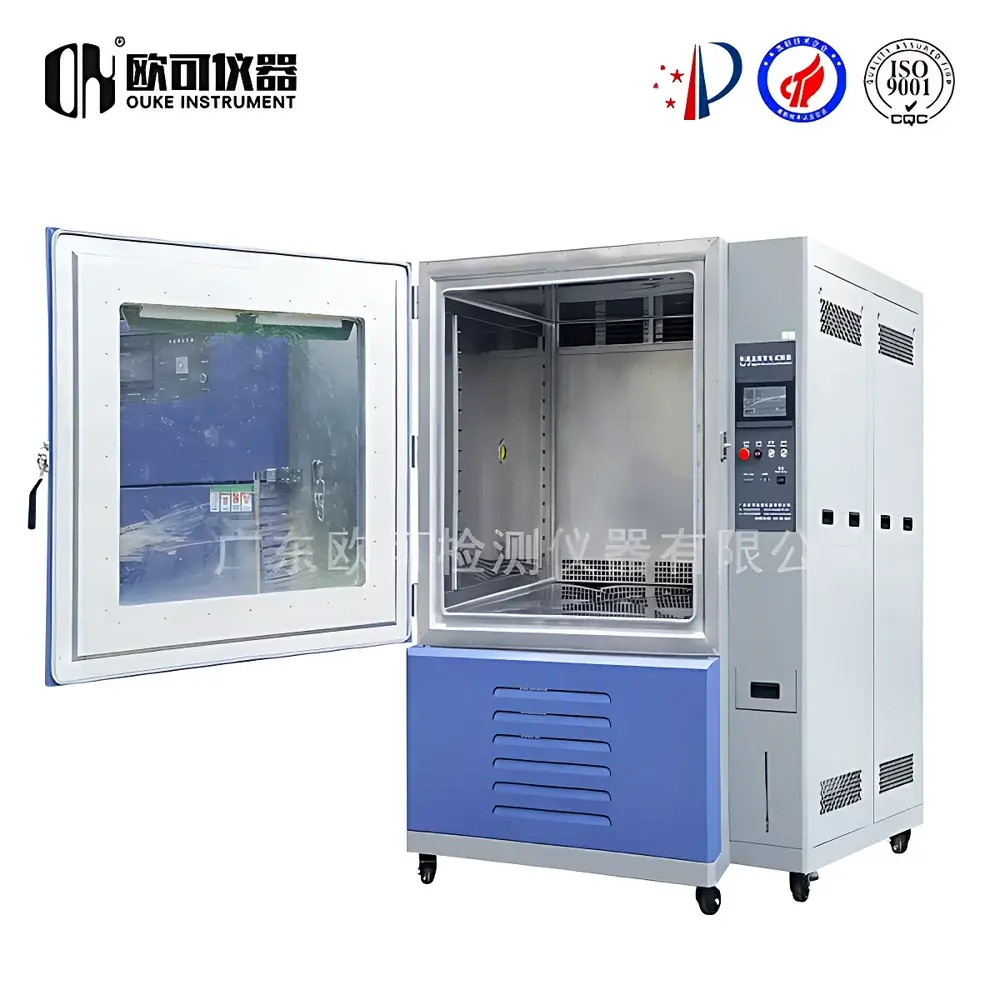
OK KS-TH-158 Rapid Temperature Transition Chamber
| Brand | OK Instruments |
|---|---|
| Origin | Guangdong, China |
| Manufacturer Type | Direct Manufacturer |
| Country of Origin | China |
| Model | KS-TH-158 |
| Price | USD 8,200 (FOB Guangdong) |
| Temperature Range | -70°C to +180°C |
| Max. Ramp Rate | 25°C/min (empty load, -40°C ↔ +85°C, linear profile) |
| Uniformity | ≤ ±2.0°C (at steady state) |
| Stability | ≤ ±0.5°C (center point, short-term) |
| Control System | 10.1" color touchscreen PLC-based controller with predictive PID algorithm |
| Refrigeration | Dual-stage cascade compression + liquid nitrogen (LN₂) assist |
| Heating | High-power tubular heaters in optimized air duct |
| Airflow | Vertical top-down forced convection, ≥3.5 m/s average velocity |
| Internal Chamber | SUS304 stainless steel |
| Insulation | 150 mm high-density polyurethane foam (λ ≤ 0.022 W/m·K) |
| Viewing Window | Triple-layer heated anti-frost glass |
| Test Port | Φ100 mm, insulated & sealed |
| Compliance | Designed per IEC 60068-2-14, GJB 150.5A, and MIL-STD-810H environmental test methodology frameworks |
Overview
The OK KS-TH-158 Rapid Temperature Transition Chamber is an engineered environmental stress screening (ESS) system designed for accelerated thermal reliability assessment of electronic components, aerospace subsystems, automotive ECUs, and advanced materials. Unlike conventional temperature cycling chambers that emulate ambient climatic variation, the KS-TH-158 implements controlled, high-rate linear or non-linear temperature transitions—up to 25°C per minute—to induce thermomechanical stress through rapid expansion and contraction across material interfaces. Its core measurement paradigm is not environmental fidelity but defect acceleration: by subjecting devices under test (DUTs) to repeated thermal excursions within defined bounds (–70°C to +180°C), it precipitates latent failures arising from coefficient-of-thermal-expansion (CTE) mismatches, interfacial delamination, solder joint fatigue, and adhesive bond degradation. The chamber achieves this performance via a rigorously integrated architecture: dual-stage cascade refrigeration provides baseline cooling capacity; liquid nitrogen injection—precisely metered via solenoid valves synchronized with real-time thermal load estimation—enables transient peak cooling power during ramp-down phases; and a high-velocity vertical airflow system ensures uniform convective heat transfer across the entire working volume, minimizing thermal gradients even under dynamic conditions.
Key Features
- High-fidelity thermal control architecture combining predictive PID algorithms with real-time load compensation logic, enabling programmable ramp profiles (linear, step, dwell, logarithmic) with minimal overshoot (< ±0.8°C) and precise dwell stability (±0.5°C over 30 min)
- Dual-mode refrigeration system: primary cascade compressor stage (Bitzer semi-hermetic units) + secondary LN₂ assist circuit with flow-regulated injection, delivering consistent cooling power across the full temperature range
- Robust internal construction: 2.0 mm thick SUS304 stainless steel chamber walls, 150 mm ultra-low-conductivity polyurethane insulation, and triple-glazed heated observation window with defrost capability down to –70°C
- Optimized forced-air circulation: axial centrifugal blower (≥1,800 m³/h airflow) integrated into a vertically oriented duct network ensuring laminar, high-velocity (≥3.5 m/s) air distribution and <2.0°C spatial uniformity at steady state
- Comprehensive safety and diagnostics: dual independent overtemperature protection, LN₂ low-pressure alarm, refrigerant leak detection, motor thermal overload cutoff, and automated fault logging with timestamped event history
Sample Compatibility & Compliance
The KS-TH-158 accommodates DUTs up to 158 L internal volume (W600 × D650 × H420 mm), supporting both passive and powered testing configurations. Standard 100 mm diameter test ports enable signal/power feedthrough with vacuum-tight sealing. The chamber meets structural and operational requirements aligned with internationally recognized ESS standards—including IEC 60068-2-14 (Test N: Change of temperature), GJB 150.5A-2012 (Temperature Shock and Cycling), and MIL-STD-810H Method 503.5—ensuring data generated is admissible in formal qualification and reliability reporting. While not certified to ISO/IEC 17025, its control system supports audit-ready data integrity features required for GLP/GMP-aligned labs: user access levels, electronic signature support, and tamper-evident data export (CSV, PDF, XML).
Software & Data Management
The embedded controller runs OK’s proprietary TCS-Link firmware, offering intuitive multi-segment profile programming, real-time graphing of chamber and reference sensor traces, and automatic data logging at configurable intervals (1–60 s). Optional PC-based TCS-Studio software extends functionality: remote monitoring via Ethernet or RS-485, batch program management, statistical analysis of cycle-to-cycle deviation, automated report generation (including pass/fail evaluation against user-defined thresholds), and integration with enterprise LIMS systems via Modbus TCP or OPC UA. All logged data includes metadata (operator ID, program name, start/end timestamps, ambient conditions), satisfying traceability requirements under FDA 21 CFR Part 11 when deployed with appropriate validation documentation.
Applications
- Electronics manufacturing: ESS screening of PCBAs, ASICs, power modules, and RF front-end assemblies prior to shipment per JESD22-A104 and GJB 1032A
- Automotive electronics: Validation of battery management systems (BMS), ADAS sensors, and infotainment units under cold-start and under-hood thermal transients
- Aerospace component qualification: Thermal cycling of avionics enclosures, satellite payload housings, and actuator assemblies per DO-160 Section 4
- Materials science research: Quantifying thermal shock resistance of ceramic matrix composites, polymer electrolytes, and thin-film coatings
- Failure analysis laboratories: Reproducing field-return failure modes linked to thermal fatigue, including wire bond lift-off and mold compound cracking
FAQ
What distinguishes rapid temperature transition from thermal shock testing?
Rapid temperature transition applies controlled, continuous ramping between setpoints (e.g., –40°C → +85°C in 6 min), inducing cumulative thermomechanical fatigue. Thermal shock uses discrete, near-instantaneous transfers between separate hot/cold chambers—producing abrupt strain rates relevant to mechanical fracture rather than long-term degradation.
Can the KS-TH-158 operate without liquid nitrogen?
Yes—it functions as a high-performance dual-stage chamber without LN₂, achieving ~10°C/min ramp rates. LN₂ assist is optional but required to reach rated 25°C/min performance, particularly below –40°C.
How is temperature uniformity validated during rapid ramps?
Uniformity is verified per IEC 60068-3-5 using nine calibrated PT100 sensors positioned per 3×3 grid. Measurements confirm ≤±2.0°C deviation across the working volume during both ramp and dwell phases.
Is the controller compliant with FDA 21 CFR Part 11?
The hardware and firmware support Part 11 requirements (audit trails, electronic signatures, role-based access) when configured with password-protected user accounts and enabled data encryption—subject to site-specific IQ/OQ validation.
What maintenance intervals are recommended for sustained ramp-rate accuracy?
Compressor oil and filter replacement every 3,000 operating hours; LN₂ valve calibration annually; airflow velocity verification quarterly; full thermal mapping biannually per ISO/IEC 17025 guidance.



