
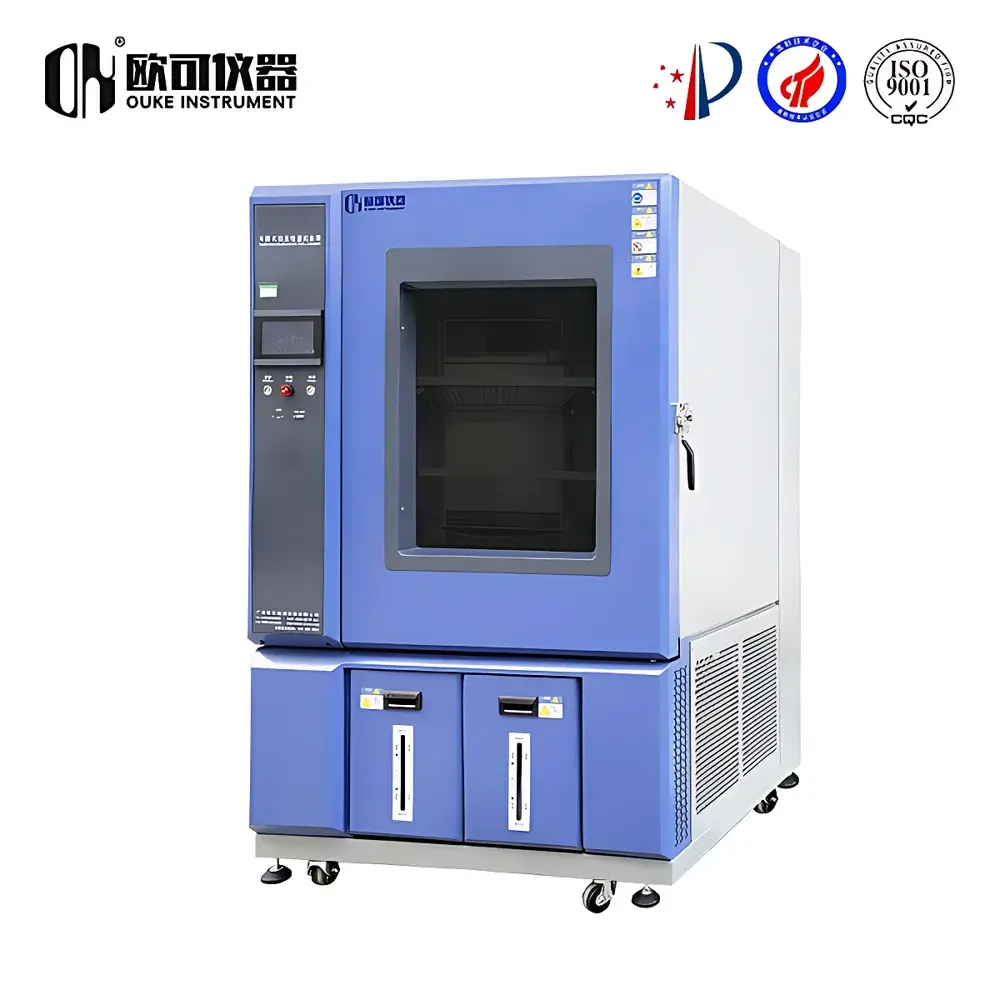
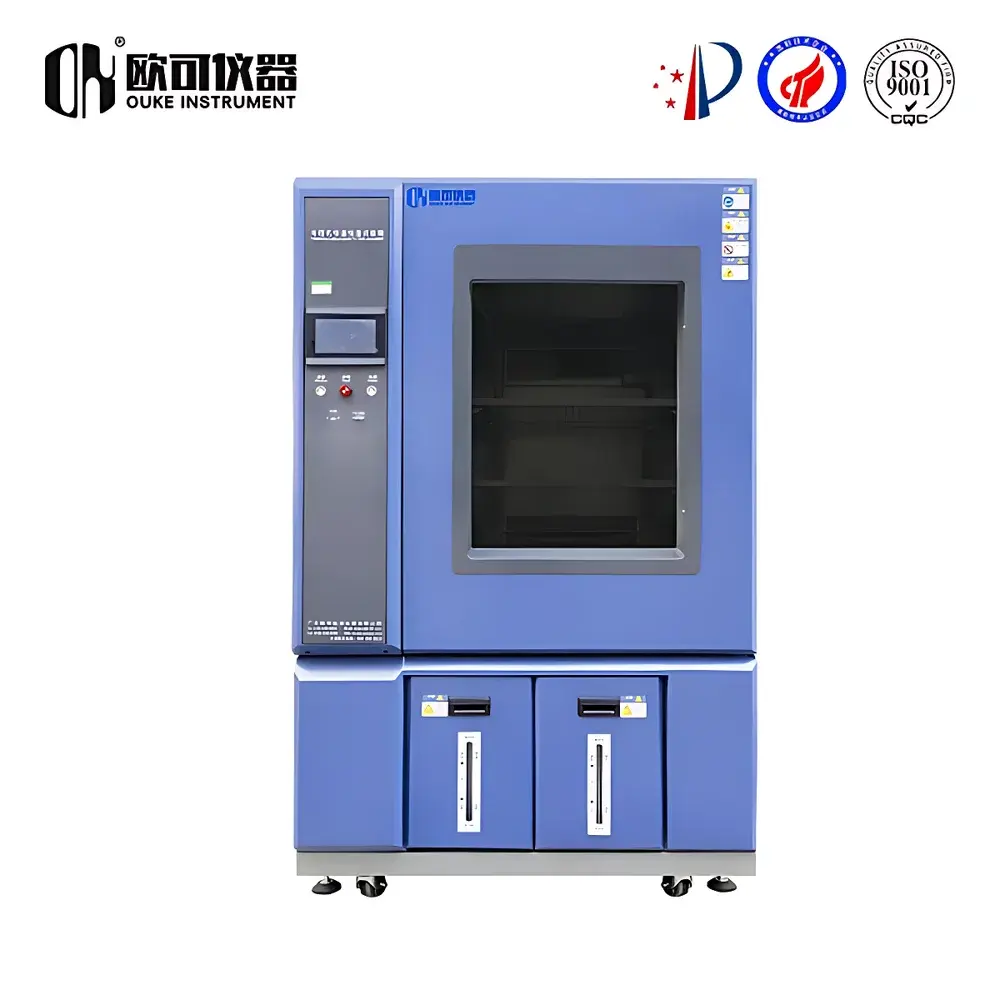
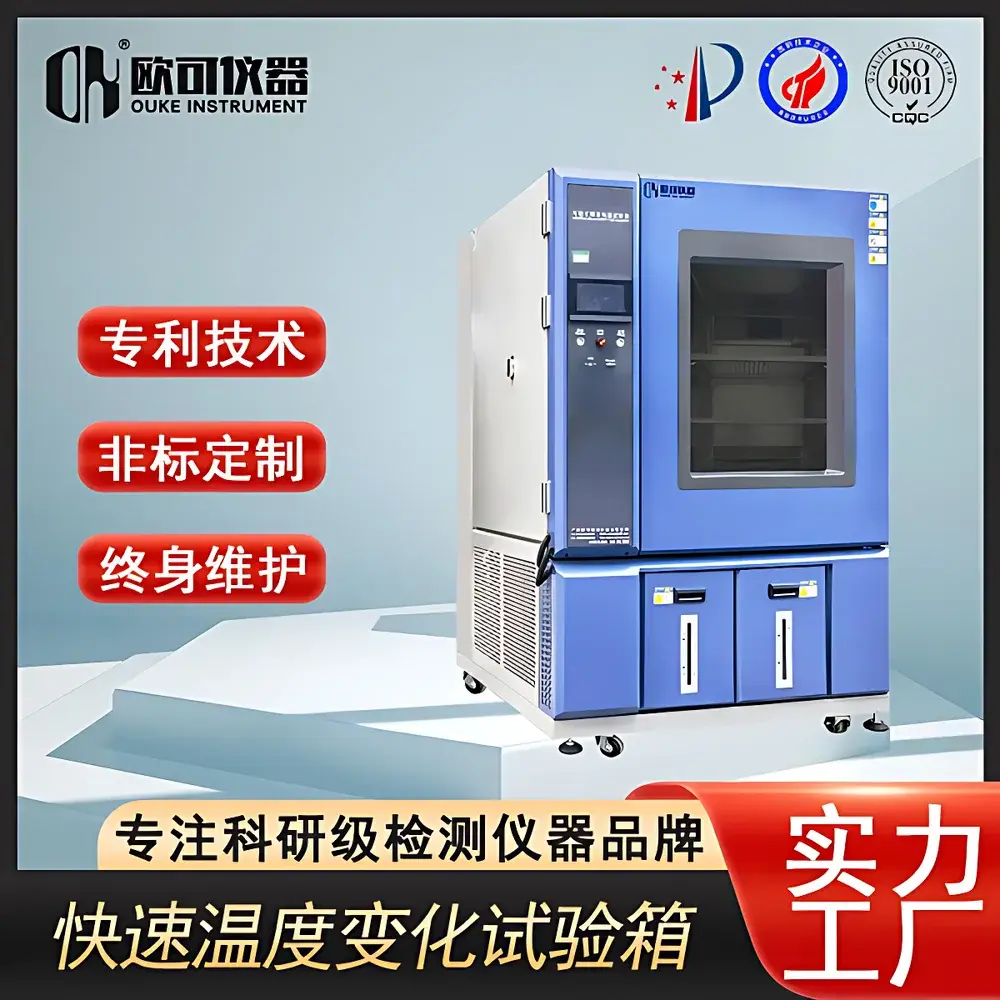
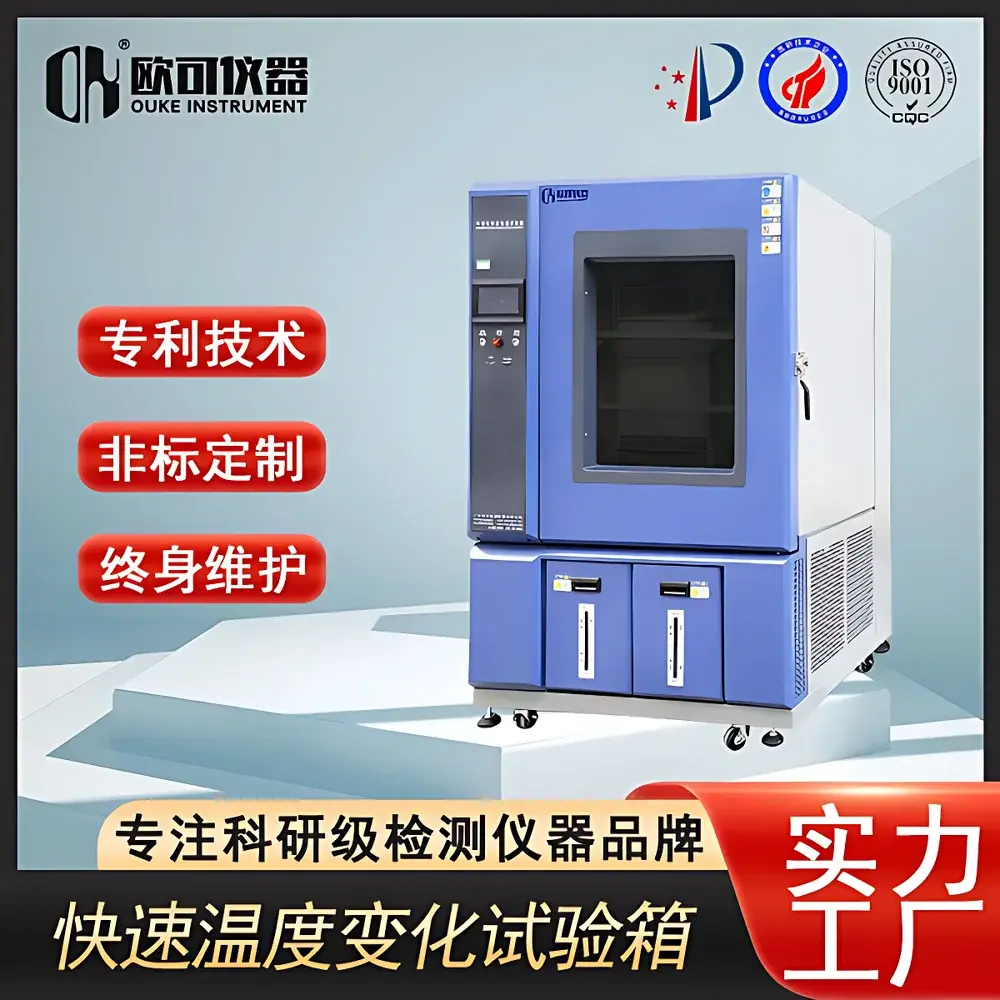
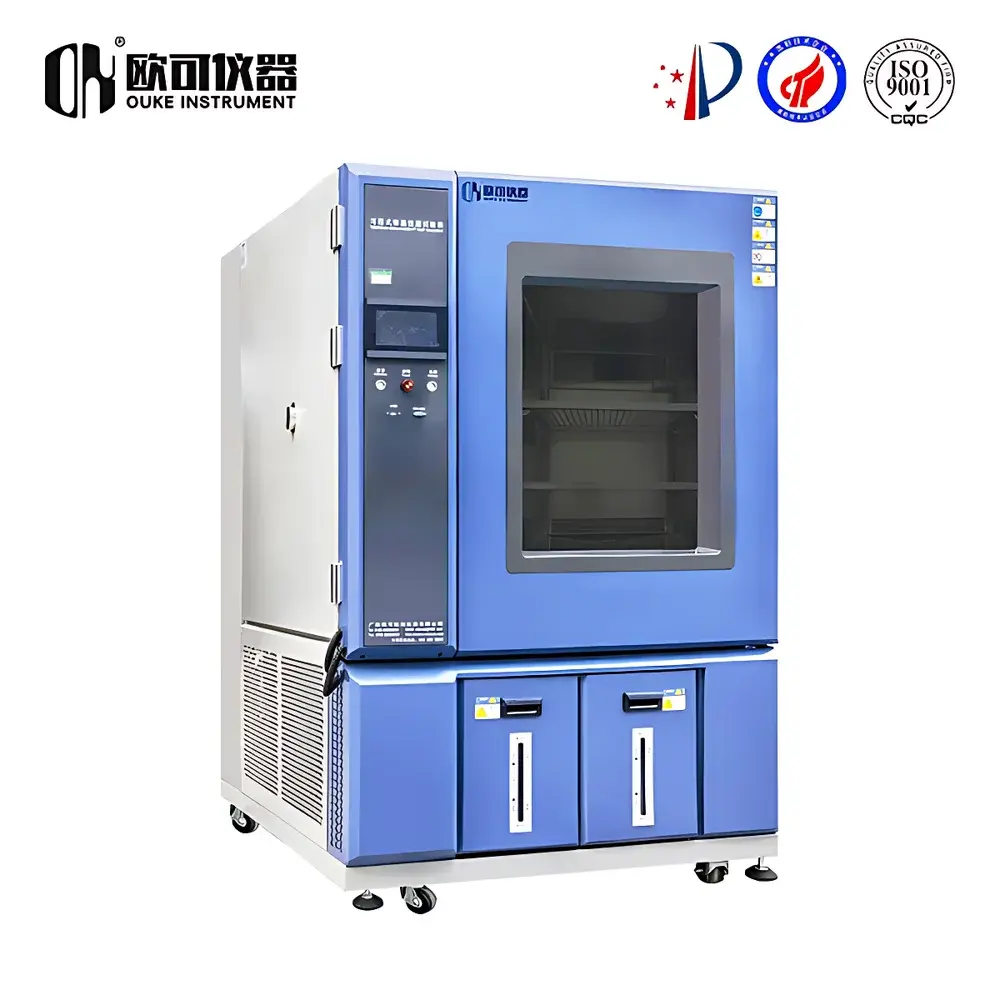
OK KS-TH-408.000 Mobile Rapid Temperature Transition Chamber
| Brand | OK Instruments |
|---|---|
| Origin | Guangdong, China |
| Manufacturer Type | Direct Manufacturer |
| Country of Origin | China |
| Model | KS-TH-408.000 |
| Price | USD 14,200 (FOB Guangdong) |
| High-Temp Zone Range | +80 °C to +200 °C |
| Low-Temp Zone Range | −10 °C to −70 °C |
| Test Zone Operating Range | +60 °C to +150 °C / −10 °C to −40 °C |
| Temperature Control Accuracy | ±2 °C |
| Temperature Resolution | 0.01 °C |
| High-Temp Ramp Rate (RT → +150 °C) | ≤40 min |
| Low-Temp Ramp Rate (RT → −70 °C) | ≤100 min |
| Test Zone Temperature Recovery Time | 3–5 min |
| Internal Dimensions (W×H×D) | 600 × 500 × 500 mm |
| External Dimensions (W×H×D) | 1500 × 2100 × 2250 mm |
| Chamber Construction | Dual-chamber (hot/cold) + test zone |
| Inner/Outer Material | SUS#304 stainless steel, brushed finish |
| Insulation | High-density glass wool + rigid polyurethane (PU) foam |
| Anti-sweat System | K-type thermocouple-based thermal energy redistribution |
| Seals | High-tensile elastomeric packing rated for −200 °C to +400 °C |
| Actuation | Pneumatic hot/cold zone isolation valves |
| Accessories | Two adjustable-height test trays |
Overview
The OK KS-TH-408.000 Mobile Rapid Temperature Transition Chamber is an engineered environmental stress screening (ESS) system designed for accelerated thermal cycling validation in reliability testing laboratories and quality assurance departments. It operates on a three-zone architecture—separate high-temperature, low-temperature, and test zones—enabling precise, repeatable thermal transitions without mechanical movement of the specimen. Unlike single-chamber thermal shock systems that rely on forced-air convection alone, this chamber utilizes dual independent refrigeration and heating circuits with pneumatically actuated isolation doors, allowing rapid thermal transfer via controlled air mass exchange between conditioned zones. The design complies with core thermal shock test requirements defined in MIL-STD-810H Method 503.7, IEC 60068-2-14, and JESD22-A104D. Its mobile configuration includes industrial-grade casters with locking brakes, facilitating repositioning within controlled lab environments without permanent floor anchoring or utility hardwiring.
Key Features
- Dual independent thermal zones (hot: +80 °C to +200 °C; cold: −10 °C to −70 °C) with dedicated compressors and heating elements
- Test zone maintained at user-defined setpoints between +60 °C and +150 °C or −10 °C and −40 °C, with ±2 °C control accuracy and 0.01 °C digital resolution
- Pneumatically driven isolation valves enabling sub-5-second zone switching and test zone temperature recovery within 3–5 minutes after transition
- Structural integrity ensured by full SUS#304 stainless steel interior and exterior panels, including door frames and sealing flanges
- Thermal insulation comprising layered high-density glass wool (≥80 kg/m³) and closed-cell rigid PU foam (thermal conductivity ≤0.022 W/m·K)
- Integrated anti-sweat system using K-type thermocouple feedback to redistribute residual thermal energy and prevent condensation on observation windows and internal surfaces
- Two height-adjustable stainless steel test trays (304 grade), each rated for static loads up to 25 kg, supporting DUTs with dimensional envelopes up to 500 mm × 500 mm × 400 mm
Sample Compatibility & Compliance
The KS-TH-408.000 accommodates electronic assemblies, PCBs, automotive ECUs, aerospace avionics modules, and hermetically sealed sensors requiring non-destructive thermal shock evaluation. Its static test zone eliminates mechanical vibration or positional disturbance during cycling—critical for solder joint fatigue assessment per IPC-9701A and JEDEC JESD22-A104D. The chamber meets electromagnetic compatibility (EMC) Class B requirements per EN 61326-1 and supports traceable calibration per ISO/IEC 17025 when operated with NIST-traceable reference thermometers. All control logic and data logging functions are structured to support GLP/GMP audit readiness, including configurable user access levels and event-driven log generation.
Software & Data Management
The embedded controller runs OK’s proprietary TCS-3000 firmware with a 7-inch resistive touchscreen HMI. Real-time monitoring includes dual-channel thermocouple inputs (T-type standard, optional K-type), ramp/soak profiling, and automatic cycle counting. Data export is supported via USB 2.0 (CSV format) and Ethernet TCP/IP for integration into enterprise MES or LIMS platforms. Audit trail functionality records operator ID, parameter changes, alarm events, and calibration interventions—fully compliant with FDA 21 CFR Part 11 requirements when deployed with electronic signature modules and time-stamped digital certificates.
Applications
- Qualification testing of printed circuit board assemblies under extreme thermal gradients
- Validation of conformal coating adhesion and thermal expansion coefficient (CTE) mismatch in multi-material packages
- Reliability screening of MEMS devices, optical sensors, and RF front-end modules
- Process development for reflow soldering profile optimization and voiding analysis
- Accelerated life testing (ALT) of battery management systems (BMS) and power electronics enclosures
- Pre-compliance verification for automotive AEC-Q200 stress tests and IATF 16949 production part approval (PPAP)
FAQ
What standards does the KS-TH-408.000 comply with for thermal shock testing?
It supports test execution per IEC 60068-2-14, MIL-STD-810H Method 503.7, JESD22-A104D, and GB/T 2423.22.
Can the chamber be integrated into an automated test cell?
Yes—it provides Modbus RTU over RS-485 and Ethernet/IP interfaces for PLC-level synchronization with robotic handlers and data acquisition systems.
Is remote monitoring supported?
Standard firmware includes HTTP-based status polling and SNMP v2c trap reporting; optional cloud gateway enables secure MQTT telemetry to AWS IoT Core or Azure IoT Hub.
What maintenance intervals are recommended?
Compressor oil and filter replacement every 12 months; pneumatic valve lubrication and seal inspection every 6 months; annual calibration of all thermocouple channels using certified dry-block calibrators.
Does the system include validation documentation?
Factory acceptance test (FAT) reports, as-built mechanical drawings, IQ/OQ templates, and a 3-point temperature uniformity map are supplied with each unit.



