
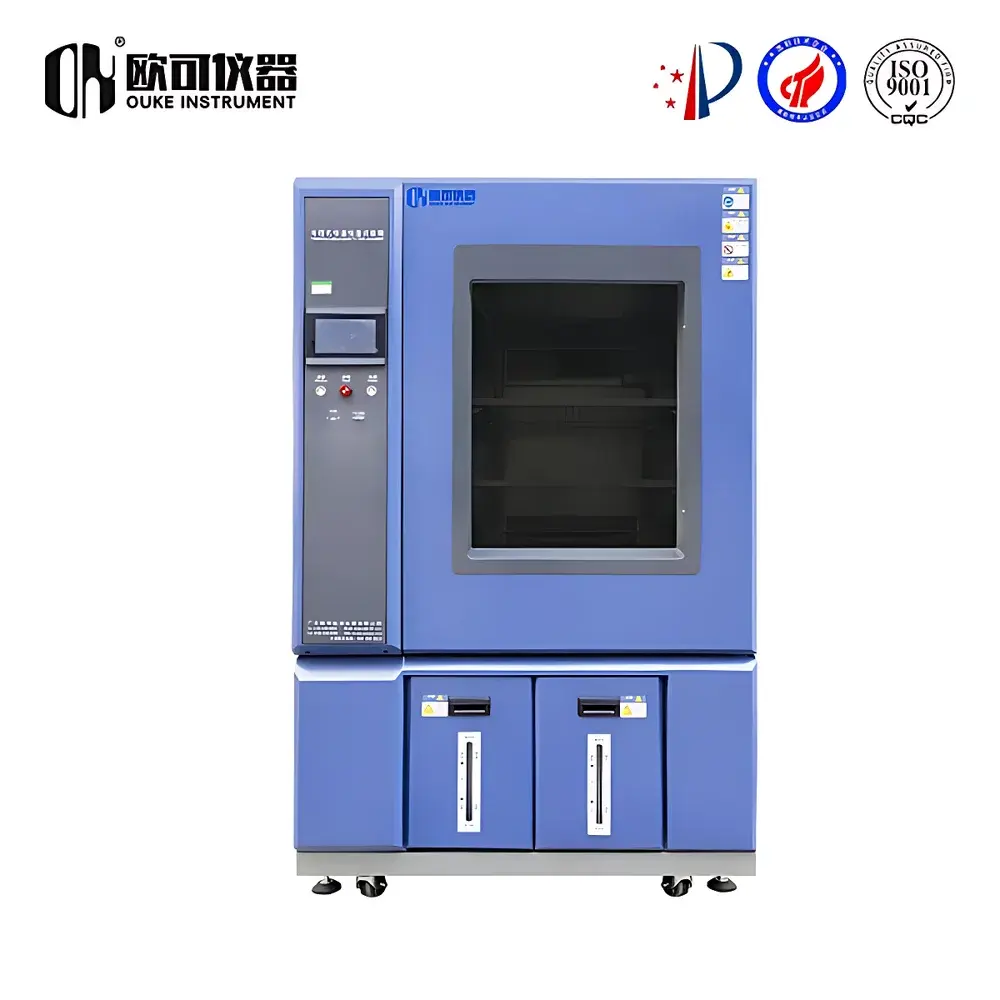
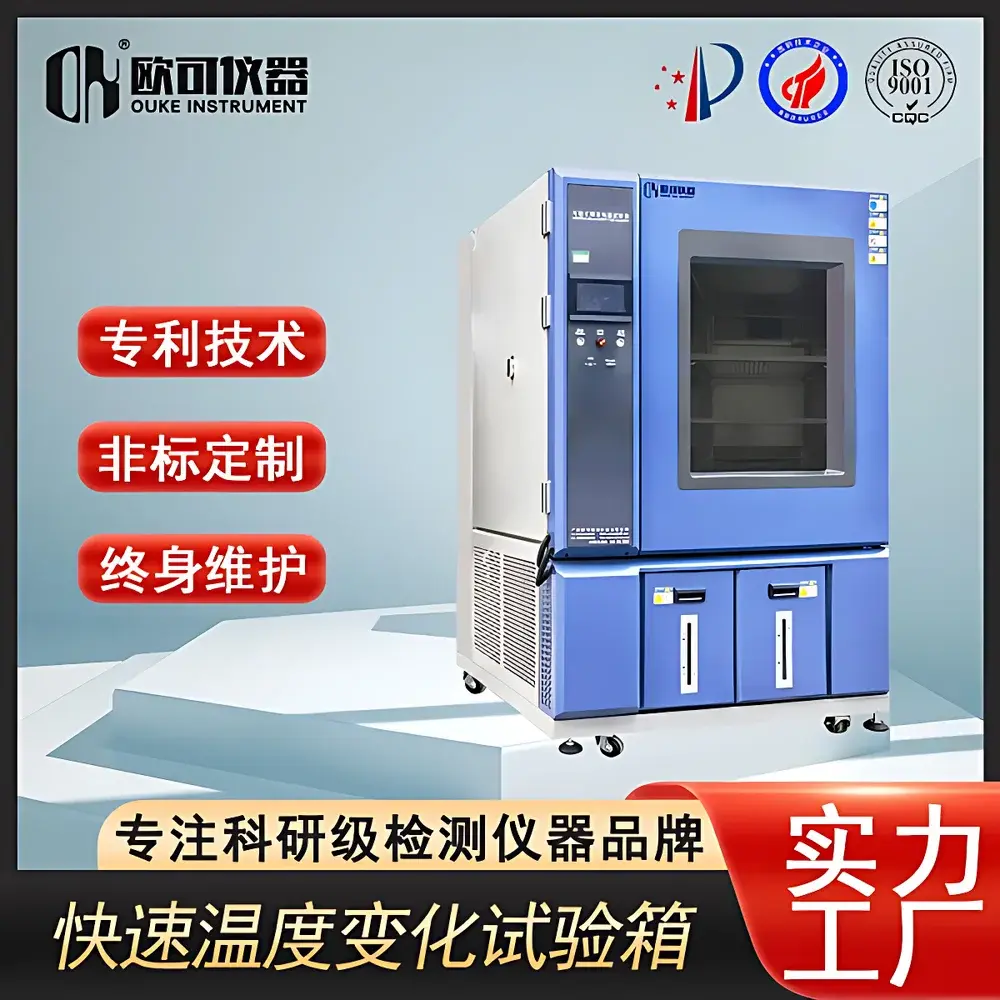
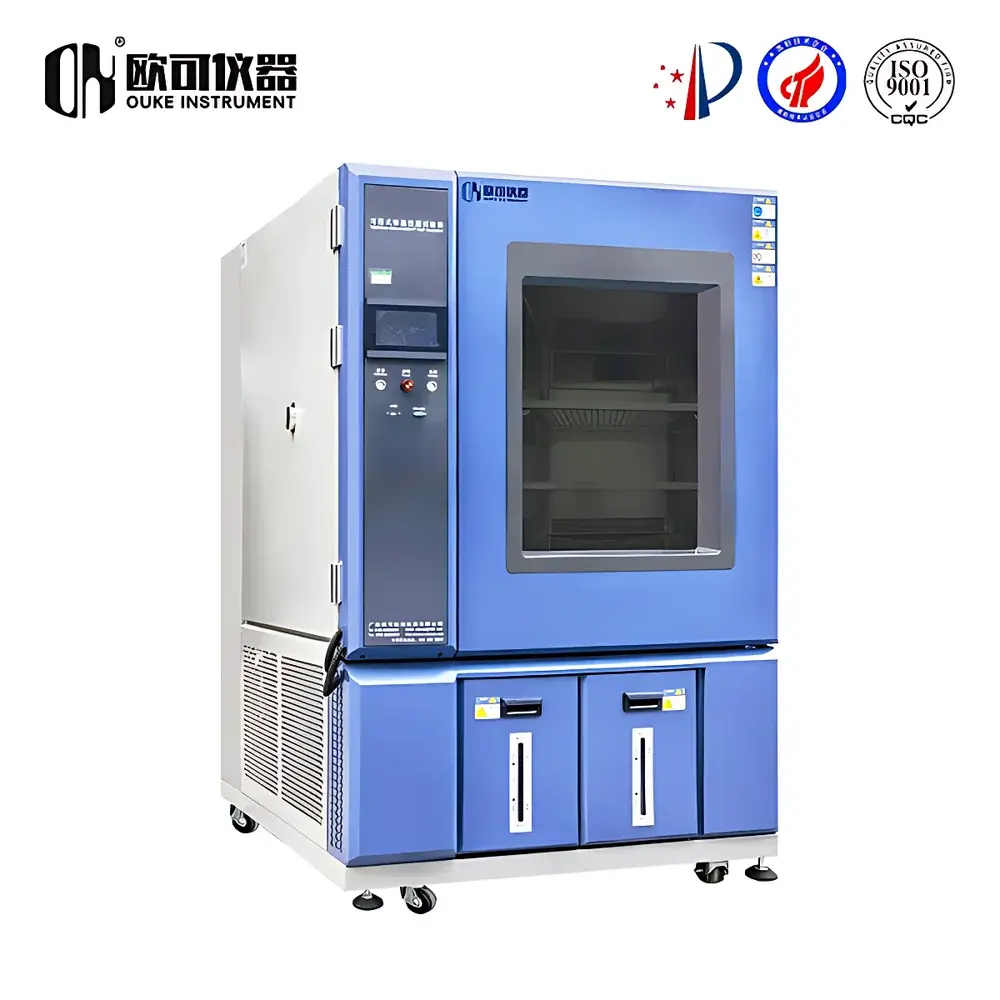
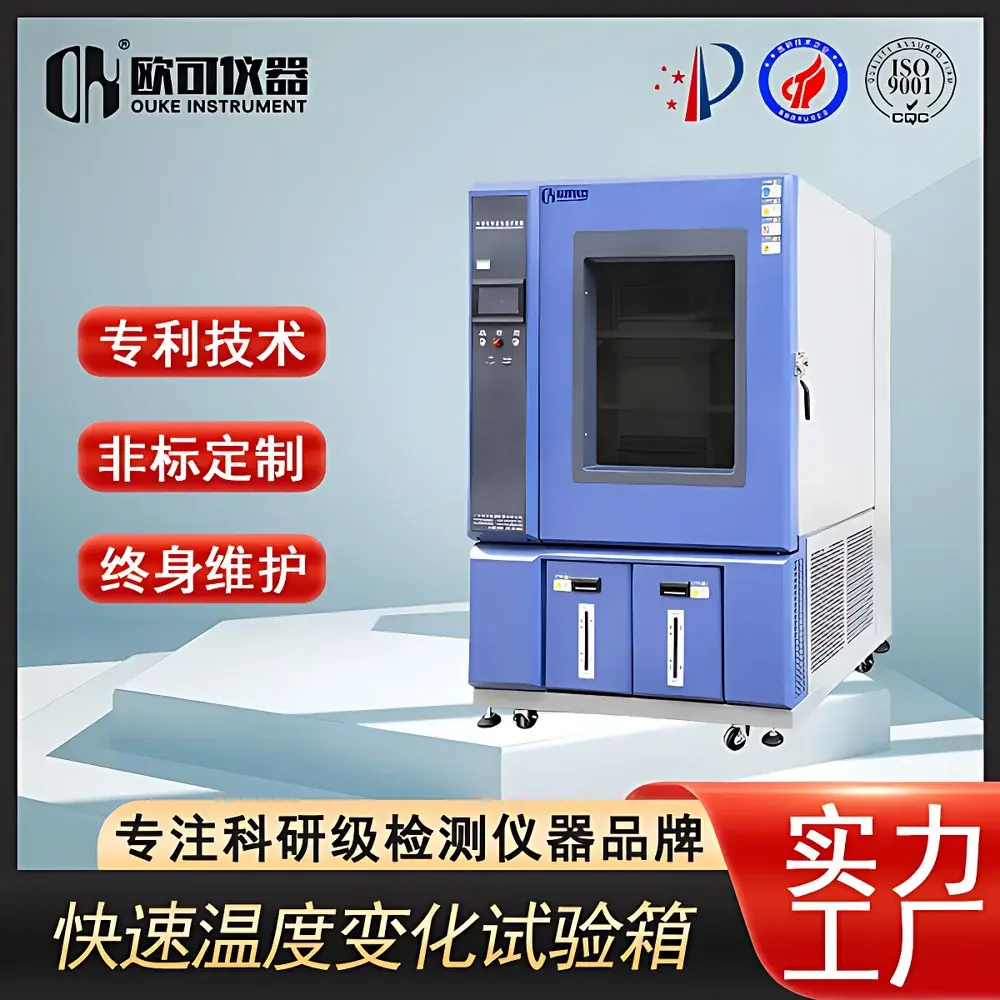
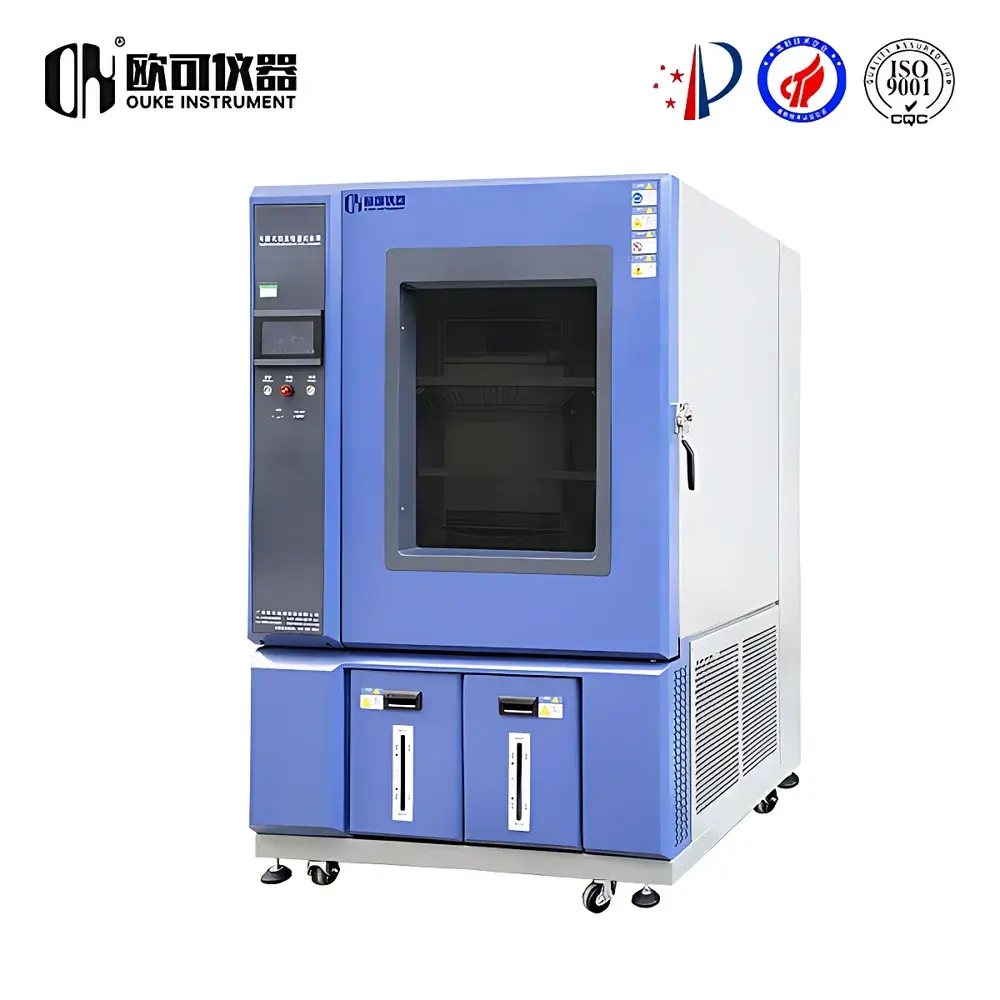
OK KS-TH-408 High-Speed Temperature Ramp Aging Chamber
| Brand | OK Instruments |
|---|---|
| Origin | Guangdong, China |
| Manufacturer Type | OEM/ODM Producer |
| Country of Origin | China |
| Model | KS-TH-408 |
| Price | USD 14,200 (FOB Guangdong) |
| Temperature Range | -70°C to +180°C |
| Ramp Rate | Up to 15°C/min (linear segment, unloaded) |
| Internal Volume | 408 L |
| Control System | 10.4" Color Touchscreen PLC Controller with Programmable Ramp/Soak/Cycle Profiles |
| Refrigeration | Cascade Dual-Stage Compressor System |
| Inner Chamber Material | SUS304 Stainless Steel |
| Safety Protections | Over-Temperature, Over-Current, Leakage Current, Fan Overheat, Compressor High-Pressure & Overload Protection |
| Compliance | Designed per ISO 16750-4, GB/T 2423.22, GJB 150A-2009 Environmental Test Standards |
Overview
The OK KS-TH-408 High-Speed Temperature Ramp Aging Chamber is an engineered environmental stress screening (ESS) system designed for controlled, linear thermal cycling under reproducible laboratory conditions. Unlike thermal shock systems that rely on physical chamber transfer or gas switching, the KS-TH-408 achieves rapid temperature transitions through a dynamically balanced cascade refrigeration architecture and high-capacity resistive heating—enabling continuous, programmable ramp rates up to 15°C/min across its full operating range of –70°C to +180°C. This capability supports accelerated aging, thermal fatigue evaluation, and design validation where gradual yet aggressive thermal excursions better replicate real-world field stresses—such as those experienced by automotive ECUs during cold-start warm-up or battery modules during fast-charging cycles in sub-zero ambient conditions. The chamber operates on fundamental thermodynamic principles: precise heat exchange management via evaporator/condenser load balancing, PID-controlled heater modulation, and volumetric airflow optimization to minimize thermal gradients (< ±2°C uniformity at steady state, per IEC 60068-3-5).
Key Features
- Linear ramp rate control from –70°C to +180°C, with selectable profiles including single-ramp, multi-segment ramp/soak, and repeatable cycling (up to 999 cycles)
- Cascade dual-stage refrigeration system using environmentally compliant R404A/R23 mixed-refrigerant stages, enabling stable low-temperature hold and rapid cooldown without liquid nitrogen dependency
- 10.4-inch high-resolution color touchscreen PLC controller with embedded USB data logging, real-time graphing, and password-protected parameter editing
- SUS304 stainless steel inner chamber with rounded corners and seamless welding for corrosion resistance, thermal stability, and ease of cleaning
- Integrated safety interlocks: independent mechanical over-temperature cutoff, compressor discharge pressure monitoring, phase failure detection, and ground-fault circuit interruption (GFCI)
- Optional RS485 Modbus RTU or Ethernet TCP/IP interface for integration into centralized lab management systems (LIMS) or MES platforms
Sample Compatibility & Compliance
The KS-TH-408 accommodates test specimens up to 408 L internal volume (W600 × D700 × H970 mm), supporting standard automotive ECU housings, 18650/21700 battery modules, PCB assemblies with active thermal loads (< 300 W), and polymer-based enclosures. It complies with the thermal test requirements of ISO 16750-4 (road vehicles), GB/T 2423.22 (IEC 60068-2-14) for temperature cycling, and GJB 150A-2009 Method 502.5 (military equipment). While not certified to UL or CE as a standalone appliance, its electrical architecture meets IEC 61000-6-2/6-4 immunity/emission limits, and all safety circuits are validated per EN 61010-1. Calibration traceability follows ISO/IEC 17025 guidelines; factory calibration reports include NIST-traceable sensor verification at three points (–40°C, 25°C, +125°C).
Software & Data Management
The embedded controller firmware supports user-defined test sequences with up to 100 program steps, each specifying target temperature, ramp rate, dwell time, and cycle count. All runtime data—including chamber air temperature (PT100 Class A sensors), controller setpoint, compressor stage status, and alarm history—are timestamped and stored internally (≥30 days at 1-second resolution) and exportable via USB to CSV. Optional OK-DataLink software (Windows-based) enables remote monitoring, automated report generation (PDF/Excel), and audit trail configuration aligned with FDA 21 CFR Part 11 requirements—including electronic signatures, operator ID logging, and immutable change history. Raw data files include metadata headers specifying firmware version, calibration date, and sensor serial numbers to support GLP/GMP documentation workflows.
Applications
- Automotive electronics: Validation of ADAS sensors, infotainment units, and DC-DC converters per ISO 16750-4 thermal cycling profiles
- Energy storage systems: Cycle-life assessment of Li-ion battery cells and packs under dynamic thermal loading (e.g., –30°C → +65°C @ 10°C/min)
- Consumer electronics: Reliability screening of smartphones, wearables, and IoT gateways prior to HALT/HASS deployment
- Aerospace components: Thermal qualification of avionics cooling plates and RF front-end modules per DO-160 Section 4
- Materials science: Accelerated aging studies of encapsulants, conformal coatings, and solder joint integrity in PCBAs
- Industrial automation: Stress testing of PLCs, HMIs, and motor drives exposed to warehouse or outdoor ambient fluctuations
FAQ
What is the difference between “linear ramp rate” and “average ramp rate” in specification sheets?
Linear ramp rate refers to the constant slope achieved over a defined temperature interval (e.g., –40°C to +85°C), measured under no-load conditions. Average ramp rate includes stabilization periods and may be significantly lower across the full range; OK specifies only linear segment performance per IEC 60068-3-10.
Can the chamber maintain ramp rate with a 10 kg aluminum load inside?
Yes—rated ramp performance is verified with a standardized 10 kg Al mass (200 × 200 × 25 mm) per GB/T 2423.22 Annex B. Actual loaded rate depends on specimen thermal mass and emissivity; engineering consultation is recommended for custom load profiles.
Does the system support automated compliance reporting for ISO/IEC 17025 audits?
The controller logs all critical parameters with timestamps and operator IDs. When paired with OK-DataLink and a qualified calibration lab, full traceability documentation—including uncertainty budgets and certificate cross-references—is exportable.
Is remote firmware update supported?
Firmware updates require local USB media installation following OK’s validated release protocol; no internet-connected update mechanism is implemented to preserve system integrity and cybersecurity compliance.
What maintenance intervals are recommended for the cascade refrigeration system?
Compressor oil analysis every 2,000 operating hours; refrigerant leak check annually; condenser coil cleaning quarterly; full system performance verification biannually per OK Maintenance Manual Rev. 4.2.



