
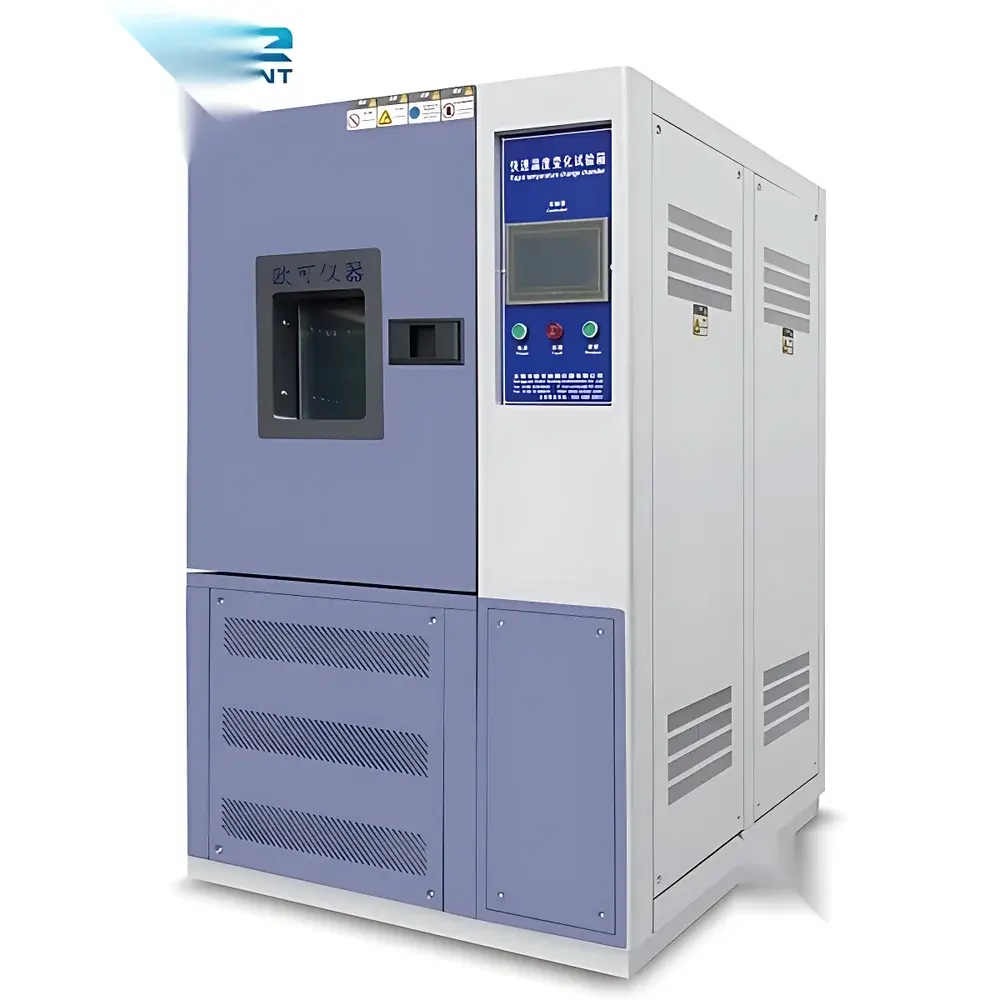
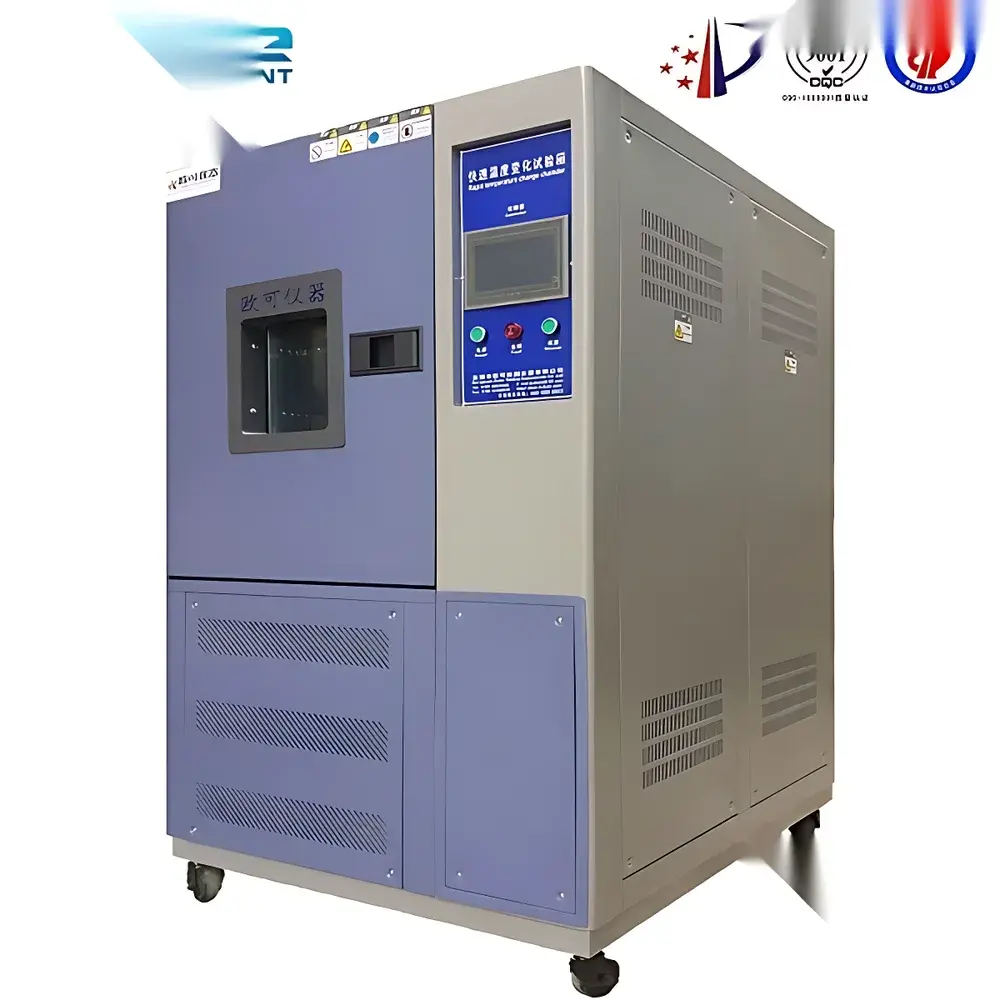
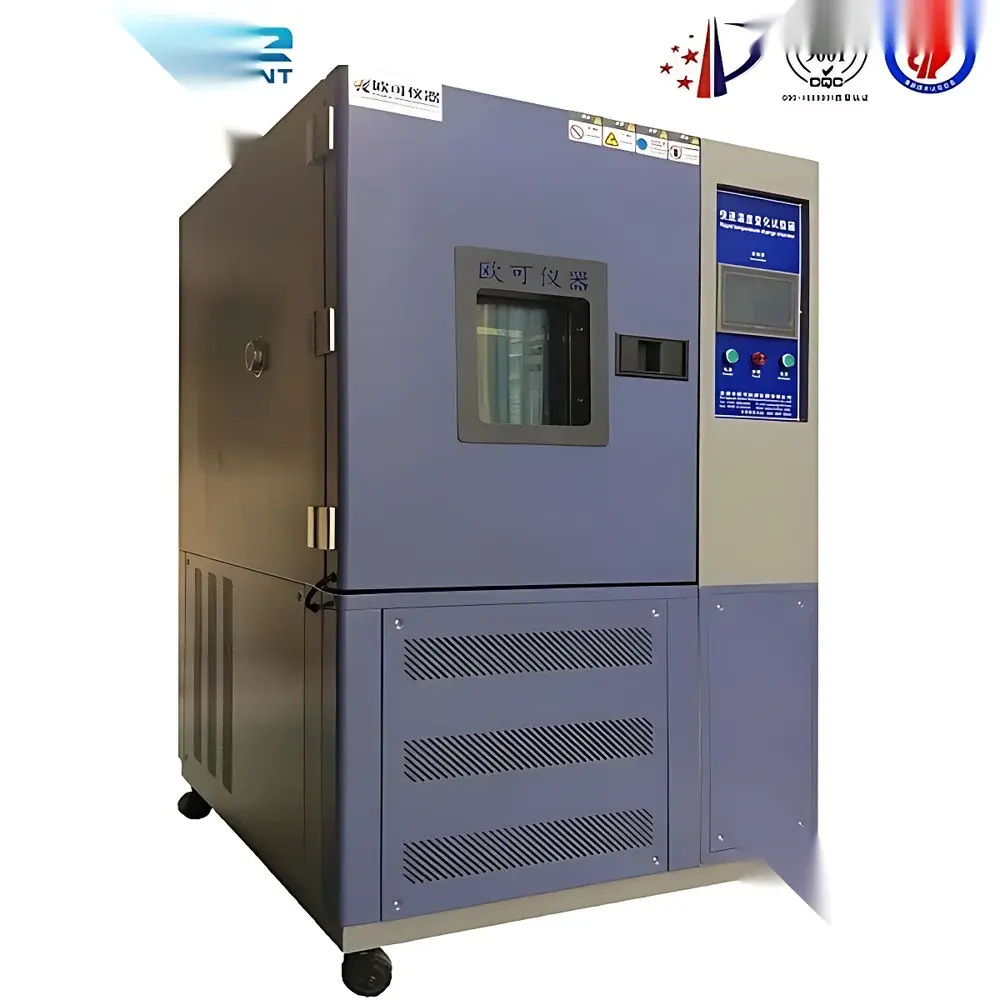
KS-TH Series Programmable Rapid Temperature Change Test Chamber
| Brand | OEM / Custom Brand |
|---|---|
| Origin | Imported |
| Manufacturer Type | Authorized Distributor |
| Price | USD 14,500 (FOB, indicative only) |
| Temperature Range | −70 °C to +150 °C |
| Humidity Range | 20–98% RH (optional: 5–98% RH) |
| Rapid Ramp Rates | 5–25 °C/min (selectable) |
| Temperature Uniformity | ±2 °C |
| Temperature Stability | ±0.5 °C |
| Humidity Uniformity | ±3.0% RH (at ≥75% RH) |
| Humidity Stability | ±2.5% RH |
| Internal Dimensions (W×H×D) | 50×75×60 cm to 100×100×100 cm |
| Test Port | Ø50 mm on left wall |
| Refrigerant | R507 / R23 (zero ODP, low GWP) |
| Control System | 7-inch color LCD touch interface with PID auto-tuning |
| Compliance Standards | GB/T 2423.1, GB/T 2423.2, GB/T 2423.22, GJB 150.3–150.4, GB/T 10589, GB/T 11158, GB/T 10592 |
Overview
The KS-TH Series Programmable Rapid Temperature Change Test Chamber is engineered for accelerated environmental stress screening (ESS) and thermal cycling validation of electronic components, automotive modules, aerospace subsystems, and industrial materials. It operates on the principle of controlled, high-rate thermal transients—inducing cyclic mechanical strain via differential thermal expansion across material interfaces and layered assemblies. By subjecting test specimens to precisely defined temperature extremes (−70 °C to +150 °C) at programmable ramp rates up to 25 °C/min, the chamber accelerates the manifestation of latent defects including solder joint fatigue, delamination in PCB laminates, intermetallic growth, sealant cracking, and adhesive bond degradation. Unlike standard thermal shock chambers relying on dual-zone air or liquid immersion, this system employs a single-chamber, forced-convection architecture with a cascaded refrigeration circuit—enabling repeatable, traceable, and ISO/IEC 17025-compatible thermal profiles without physical specimen transfer.
Key Features
- High-fidelity PID-controlled temperature regulation with auto-tuning algorithm, achieving ±0.5 °C stability and ±2 °C uniformity across full working volume.
- Modular cascaded refrigeration system using hermetically sealed, low-noise compressors (imported from Europe and North America) and environmentally compliant HFC refrigerants (R507/R23), certified ozone depletion potential (ODP) = 0 and reduced global warming potential (GWP).
- 7-inch full-color TFT-LCD touchscreen controller with bilingual (English/Chinese) interface, supporting up to 96 independent test programs, 999-hour cycle duration, and 999-cycle repetition count.
- Robust internal construction using electropolished SUS#304 stainless steel; seamless welded corners and insulated double-wall design minimize thermal leakage and condensation risk.
- Dedicated 50-mm-diameter access port on left chamber wall, fitted with silicone gasket and locking flange—compatible with external power feeds, thermocouple wiring, and real-time sensor monitoring.
- Comprehensive safety architecture: overcurrent/overvoltage protection, ground fault interruption, compressor high-pressure/low-pressure cutout, door interlock, overtemperature alarm, and audible/visual fault indication—all managed by industrial-grade PLC with event logging.
Sample Compatibility & Compliance
The KS-TH chamber accommodates samples ranging from small IC packages (e.g., QFN, BGA) to full automotive control units (ECUs), battery modules (up to 30 kg), and optical sensor assemblies. Its uniform airflow distribution—validated per IEC 60068-3-5—ensures minimal thermal gradient across load zones, critical for multi-point thermocouple validation and statistical process control (SPC) applications. The system complies with major international test standards including GB/T 2423.22 (temperature change), GJB 150.3–150.4 (military environmental testing), and GB/T 10592 (performance requirements for environmental test chambers). Optional calibration reports are available traceable to NIM (National Institute of Metrology, China) or equivalent national metrology institutes (NMI), supporting GLP/GMP audit readiness and ISO 9001:2015 quality system integration.
Software & Data Management
The embedded controller supports real-time data acquisition at 1-second intervals, with onboard storage for ≥30 days of continuous profile history. Export formats include CSV and Excel-compatible .xls for post-test analysis in MATLAB, JMP, or Minitab. Optional Ethernet/Wi-Fi connectivity enables remote monitoring via secure HTTPS web interface and integration into enterprise MES or LIMS platforms. All user actions—including program edits, start/stop commands, and parameter adjustments—are time-stamped and logged with operator ID, satisfying FDA 21 CFR Part 11 requirements for electronic records and signatures when paired with optional audit trail module.
Applications
- Qualification testing of avionics hardware per DO-160 Section 4 (temperature variation)
- Reliability assessment of EV battery packs under dynamic thermal load cycling
- Process validation of conformal coating adhesion and curing integrity
- Failure mode identification in MEMS sensors subjected to thermal hysteresis
- Material compatibility evaluation for medical device housings (ISO 10993-12)
- Accelerated life testing of LED lighting modules in outdoor-rated enclosures
FAQ
What is the maximum allowable sample mass and dimensional envelope for KS-TH-1000?
Maximum recommended load is 45 kg, with external dimensions not exceeding 90 × 90 × 90 cm to maintain airflow integrity and thermal uniformity.
Can the chamber be configured for combined temperature-humidity cycling per IEC 60068-2-30?
Yes—humidity capability (20–98% RH) is standard; extended range (5–98% RH) is available as an optional upgrade with enhanced dew-point control and anti-condensation heater management.
Is third-party calibration and IQ/OQ documentation supported?
Yes—factory-installed NIST-traceable PT100 sensors and optional 21-point temperature mapping kit enable formal installation qualification (IQ) and operational qualification (OQ) per ASTM E2297 and ISO/IEC 17025 guidelines.
What refrigerant service intervals and maintenance protocols are recommended?
Refrigerant charge verification and oil analysis every 24 months; condenser coil cleaning quarterly; full system performance verification annually—detailed in the included Maintenance Logbook and Service Manual.
Does the controller support custom script-based test sequencing (e.g., dwell-ramp-dwell with conditional branching)?
Yes—the advanced programming mode allows nested loops, step-dependent triggers, and pass/fail logic based on real-time sensor inputs, enabling complex HALT/HASS-like profiles without external PC dependency.



