
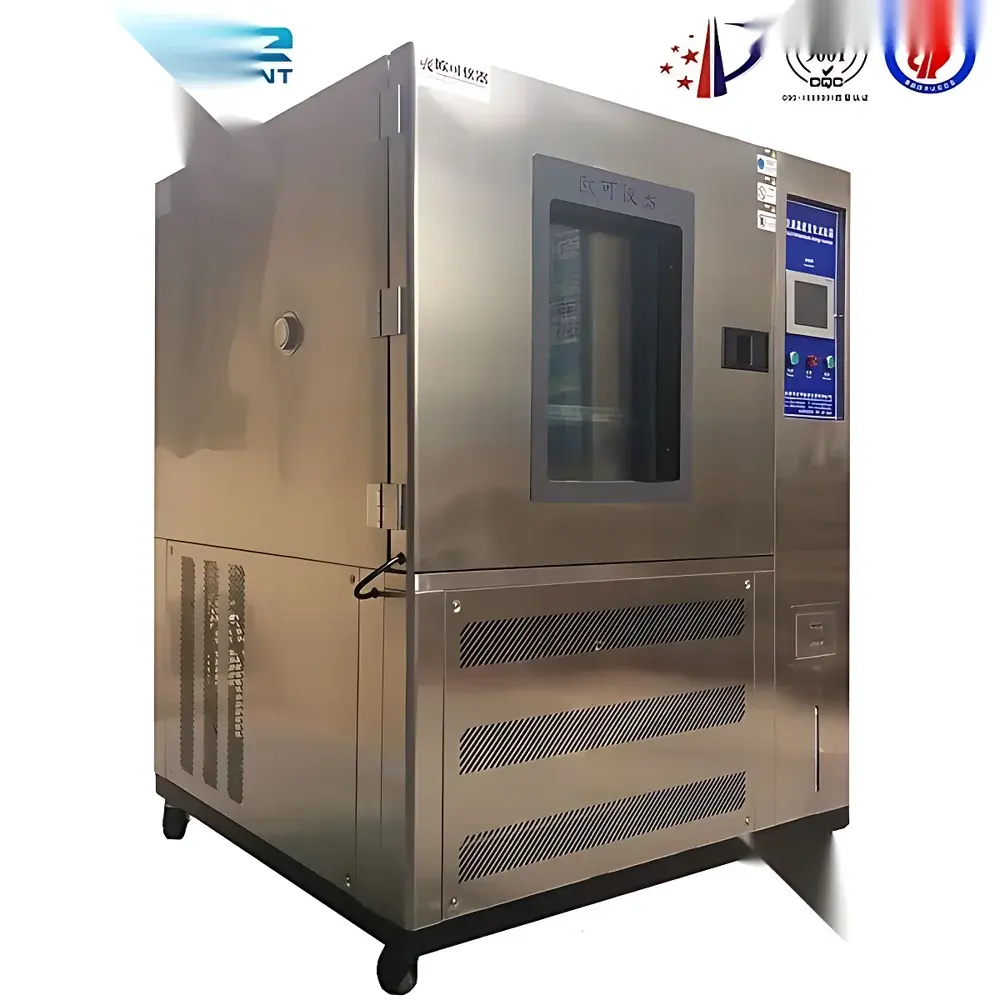
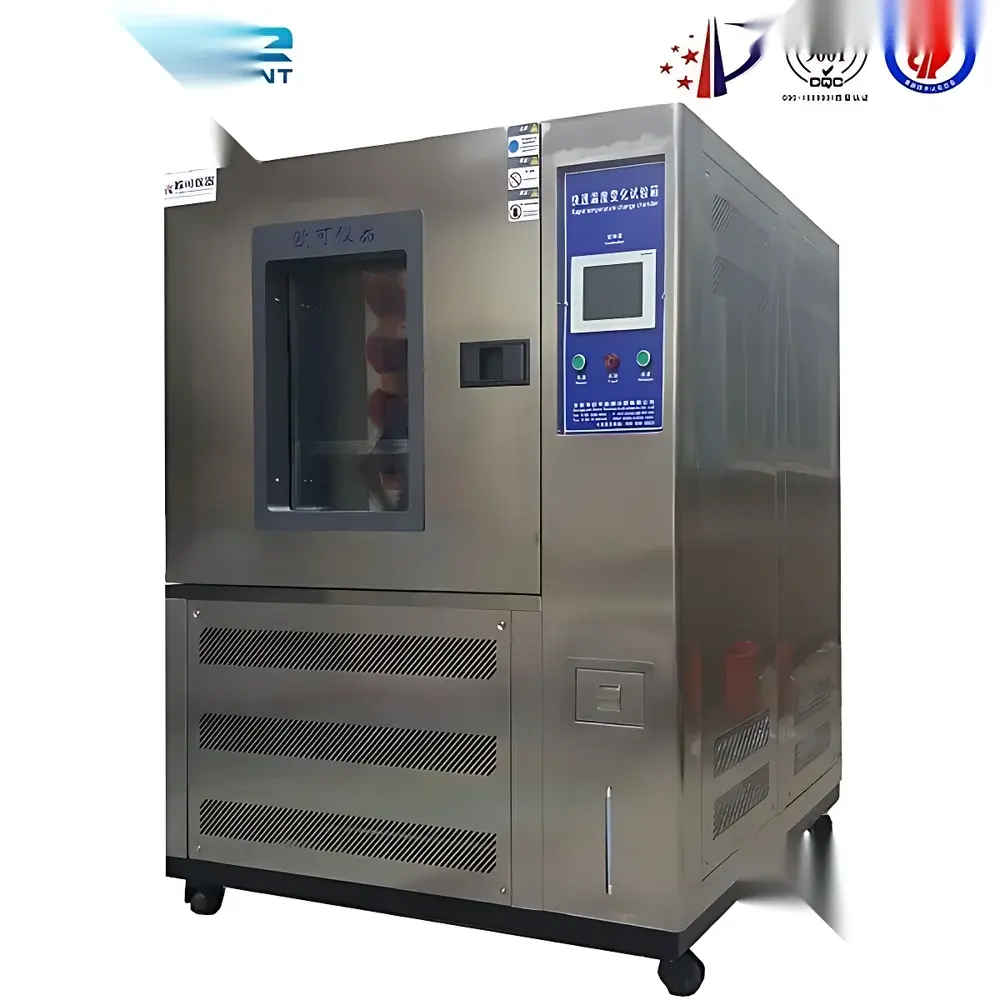
KS-TH Series Rapid Temperature Transition Environmental Test Chambers
| Brand | Other Brands |
|---|---|
| Origin | Imported |
| Manufacturer Type | Authorized Distributor |
| Price | USD 14,000–32,000 (FOB) |
| Internal Dimensions (W×H×D, mm) | 500×600×500 to 1000×1000×1000 |
| External Dimensions (W×H×D, mm) | 1750×2250×2350 to 2350×2800×3000 |
| Temperature Range | −70 °C to +150 °C |
| Humidity Range (optional) | 20–98 % RH |
| Rapid Transition Range | −45 °C to +85 °C |
| Transition Rate Options | 5–30 °C/min (linear or non-linear mode selectable) |
| Temperature Uniformity | ±2.0 °C |
| Humidity Uniformity | ±3.0 % RH |
| Temperature Control Accuracy | ±0.5 °C |
| Humidity Control Accuracy | ±2.5 % RH |
| Temperature Resolution | 0.1 °C |
| Humidity Resolution | 0.1 % RH |
| Refrigeration System | Water-cooled |
| Compressor | Tecumseh (France) or Bitzer (Germany) |
| Inner Chamber Material | SUS 304 stainless steel |
| Outer Chamber Material | Cold-rolled steel with epoxy powder coating or stainless steel |
| Insulation | High-density polyurethane foam (CFC-free) |
| Power Supply | AC 380 V, 3-phase 5-wire, 50/60 Hz |
| Weight | 950–2300 kg |
Overview
The KS-TH Series Rapid Temperature Transition Environmental Test Chambers are engineered for high-fidelity thermal shock and accelerated environmental stress screening (ESS) of electronic components, automotive ECUs, aerospace subsystems, and advanced materials. These chambers operate on a dual-chamber or single-chamber forced-air convection architecture with independent high-efficiency refrigeration circuits, enabling precise, repeatable, and programmable transitions between extreme temperature extremes. Unlike conventional thermal cycling systems, the KS-TH series delivers certified linear or non-linear ramp profiles across a broad operational envelope—from −70 °C to +150 °C—with optional humidity control (20–98 % RH). The system’s thermodynamic design prioritizes thermal inertia minimization, validated by ISO 16750-4 (road vehicles), MIL-STD-810H Method 503.5 (temperature shock), and IEC 60068-2-14 (change of temperature), ensuring compliance in qualification testing workflows governed by JESD22-A104, A106, and JEDEC standards.
Key Features
- Programmable transition rates from 5 °C/min to 30 °C/min—selectable per test segment with real-time slope validation
- Dual independent refrigeration circuits with water-cooled condensers for stable high-speed thermal response under load
- SUS 304 stainless steel inner chamber and reinforced insulated housing (polyurethane foam, ≥120 mm thickness) for low thermal leakage
- Intelligent fault diagnostics including refrigerant high/low pressure monitoring, over-temperature/over-humidity cutoff, phase loss detection, and water flow interlock
- Touchscreen HMI with embedded data logging (100,000-point buffer), USB export, and configurable alarm thresholds
- Optional accessories: observation window with heated double-glazed door, external pure water purification unit for humidity generation, integrated dehumidifier, and analog/digital signal I/O for external PLC synchronization
Sample Compatibility & Compliance
The KS-TH chambers accommodate test specimens up to 1000 L internal volume (KS-TH-1000 model), supporting full-size automotive control modules, PCB assemblies, battery packs, and packaged semiconductor wafers. All models meet structural and safety requirements per IEC 61000-6-2 (immunity) and IEC 61000-6-4 (emission), with CE marking and RoHS-compliant construction. Humidity-capable variants comply with ASTM E1823 (terminology) and ISO 4618 (coating testing environments), while thermal shock protocols align with USP for pharmaceutical packaging validation and AEC-Q200 for passive component qualification. The system supports GLP/GMP audit trails when paired with optional 21 CFR Part 11-compliant software extensions.
Software & Data Management
Standard firmware includes multi-segment profile programming (up to 999 cycles, 999 steps), deviation alarm history with timestamped event logs, and real-time graphing of chamber setpoint vs. measured values. Optional PC-based software enables remote monitoring via Ethernet/IP, automated report generation (PDF/CSV), and integration with LIMS or MES platforms through Modbus TCP or OPC UA. Calibration traceability is maintained via NIST-traceable temperature/humidity sensors (Class B PT100 and capacitive RH transducers), with annual recalibration support documentation provided per ISO/IEC 17025 requirements.
Applications
- Qualification of solder joint integrity and CTE mismatch in multilayer PCBs under repeated thermal shock
- Reliability screening of EV battery management systems (BMS) and power electronics subjected to rapid ambient shifts
- Material characterization of polymer encapsulants, conformal coatings, and adhesive bonds under combined thermal-humidity stress
- Process validation of hermetic sealing for MEMS devices and medical-grade sensors
- Accelerated life testing (ALT) of avionics hardware per DO-160 Section 4 (temperature variation)
- Environmental stress screening (ESS) in military depot-level repair facilities per MIL-HDBK-344A
FAQ
What is the difference between linear and non-linear ramp modes?
Linear mode enforces constant rate (e.g., 15 °C/min) throughout the entire transition; non-linear mode allows user-defined acceleration/deceleration profiles near setpoints to minimize thermal overshoot and mechanical stress on DUTs.
Can the chamber maintain humidity during rapid temperature transitions?
Humidity control is suspended during active ramp phases per IEC 60068-3-5 to prevent condensation and sensor drift; RH stabilization resumes only during dwell segments at target temperature.
Is remote calibration verification supported?
Yes—via optional calibrated reference probes and software-driven auto-calibration routines that generate ISO 17025-compliant calibration certificates.
What safety certifications do these chambers carry?
CE, UL/cUL recognized components, IP20 enclosure rating, and conformity to EN 61000-6-2/6-4, EN 60204-1, and EN 60529 for electrical safety and EMC robustness.
How is thermal uniformity validated across the working volume?
Per ISO 16750-4 Annex B: nine-point mapping using traceable Class A PT100 sensors at defined grid locations, performed during factory acceptance testing and recommended annually.



