
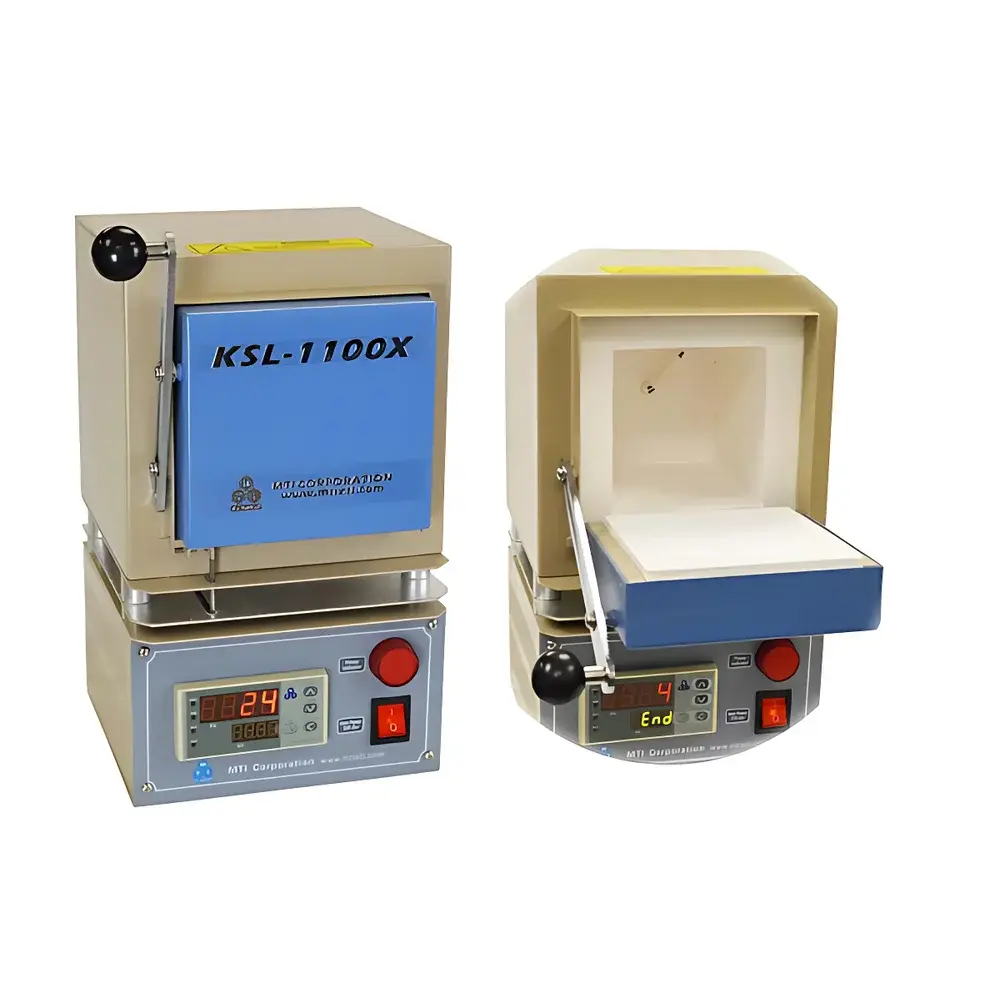
KSL-1100X-S Mini Box-Type Muffle Furnace by Hefei Kejing
| Brand | Hefei Kejing |
|---|---|
| Origin | Anhui, China |
| Model | KSL-1100X-S |
| Maximum Temperature | 1100°C (≤1 hr) |
| Continuous Operating Temperature | 1000°C |
| Temperature Control Accuracy | ±1°C |
| Heating Rate | 30°C/min |
| Rated Power | 700 W |
| Internal Chamber Dimensions | 100 × 100 × 100 mm |
| Heating Element | Kanthal A1-type Resistance Wire with Zirconia Coating |
| Insulation | High-Purity Alumina Polycrystalline Fiber (Japan-sourced) |
| Thermocouple | Type K |
| Controller | 30-Stage Programmable PID Temperature Controller |
| Power Supply | 110/200 V, 50 Hz |
| Net Weight | 8 kg |
| External Dimensions | 200 × 230 × 360 mm |
Overview
The KSL-1100X-S Mini Box-Type Muffle Furnace is a compact, high-precision laboratory furnace engineered for controlled thermal processing in research and quality assurance environments. Utilizing Joule heating via Kanthal A1 resistance wire—coated with a protective zirconia layer to suppress oxidation and extend service life—the furnace achieves stable, uniform temperature distribution across its 100 × 100 × 100 mm alumina fiber-lined chamber. The furnace operates on a dual-voltage (110/200 V), 50 Hz supply and delivers rapid thermal ramping (up to 30°C/min) while maintaining ±1°C accuracy at setpoints up to 1000°C continuously, and 1100°C for short-duration cycles (≤60 min). Its lightweight (8 kg), space-efficient footprint (200 × 230 × 360 mm) and downward-opening door design facilitate integration into confined workspaces—including gloveboxes—enabling safe operation under inert or oxidizing atmospheres when connected to external gas lines via standard 8 mm barbed fittings.
Key Features
- High-efficiency insulation using Japanese-sourced polycrystalline alumina fiber with proprietary 1750°C-rated alumina reflective coating, enhancing thermal retention and reducing standby energy consumption to ≤700 W
- 30-stage programmable PID controller supporting complex multi-step thermal profiles (e.g., hold-ramp-cool sequences) with real-time logging and USB export capability
- Downward-lifting door mechanism with integrated safety interlock: power automatically de-energizes upon door opening, complying with IEC 61000-6-2 and EN 61000-6-4 EMC requirements
- Gas-compatible design with dual 8 mm barbed inlet/outlet ports (user-supplied tubing and regulators required); suitable for N₂, Ar, O₂, or forming gas—not rated for flammable, explosive, or highly corrosive gases (e.g., Cl₂, NH₃, HF, H₂S) without prior custom lining treatment
- Robust mechanical architecture: outer casing constructed from cold-rolled steel with high-temp enamel finish; internal chamber surface treated with US-imported high-emissivity alumina coating for improved radiative heat transfer
Sample Compatibility & Compliance
The KSL-1100X-S accommodates ceramic crucibles (Al₂O₃, quartz), metal samples (Fe, Cu, Ni alloys), thin-film substrates, and powder compacts within its 1 L chamber volume. It supports ASTM E1113 (Standard Test Method for Determining Thermal Stability of Materials), ISO 8501-1 (surface preparation prior to coating), and USP (thermal sterilization validation protocols) when operated under documented SOPs. CE marking confirms conformity with EU Machinery Directive 2006/42/EC and Low Voltage Directive 2014/35/EU. All electrical components exceeding 24 V meet UL 61010-1, MET Labs, and CSA C22.2 No. 61010-1 safety standards. Optional TÜV Rheinland or CSA single-unit certification available upon customer-requested third-party assessment (additional fee applies).
Software & Data Management
The integrated 30-segment controller includes non-volatile memory for ≥100 program storage and supports timestamped temperature logging at user-defined intervals (1–60 s). Data export is performed via USB flash drive in CSV format for post-processing in MATLAB, Excel, or LabVIEW. While the furnace does not include native network connectivity or cloud integration, its analog output (0–5 V) and RS485 interface (Modbus RTU protocol) allow seamless integration into centralized SCADA or LIMS platforms compliant with FDA 21 CFR Part 11 when paired with validated data acquisition hardware and audit-trail-enabled software. Full GLP/GMP traceability requires external validation of calibration records, thermocouple drift verification, and periodic system suitability testing per ISO/IEC 17025 guidelines.
Applications
- Materials science: sintering of oxide ceramics, annealing of thin-film electrodes, ashing of organic residues prior to elemental analysis (e.g., ICP-OES sample prep)
- Metallurgy: stress-relief heat treatment of small-scale alloy specimens, phase transformation studies under controlled atmospheres
- Quality control labs: thermal stability screening per IEC 60695-2-10, burn-out of investment casting molds, moisture content determination via gravimetric loss-on-ignition (LOI)
- Academic research: precursor decomposition kinetics, catalyst calcination, and solid-state reaction monitoring in air or inert environments
- Glovebox-integrated workflows: oxygen-sensitive synthesis (e.g., Li-ion cathode materials), vacuum-assisted preheating prior to CVD loading
FAQ
Can this furnace be used under vacuum?
No. The KSL-1100X-S lacks vacuum-tight sealing and is not designed for vacuum operation. It is intended for ambient-pressure use only—with optional gas purging or flow-through inert/oxidizing atmospheres.
What maintenance is required for long-term reliability?
Annual inspection of thermocouple calibration against a reference standard (e.g., Fluke 724), visual assessment of furnace lining integrity, and replacement of the K-type thermocouple every 2–3 years under continuous 1000°C operation are recommended. Minor surface microcracking in the alumina fiber lining is normal and does not impair performance; re-coating with high-purity Al₂O₃ slurry restores emissivity if needed.
Is corrosion resistance available for aggressive process gases?
Yes—upon advance notification, the chamber can be lined with chemically resistant mullite or yttria-stabilized zirconia (YSZ) coatings. This modification requires engineering review and extends lead time by 3–4 weeks.
Does the unit comply with FDA 21 CFR Part 11 for electronic records?
The furnace itself does not provide Part 11–compliant electronic signatures or audit trails. However, its analog/RS485 outputs enable integration into validated, Part 11–enabled data systems when deployed with appropriate access controls, electronic signature modules, and change-control documentation.



