
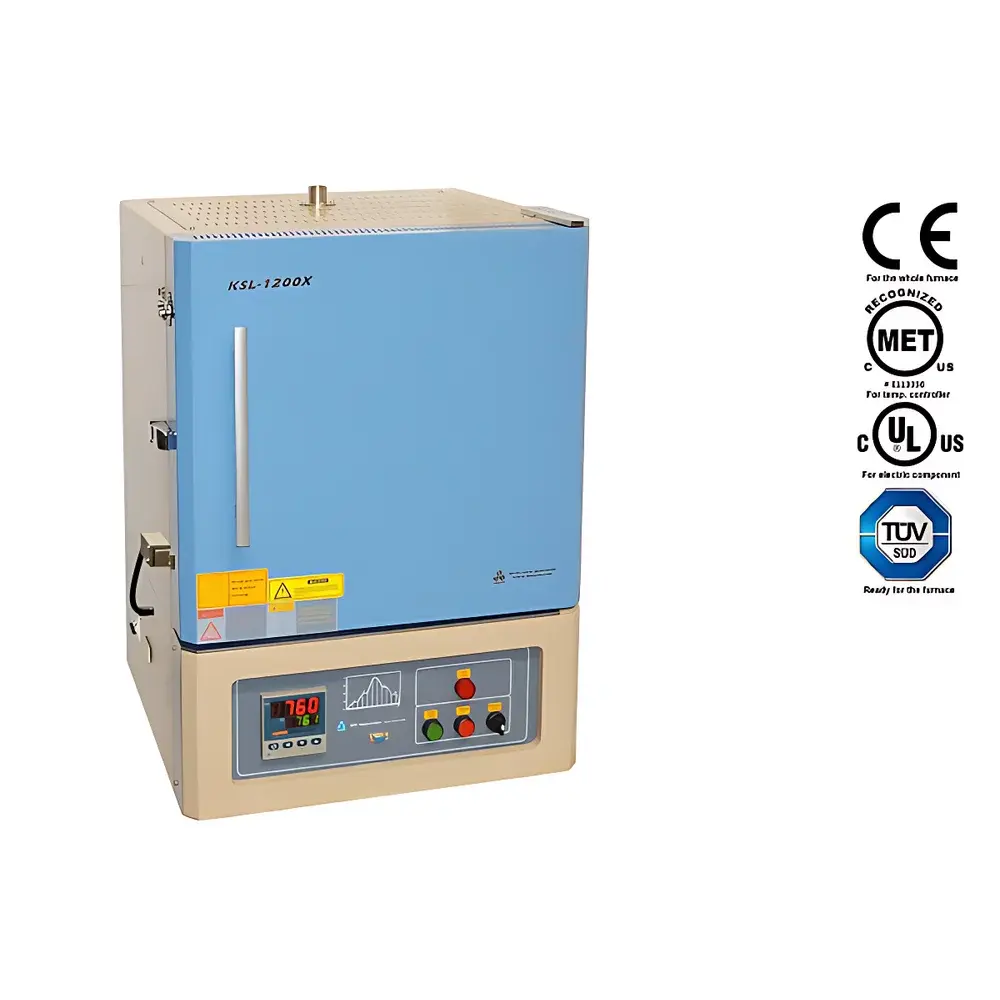
KSL-1200X-M (27L) High-Temperature Box Furnace
| Brand | Hefei Kejing |
|---|---|
| Origin | Anhui, China |
| Model | KSL-1200X-M(27L) |
| Max Temperature | 1200°C (< 3 h) |
| Temperature Uniformity | ±3.45°C @ 1000°C |
| Control Accuracy | ±1°C |
| Max Power | 7.5 kW |
| Heating Rate | 20°C/min (to max temp) |
| Chamber Dimensions | 300 × 300 × 300 mm (27 L) |
| Voltage | 208–240 VAC, 1-phase, 50/60 Hz |
| Heating Element | Mo-doped Fe-Cr-Al alloy wire with ZrO₂ coating |
| Insulation | High-purity alumina fiber + US-imported 1750°C alumina reflective coating |
| Safety Certifications | CE |
| Optional PC Software | Yes |
| Exhaust Port | Top-mounted |
| Inlet Port | Rear-mounted 1/4" NPT |
| External Dimensions | 610 × 660 × 559 mm (D × H × W) |
Overview
The KSL-1200X-M (27L) is a precision-engineered high-temperature box furnace designed for controlled thermal processing in research laboratories and quality control environments. Operating on resistive heating principles, it utilizes Mo-doped Fe-Cr-Al alloy heating elements embedded within a double-walled, air-cooled stainless steel enclosure. The furnace chamber is lined with high-purity alumina fiber insulation and coated with a proprietary 1750°C-rated alumina reflective layer—imported from the United States—to enhance thermal efficiency, improve temperature uniformity, and extend service life. Capable of continuous operation at 1100°C and short-term exposure up to 1200°C (≤3 hours), the unit complies with standard laboratory thermal processing requirements for sintering, annealing, calcination, and ashing applications. Its robust architecture supports reproducible thermal profiles under non-vacuum, ambient-atmosphere or inert-gas-purged conditions.
Key Features
- Double-layer shell with forced-air cooling system maintains external surface temperature below 60°C during operation, ensuring operator safety and reducing ambient heat load.
- High-density alumina fiber insulation combined with a high-emissivity, high-refractoriness alumina coating improves thermal retention and reduces energy consumption per cycle.
- PID-based temperature controller supports up to 30 programmable ramp-hold segments, enabling precise thermal profile execution for complex multi-step processes.
- Integrated K-type thermocouple provides real-time feedback for closed-loop temperature regulation with ±1°C accuracy across the operational range.
- Top-mounted exhaust port facilitates safe venting of volatile or mildly corrosive byproducts (e.g., organic volatiles, low-concentration halogenated vapors); optional rear 1/4″ NPT inlet enables controlled gas purging with inert or reducing atmospheres.
- Over-temperature and thermocouple-failure protection circuits automatically deactivate heating elements if sensor failure or thermal runaway is detected—critical for unattended operation.
- Complies with CE marking requirements; all electrical components rated above 24 V meet UL, MET, and CSA safety standards. TÜV or CSA certification available upon request (customer-funded).
Sample Compatibility & Compliance
The KSL-1200X-M accommodates standard ceramic crucibles (alumina, quartz, silicon carbide), metal trays, and refractory boats suitable for solid-state materials processing. It is not rated for vacuum operation or sealed atmosphere use; therefore, it must not be operated with flammable, explosive, or highly reactive gases (e.g., H₂, CH₄, CO). While mild corrosion resistance is provided via the alumina coating, prolonged exposure to aggressive agents—including Cl₂, HF, NH₃, or sulfur compounds—requires prior consultation for customized chamber treatment (e.g., enhanced coating or alternative lining). The furnace meets general laboratory safety expectations under ISO/IEC 17025-aligned thermal equipment validation protocols and supports GLP-compliant documentation when paired with optional PC-based data logging software.
Software & Data Management
An optional Windows-compatible control software package enables remote configuration of temperature programs, real-time monitoring of thermocouple readings, and export of time-temperature datasets in CSV format. The software records timestamped process logs—including setpoints, actual temperatures, power output, and alarm events—with audit-trail capability suitable for internal QA review. While not FDA 21 CFR Part 11-compliant out-of-the-box, the system can be integrated into validated workflows when deployed with IT-administered user access controls and electronic signature modules. Data files are stored locally and may be archived in accordance with institutional data retention policies.
Applications
This furnace serves routine and advanced thermal processing needs across multiple disciplines: ceramic sintering and densification studies; synthesis and post-annealing of battery electrode materials (e.g., LiCoO₂, NMC cathodes); thermal gravimetric pre-treatment of catalysts; ash content determination per ASTM E1755; heat treatment of metallurgical samples; and controlled oxidation/reduction experiments under nitrogen or argon purge. Its 27 L working volume and ±3.45°C temperature uniformity at 1000°C make it especially suited for batch-scale sample conditioning where spatial consistency is critical for comparative analysis.
FAQ
What is the recommended maximum ramp rate for long-term reliability?
We recommend limiting heating and cooling rates to ≤10°C/min for routine operation to minimize thermal stress on insulation and heating elements.
Can this furnace be used under vacuum or reduced pressure?
No—it lacks vacuum-tight sealing and is not designed for sub-atmospheric operation.
Is the interior coating repairable if cracking occurs?
Yes—minor surface microcracking in the alumina coating is normal after repeated thermal cycling and can be refurbished using compatible high-temperature alumina paint.
What gas atmospheres are permissible?
Inert (N₂, Ar) and mildly reducing (5% H₂/N₂) atmospheres are supported with proper inlet fitting; oxidizing (air) is standard. Strongly corrosive or flammable gases require engineering review prior to use.
Does the unit include a data interface for integration into lab automation systems?
It features RS485 communication (Modbus RTU protocol) for third-party SCADA or LIMS integration, though custom driver development may be required depending on host system architecture.



