
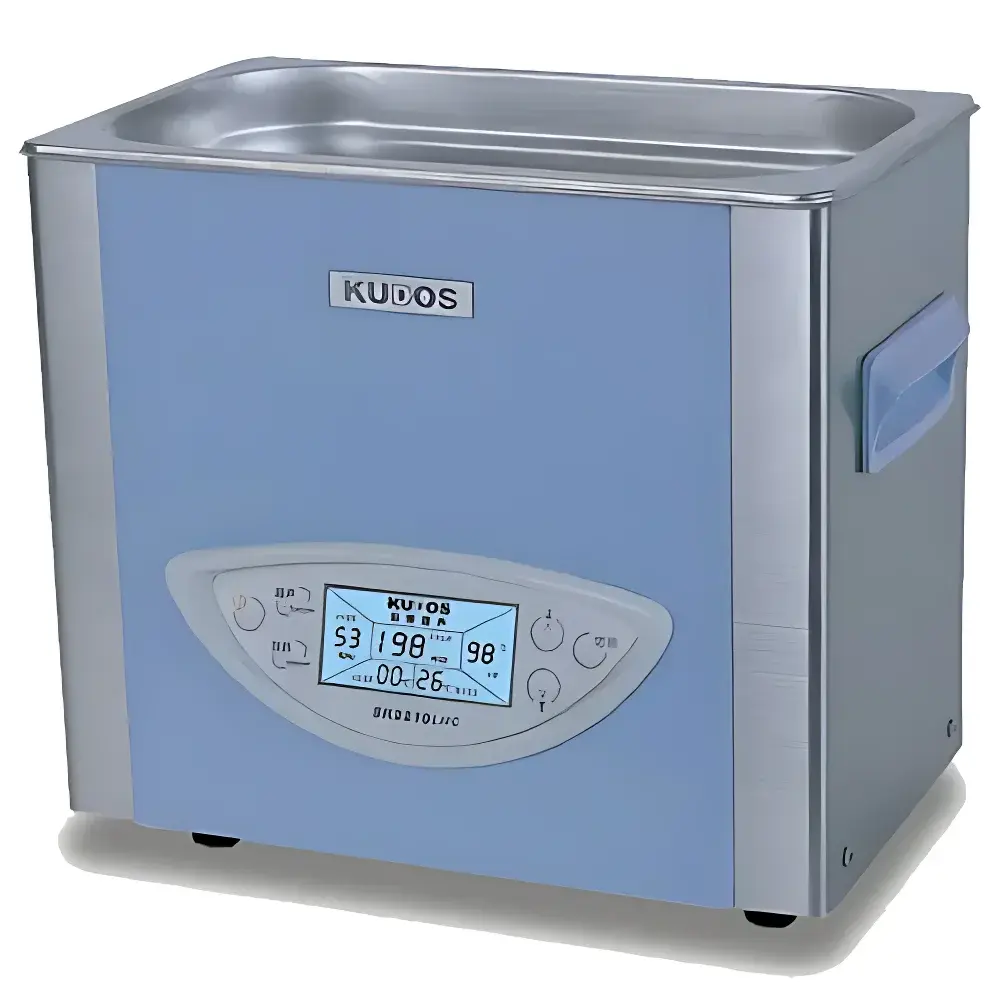
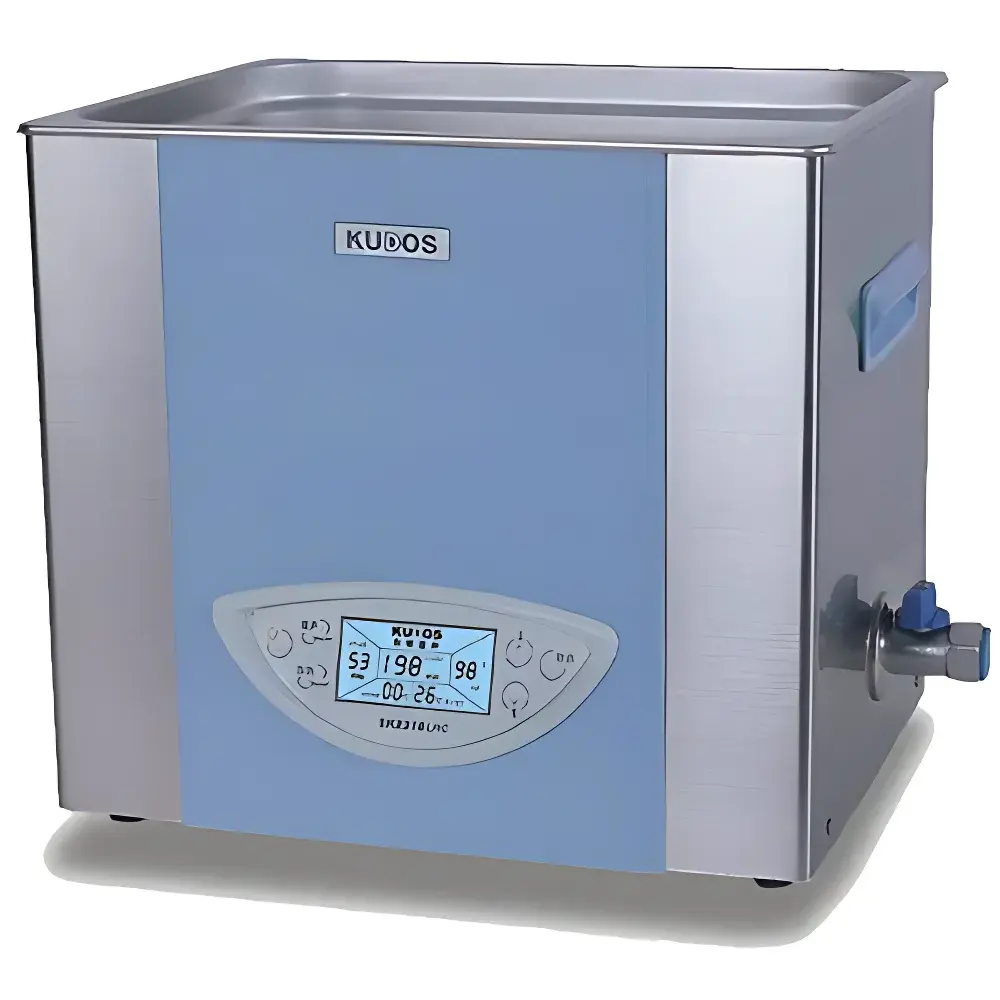
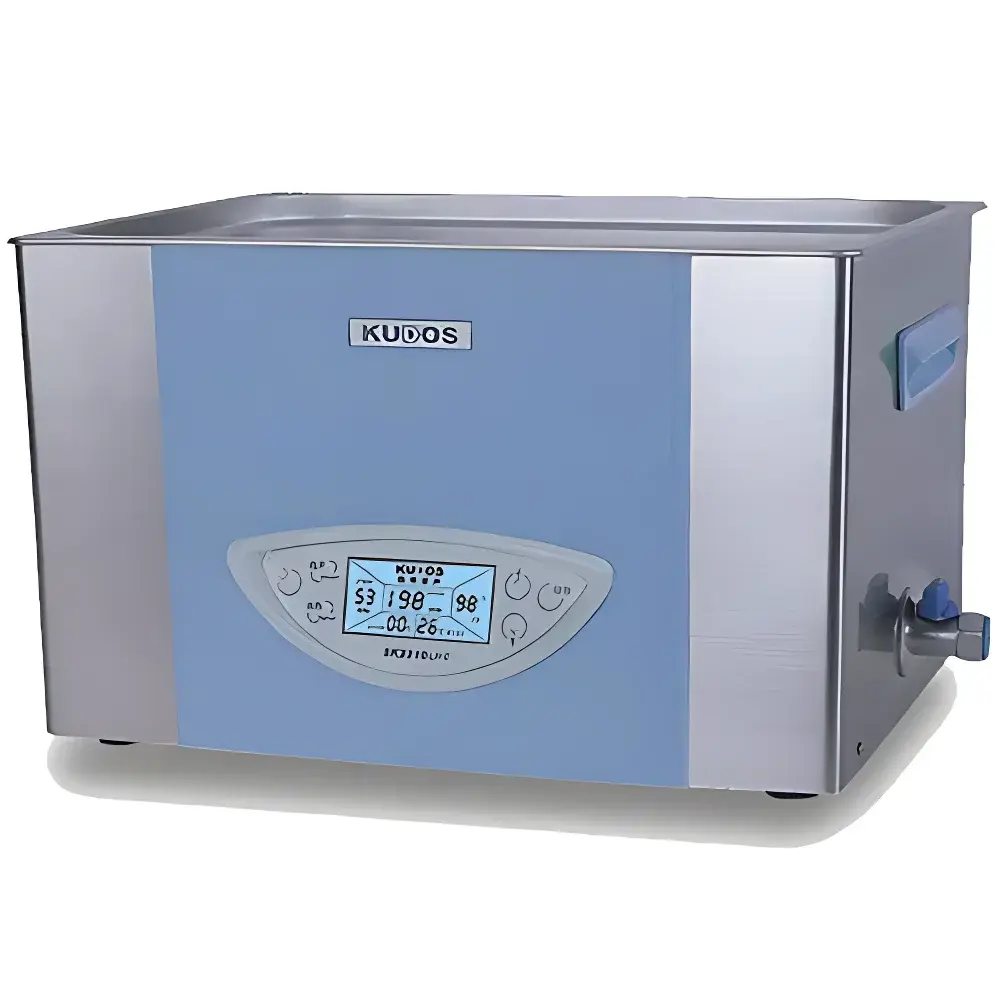
KUDOS SK2200LHC–SK8200LHC Dual-Frequency Benchtop Ultrasonic Cleaner
| Brand | KUDOS |
|---|---|
| Origin | Shanghai, China |
| Model Range | SK2200LHC / SK3200LHC / SK3300LHC / SK5200LHC / SK250LHC / SK6200LHC / SK7200LHC / SK8200LHC |
| Tank Capacity | 3–22.5 L |
| Operating Frequencies | 35 kHz and 53 kHz (switchable) |
| Ultrasonic Power Output | 100–500 W |
| Timer Range | 1–199 min |
| Power Adjustment | 40–100% in 1% increments |
| Display | Backlit LCD with real-time parameter readout |
| Temperature Monitoring | Ambient tank temperature displayed (no heating function) |
| Lid | Acoustic-dampening hinged cover |
| Drain/Refill | Manual valve control |
| Tank Material | AISI 304 stainless steel |
| Power Supply | 220 V AC, 50 Hz |
| Power Memory | Yes (parameters retained after power interruption) |
| Compliance | Designed for general laboratory use per IEC 61010-1 safety requirements |
Overview
The KUDOS SK2200LHC–SK8200LHC series comprises dual-frequency benchtop ultrasonic cleaners engineered for precision cleaning of delicate laboratory components—including glassware, pipette tips, microplates, optical lenses, semiconductor wafers, and analytical sample holders. These units operate on the principle of cavitation-induced acoustic energy transfer: high-frequency sound waves generate transient microbubbles in the cleaning solvent, whose implosive collapse delivers localized mechanical shear forces that dislodge particulate contamination, organic residues, and weakly adhered biofilms without surface abrasion. The dual-frequency capability—35 kHz for higher-energy macro-cavitation (optimized for robust particulate removal from coarse surfaces) and 53 kHz for finer, more uniform micro-cavitation (suited to microfluidic devices and MEMS structures)—enables method-specific optimization across diverse sample geometries and soil types. Unlike heated ultrasonic systems, this series maintains ambient bath temperature only; it is therefore appropriate for thermally sensitive substrates and solvents with low flash points (e.g., acetone, isopropanol), aligning with OSHA and NFPA guidelines for volatile organic compound handling.
Key Features
- Dual-frequency operation (35 kHz / 53 kHz) with front-panel toggle selection for application-driven cavitation tuning
- Backlit LCD interface displaying real-time timer, power level (%), and measured bath temperature (sensor-integrated, non-heating)
- Precision power modulation from 40% to 100% in 1% increments—enabling reproducible energy delivery across validation protocols
- Extended timer range (1–199 minutes) supporting both rapid rinse cycles and extended soak protocols
- AISI 304 stainless steel tank with radiused corners and electropolished interior for corrosion resistance and ease of decontamination
- Integrated acoustic-dampening lid reducing operational noise to ≤55 dB(A) at 1 m distance, compliant with ISO 7779 and EU Directive 2000/14/EC
- Power interruption memory: all active parameters (frequency, time, power %) are retained upon re-energization
- Manual drain-and-fill valve system with leak-resistant brass fittings—designed for compatibility with aqueous and low-surface-tension solvents
Sample Compatibility & Compliance
These cleaners accommodate a broad spectrum of laboratory hardware: borosilicate glassware (vials, cuvettes, condensers), ceramic crucibles, stainless-steel forceps and tweezers, silicon wafers, quartz optics, and polymer-based microfluidic chips. The absence of heating elements eliminates thermal stress risks for heat-sensitive polymers (e.g., PMMA, PDMS) and prevents solvent degradation during prolonged cycles. Units meet IEC 61010-1:2010 for electrical safety in laboratory environments and incorporate reinforced insulation and ground-fault detection circuitry. While not certified for sterile processing per ISO 13485 or EN 13060, they support GLP-aligned cleaning SOPs when integrated into documented workflows—particularly where residue verification (e.g., via TOC or HPLC residual assay) is performed post-cleaning.
Software & Data Management
This series operates as a standalone instrument with no embedded firmware-based data logging or network connectivity. All operational parameters are set and monitored locally via the LCD interface. For regulated environments requiring audit trails (e.g., pharmaceutical QC labs under FDA 21 CFR Part 11), users must implement external documentation: manual logbook entries or integration with LIMS via timed photographic records or third-party USB data loggers (not supplied). The consistent power resolution (1%) and repeatable frequency switching support method transfer between instruments within the same model family—facilitating multi-site harmonization in contract research organizations.
Applications
- Pretreatment of HPLC vials and autosampler trays to eliminate carryover artifacts
- Cleaning of electron microscopy grids and TEM specimen holders prior to carbon coating
- Decontamination of reusable PCR plates and qPCR seals between runs
- Removal of photoresist residuals from mask blanks in cleanroom prototyping
- Pre-analytical preparation of environmental filter membranes for gravimetric or ICP-MS analysis
- Routine maintenance of viscometer spindles, rheometer geometry, and particle sizers’ flow cells
FAQ
Does this unit include a heater or temperature control function?
No. The built-in temperature sensor displays ambient bath temperature only; no heating element is installed. This design prioritizes thermal stability for solvent-sensitive applications.
Can the timer be paused mid-cycle?
No—timer operation is continuous once initiated. To interrupt cleaning, power must be manually cycled, after which the unit resumes from its stored memory state.
Is the tank depth uniform across all models in the SK-series?
No. Tank dimensions scale with capacity: SK250LHC (0.25 L) features a shallow 40 mm depth, whereas SK8200LHC (22.5 L) offers 150 mm depth to accommodate taller vessels—detailed dimensional drawings are available upon request.
What solvent compatibility should be observed?
Aqueous detergents, ethanol, isopropanol, and acetone are routinely used. Chlorinated solvents (e.g., chloroform) are not recommended due to accelerated stress corrosion cracking of 304 stainless steel.
Is calibration traceable to national standards?
Frequency and timer accuracy are factory-verified against NIST-traceable references. Power output is calibrated using calorimetric methods per ASTM E1755-00. Certificate of Conformance is provided with each shipment.



