
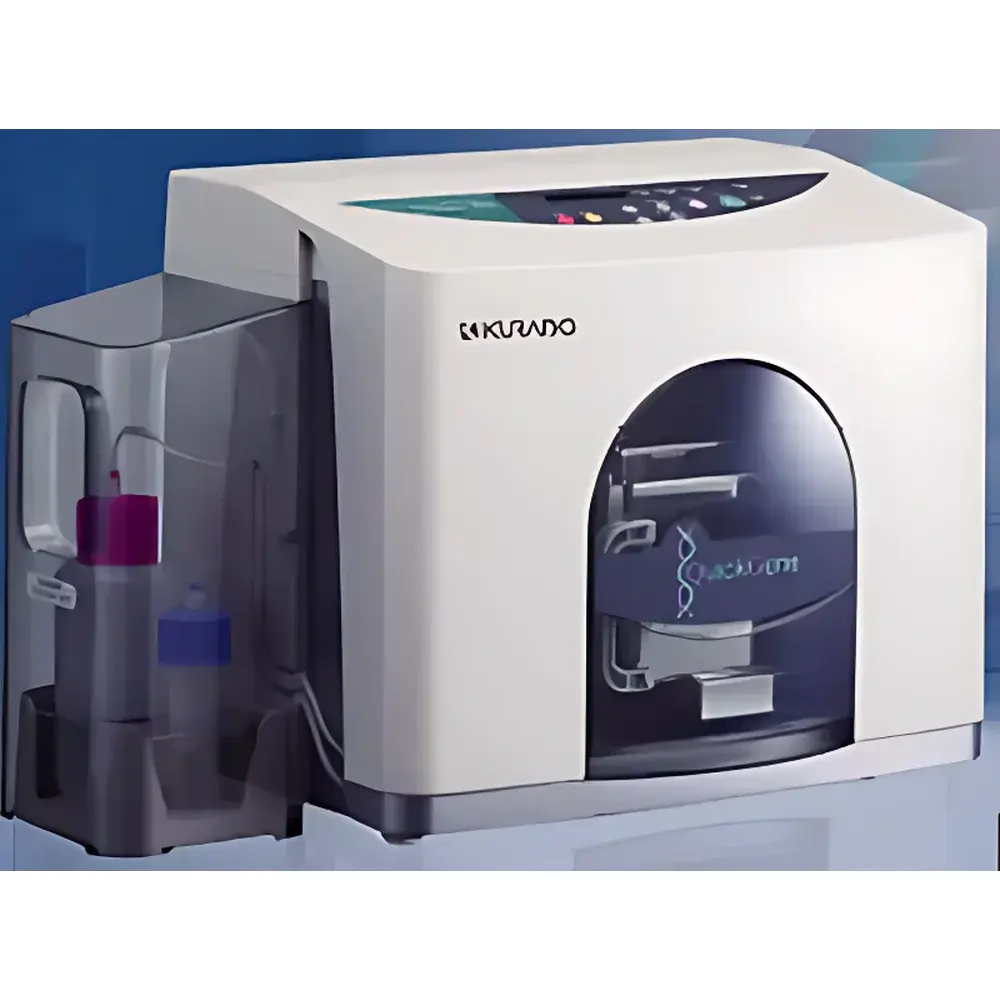
Kurabo QuickGene-610L Automated Nucleic Acid Purification System
| Origin | Japan |
|---|---|
| Manufacturer Type | Authorized Distributor |
| Origin Category | Imported |
| Model | Kurabo QuickGene-610L |
| Price Range | USD 27,000–40,000 (FOB) |
| Automation Level | Dedicated Fully Automatic |
| Throughput per Run | 6 samples |
| Sample Volume Range | 2 mL |
| Processing Time per Batch | 12 minutes |
Overview
The Kurabo QuickGene-610L is a benchtop, fully automated nucleic acid purification system engineered for high-integrity genomic DNA isolation from whole blood. It employs a proprietary hydrophilic porous membrane technology—distinct from conventional glass-fiber or silica-membrane formats—to enable pressure-driven, centrifuge-free solid-phase extraction. The membrane’s ultra-thin profile (80 µm) and high surface-area-to-volume ratio (20× greater than standard glass-fiber membranes) facilitate rapid, selective binding of nucleic acids under low differential pressure. This architecture eliminates reliance on high-speed centrifugation or vacuum manifolds, reducing mechanical stress on DNA and minimizing shearing—critical for preserving long-fragment integrity up to 97 kbp. Designed specifically for clinical and translational research workflows, the system delivers reproducible, GLP-aligned purification without manual intervention beyond sample loading and reagent cartridge insertion.
Key Features
- Dedicated whole-blood workflow optimized for 2 mL input volumes—compatible with EDTA, citrate, or heparin anticoagulated samples.
- Integrated three-stage pressure-controlled protocol: binding (low-pressure adsorption), washing (intermediate-pressure buffer exchange), and elution (high-purity low-salt recovery)—all executed within a single sealed cartridge.
- No centrifugation required: filtration-based separation replaces rotor-based pelleting, eliminating tube handling, g-force variability, and cross-contamination risk.
- Compact footprint (450 × 300 × 400 mm) and lightweight design (24 kg) suitable for BSL-2 labs, core facilities, and mobile diagnostic units.
- Pre-validated QuickGene DNA Whole Blood Kit ensures lot-to-lot consistency and compliance with ISO 13485–certified manufacturing standards.
- Onboard thermal control maintains consistent lysis and elution temperatures (±0.5 °C), critical for enzymatic step stability in integrated protocols.
Sample Compatibility & Compliance
The QuickGene-610L accepts primary whole blood specimens directly—no pre-lysis or dilution required. It is validated for human, non-human primate, and large-animal (bovine, porcine) whole blood matrices. All consumables—including the porous membrane cartridge and elution tubes—are DNase/RNase-free and certified endotoxin-free (<0.03 EU/mL). The system supports traceability requirements under 21 CFR Part 11 via optional audit-log-enabled firmware (user authentication, timestamped run records, electronic signature support). Method validation documentation aligns with CLSI EP17-A2 guidelines for nucleic acid yield and purity assessment, and meets minimum acceptance criteria for A260/A280 ≥ 1.7 and A260/A230 ≥ 1.8 across ≥95% of runs.
Software & Data Management
Operation is managed via an intuitive 7-inch capacitive touchscreen interface with embedded firmware (v3.2+). Protocols are stored as encrypted .qgp files; users may load preconfigured methods or customize incubation times, pressure profiles, and wash cycles within defined safety limits. Raw run logs—including pressure sensor outputs, temperature traces, and valve actuation timestamps—are exportable in CSV format for LIMS integration. Optional USB-C data dump enables offline QC review. No cloud connectivity or remote telemetry is implemented by default—ensuring full data sovereignty per GDPR and HIPAA-compliant institutional policies.
Applications
- High-yield gDNA preparation for next-generation sequencing library construction (WGS, WES, targeted panels).
- Input material generation for long-read sequencing platforms (PacBio SMRT, Oxford Nanopore) where fragment length preservation is essential.
- Biobanking operations requiring standardized, operator-independent nucleic acid isolation from longitudinal cohorts.
- Molecular diagnostics development, including assay qualification studies under ISO 15189 or CAP accreditation frameworks.
- Automated extraction for IVD kit manufacturing process validation, where batch consistency and residual inhibitor profiling are routinely assessed.
FAQ
Does the QuickGene-610L support RNA isolation?
No—the system is purpose-built for genomic DNA purification from whole blood. RNA isolation requires distinct lysis chemistry and RNase inhibition strategies not accommodated by the current hardware or kit formulation.
Can the instrument be integrated into robotic liquid handling workcells?
Yes—standardized I/O ports (RS-232, TTL-triggered GPIO) allow handshake signaling with third-party automation platforms for unattended batch loading and result flagging.
What is the expected membrane cartridge lifetime?
Each cartridge is designed for single-use only; reuse is prohibited due to irreversible binding saturation and potential carryover risk. Cartridge lot numbers are logged automatically during run initialization.
Is method transfer support available for regulatory submissions?
Kurabo provides full technical documentation packages—including IQ/OQ protocols, performance qualification reports, and reagent stability data—for inclusion in FDA 510(k), CE-IVDR, or PMDA submissions.
How is carryover contamination prevented between runs?
The system performs an automated air-purge cycle post-elution, followed by positive-pressure sterilization-grade filter flushes across all fluidic paths. No wetted surfaces contact multiple samples.




