
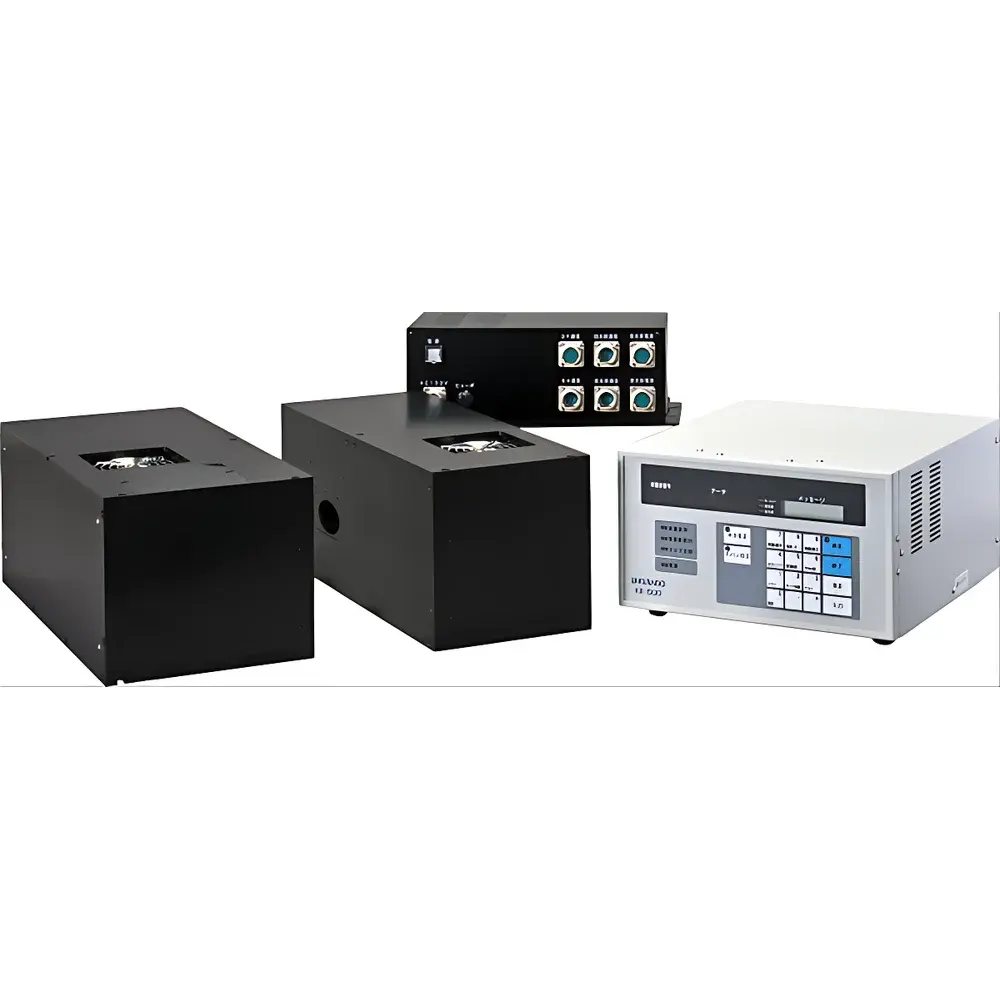
Kurabo RX410 Infrared Dual-Layer Thickness Gauge for Lithium-Ion Battery Separator and Ceramic Coating
| Brand | Kurabo |
|---|---|
| Origin | Japan |
| Model | RX410 |
| Measurement Principle | Multi-Wavelength Infrared Absorption Spectroscopy |
| Detection Capability | Simultaneous Non-Contact Measurement of Base Film Thickness and Heat-Resistant Coating Thickness (or Areal Mass) |
| Optical Configuration | Rotating Filter Wheel (6-position, 3 active wavelengths standard) |
| Spot Size | 20 × 30 mm (elliptical) |
| Standoff Distance | 20 mm (sensor-to-sample), 40 mm (inter-sensor gap) |
| Response Time | ≤50 ms |
| Output Options | 0–10 V analog or 4–20 mA current loop |
| Operating Temperature | 5–40 °C (non-condensing, ambient ≤35 °C without forced air cooling) |
| Power Supply | AC 100 V ±10%, 50/60 Hz, 200 VA per unit |
Overview
The Kurabo RX410 is an industrial-grade, non-contact infrared thickness gauge engineered specifically for real-time, in-line metrology of lithium-ion battery separators and their functional coatings. It employs multi-wavelength infrared absorption spectroscopy — a physically grounded, calibration-stable technique that quantifies layer thickness by measuring differential attenuation of IR radiation at wavelengths selectively absorbed by the base polyolefin film (e.g., PP/PE) and the overlying heat-resistant ceramic or polymer coating (e.g., Al₂O₃, SiO₂, PVDF). Unlike optical interferometry or beta-gauge methods, the RX410 operates reliably on porous, semi-transparent, and low-optical-contrast substrates — a critical requirement for microporous separator films with porosities exceeding 40% and nominal base thicknesses ranging from 9 to 25 µm. Its dual-layer resolution enables independent, simultaneous determination of both base film thickness and coating areal mass (g/m²), supporting closed-loop process control during slot-die or gravure coating operations.
Key Features
- Simultaneous dual-layer measurement: Quantifies base separator thickness and ceramic/polymer coating thickness (or grammage) in a single pass without physical contact.
- Multi-wavelength IR absorption architecture: Standard 3-wavelength configuration (expandable to 6 via rotating filter wheel) enables spectral selectivity — isolating absorption signatures unique to each layer’s chemical composition.
- Robust performance on porous media: Optimized for microporous polypropylene/polyethylene films with high void fraction and low IR transmittance; delivers repeatability < ±0.3 µm (3σ) under stable environmental conditions.
- Non-contact, in-line integration: Designed for continuous web monitoring at line speeds up to 100 m/min; standoff distance of 20 mm ensures compatibility with existing coater and calendering infrastructure.
- High-speed response: 50 ms measurement cycle time captures transient thickness variations during start-stop transitions or coating formulation adjustments.
- Industrial-grade hardware: IP54-rated sensor heads (410 × 164 × 190 mm, 10.4 kg emitter / 8.6 kg receiver); compact signal processing unit (322 × 140 × 113 mm, 4 kg); dedicated data acquisition module (275 × 300 × 165 mm, 6 kg).
Sample Compatibility & Compliance
The RX410 is validated for use with standard Li-ion battery separator architectures: monolayer PE, biaxially oriented PP, trilayer PP/PE/PP, and coated variants with α-Al₂O₃, boehmite, or PVDF-based heat-resistant layers. It complies with IEC 62660-1 (secondary lithium cells — performance testing) and supports quality assurance protocols aligned with ISO 9001:2015 and IATF 16949. While not intrinsically certified for hazardous locations, its Class 1 laser product classification (IEC 60825-1) and absence of ionizing radiation ensure safe deployment in cleanroom and dry-room environments (ISO Class 7–8). The system meets electromagnetic compatibility requirements per EN 61326-1 and is compatible with factory-wide SCADA and MES integration via analog output (0–10 V or 4–20 mA).
Software & Data Management
The RX410 includes embedded firmware with real-time thickness trending, statistical process control (SPC) charting (X-bar/R, Cpk), and alarm thresholds configurable per layer. Raw spectral data and calibrated thickness values are timestamped and exportable in CSV format. Optional PC-based software provides advanced diagnostics, multi-sensor synchronization, and audit-trail logging compliant with FDA 21 CFR Part 11 requirements when deployed in GMP-regulated production facilities. Calibration traceability is maintained through NIST-traceable reference standards for polyolefin film and ceramic-coated foil, with annual verification recommended per ISO/IEC 17025 guidelines.
Applications
- In-line monitoring of base film thickness during cast film extrusion and stretching processes.
- Real-time control of ceramic slurry coating weight uniformity across 1–3 m wide webs.
- Post-calendering thickness verification to detect compression-induced non-uniformity.
- Development and qualification of next-generation composite separators (e.g., PI-coated, aramid-reinforced, or gradient-coated architectures).
- Quality gate inspection for incoming separator rolls prior to electrode lamination.
- Cross-functional R&D support for optimizing pore structure–thickness trade-offs using correlated SEM and IR thickness data.
FAQ
Can the RX410 measure thickness of transparent or highly reflective coatings?
Yes — its multi-wavelength IR absorption method is insensitive to surface reflectivity and does not require specular reflection; it relies on bulk absorption characteristics, making it suitable for matte, rough, or metallized coatings.
Is calibration required for each new coating formulation?
A one-time spectral calibration is performed using representative reference samples; subsequent measurements remain valid unless the base polymer chemistry or coating composition changes significantly.
How is sensor alignment maintained during long-term operation?
The emitter and receiver housings incorporate precision-machined kinematic mounts and thermal expansion compensation; routine verification with alignment jig is recommended every 6 months.
Does the system support integration with PLC-based automation systems?
Yes — analog outputs (0–10 V / 4–20 mA) are directly compatible with Siemens S7, Rockwell ControlLogix, and Beckhoff CX series PLCs; Modbus TCP option available upon request.
What environmental controls are necessary for stable operation?
Ambient temperature must be maintained between 5–40 °C with relative humidity < 60% RH and no condensation; above 35 °C, localized air conditioning or purge airflow is required to prevent thermal drift in optical path length.



