
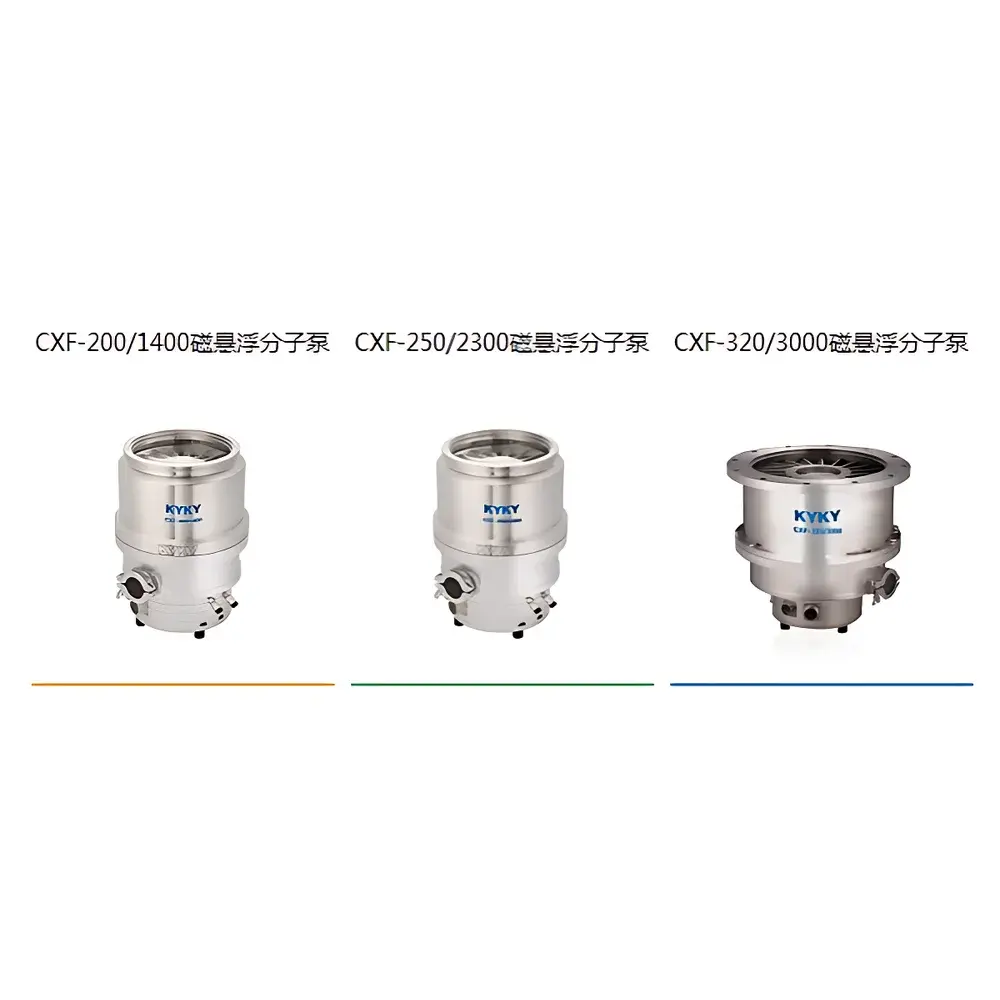
KYKY CXF Series Magnetic Levitation Turbo Molecular Pumps
| Brand | KYKY (Beijing Zhongke Keyi Co., Ltd.) |
|---|---|
| Origin | Beijing, China |
| Model Series | CXF-200/1400, CXF-250/2300, CXF-320/3000 |
| Bearing Technology | Active Magnetic Levitation |
| Pumping Speed (N₂) | 1400 L/s to 3000 L/s |
| Ultimate Pressure (Base Vacuum) | ≤5×10⁻⁹ Pa |
| Operating Temperature Range | 10–40 °C |
| Power Supply | 3-phase AC 380 V, 50/60 Hz |
| Interface Flange | DN200 ISO-K, DN250 ISO-K, DN320 ISO-K (per model) |
| Compliance | GB/T 19067–2003, ISO 21809-2:2015 (vacuum equipment safety), CE-marked per EU Machinery Directive 2006/42/EC |
Overview
The KYKY CXF Series Magnetic Levitation Turbo Molecular Pumps represent a high-performance vacuum solution engineered for ultra-high vacuum (UHV) and extreme clean environments. Based on the principle of momentum transfer via high-speed rotating blades (typically 20,000–90,000 rpm), these pumps achieve molecular flow regimes where gas molecules collide more frequently with rotor surfaces than with each other. The defining innovation lies in the fully active magnetic levitation bearing system—eliminating mechanical contact, oil contamination, vibration transmission, and wear-related maintenance. This architecture enables continuous operation at base pressures down to ≤5×10⁻⁹ Pa, making the CXF series suitable for applications demanding exceptional vacuum integrity, particulate-free pumping, and long-term stability without lubricant degradation.
Key Features
- Active magnetic levitation bearings with real-time position feedback control—ensuring sub-micron rotor centering and zero physical contact across full speed range.
- Integrated brushless DC motor with digital servo drive, enabling precise speed regulation (±0.1% stability) and rapid acceleration (<60 s to nominal speed).
- Multi-stage bladed rotor design optimized for nitrogen-equivalent pumping speeds from 1400 L/s (CXF-200/1400) to 3000 L/s (CXF-320/3000), with high compression ratios (>10⁸ for H₂, >10¹⁰ for Ar).
- Hermetically sealed stator housing with IP54-rated electrical enclosure; compatible with bake-out up to 120 °C (with optional high-temp configuration).
- Onboard microcontroller with RS-485 (Modbus RTU) and optional Ethernet interface for remote monitoring of rotational speed, bearing status, temperature sensors (stator, bearing coils, front flange), and fault diagnostics.
- Low-vibration operation (<0.5 µm peak-to-peak at 1 m distance), critical for electron beam lithography, TEM column isolation, and interferometric metrology setups.
Sample Compatibility & Compliance
The CXF series is designed for inert, non-corrosive, and non-condensable gases typical in UHV process chambers—including N₂, O₂, Ar, He, and residual H₂O vapor (when paired with appropriate foreline trapping). It is not rated for solvent vapors, halogenated compounds, or acidic gases without upstream chemical scrubbers. All models comply with GB/T 19067–2003 (Chinese national standard for turbo molecular pump performance testing), ISO 21809-2:2015 (safety requirements for vacuum equipment), and meet CE marking requirements under the EU Machinery Directive 2006/42/EC and Electromagnetic Compatibility Directive 2014/30/EU. For regulated pharmaceutical or medical device manufacturing environments, the pump’s digital log functionality supports audit-ready event timestamps and operational state history—aligning with GLP/GMP documentation expectations when integrated into validated vacuum systems.
Software & Data Management
KYKY provides the K-VacControl desktop application (Windows 10/11, 64-bit) for configuration, real-time parameter visualization, and automated log export (CSV/JSON). The software supports programmable start/stop sequences, speed ramp profiles, and alarm threshold customization (e.g., bearing displacement >20 µm triggers immediate coast-down). All operational events—including power cycles, speed changes, thermal alerts, and emergency stops—are time-stamped with millisecond resolution and stored onboard for ≥30 days. When deployed in networked vacuum systems, the pump integrates natively with common SCADA platforms (Ignition, Siemens Desigo, Beckhoff TwinCAT) via Modbus TCP or OPC UA (with optional gateway module), enabling centralized vacuum asset management and predictive maintenance scheduling based on cumulative operating hours and thermal trend analysis.
Applications
- Semiconductor fabrication: Load-lock evacuation, ion implantation chamber pumping, and ALD/CVD process chamber base-pressure conditioning.
- Analytical instrumentation: Electron microscopy (SEM, TEM, FIB-SEM), Auger electron spectroscopy (AES), and X-ray photoelectron spectroscopy (XPS) columns requiring <10⁻⁸ Pa operating environment.
- Thin-film deposition: Sputtering, e-beam evaporation, and pulsed laser deposition (PLD) systems where hydrocarbon-free vacuum prevents film contamination.
- Research infrastructure: Particle accelerator beamlines, atomic physics traps, and quantum computing dilution refrigerator shielding.
- Medical device manufacturing: Sterilization chamber evacuation for low-temperature plasma sterilizers compliant with ISO 14937.
FAQ
What forevacuum requirements must be met before starting the CXF pump?
A pre-vacuum of ≤10 Pa (measured at the pump inlet) is mandatory. A two-stage rotary vane or dry scroll backing pump meeting ISO 8573-1 Class 2 purity is recommended.
Can the CXF series operate continuously in vertical orientation?
Yes—all models are certified for 0°–90° mounting angles, including inverted installation, provided thermal dissipation paths remain unobstructed and ambient airflow meets datasheet specifications.
Is firmware update supported in-field?
Yes, firmware updates are delivered via USB memory stick using K-VacControl; no hardware modification or factory return is required.
Does the pump include built-in vibration isolation?
No external isolators are needed—the magnetic bearing system inherently suppresses mechanical resonance; however, rigid mounting to a grounded optical table or massive concrete plinth is advised for sub-nanometer stability applications.
How is bearing health monitored during operation?
Six-axis position sensors continuously track rotor displacement in real time; deviation trends, peak excursions, and coil current harmonics are logged and accessible via K-VacControl diagnostic view.



