
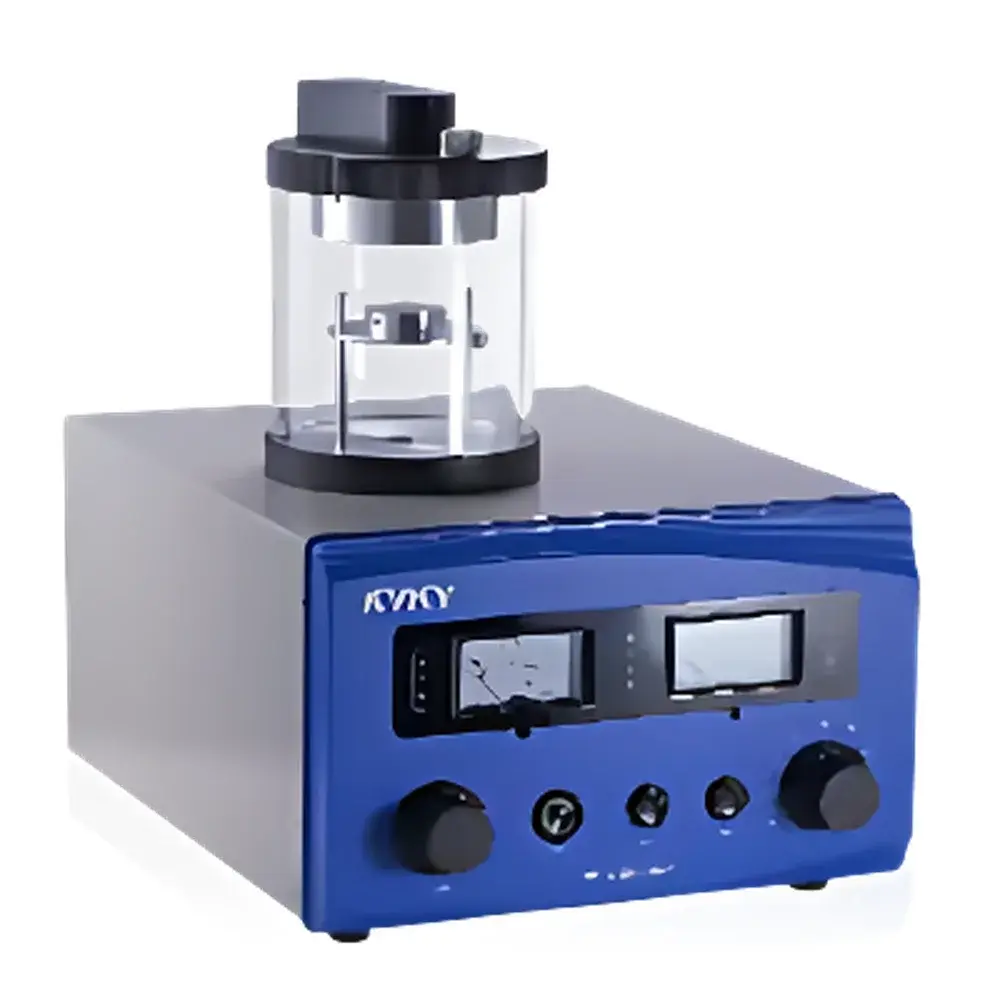
KYKY SBC-12 Compact Ion Sputter Coater
| Brand | KYKY |
|---|---|
| Origin | Beijing, China |
| Manufacturer Type | Direct Manufacturer |
| Country of Origin | China |
| Model | SBC-12 |
| Target Materials | Au, Ag, Pt, Cr, Ti, Cu, Ni, Au-Pd alloy |
| Target Diameter & Thickness | Φ58 mm × 0.12 mm |
| Control Method | Manual |
| Chamber Dimensions | Φ40 mm × 130 mm (sample compartment) |
| Stage Diameter | Φ40 mm (standard), optional Φ60 mm stage |
| Sputtering Gas | Air or Argon |
| Vacuum System | Two-stage direct-coupled rotary vane pump |
| Vacuum Gauge | Pirani gauge |
| Safety Feature | Micro-flow gas inlet valve for ion current regulation |
| Chamber Viewport | Reinforced borosilicate glass with optimized sealing |
Overview
The KYKY SBC-12 Compact Ion Sputter Coater is a benchtop vacuum deposition system engineered for reliable, low-cost conductive coating of non-conductive specimens prior to scanning electron microscopy (SEM) analysis. It operates on the principle of DC diode sputtering: under controlled low-pressure conditions (typically 1–20 Pa), inert gas ions (primarily Ar⁺) are accelerated toward a metallic target (e.g., Au, Pt, or Au-Pd), dislodging atoms that subsequently condense as a uniform, nanoscale conductive film on the sample surface. Unlike magnetron sputter coaters, the SBC-12 employs a simple, robust diode configuration—eliminating complex magnetic field alignment while maintaining sufficient film homogeneity and grain fineness for high-resolution SEM imaging at ≤5 kV accelerating voltage. Its compact footprint (≤0.3 m² floor space), sealed glass viewport, and absence of cryogenic or high-voltage subsystems make it suitable for shared core facilities, teaching labs, and routine QC environments where operational simplicity, rapid turnaround, and long-term serviceability are prioritized over ultra-thin or multi-layer deposition capabilities.
Key Features
- Optimized mechanical sealing architecture minimizes glass viewport stress—reducing risk of fracture during repeated pump-down cycles and extending viewport service life beyond 5,000 operational hours.
- Manually operated interface with tactile pressure-regulating valve enables precise, repeatable control of sputtering gas flow and resulting ion current density—critical for balancing coating thickness (typically 2–10 nm) against thermal load on beam-sensitive biological or polymeric samples.
- Dual-stage rotary vane vacuum pump achieves base pressure ≤5 × 10⁻¹ Pa within 90 seconds; integrated Pirani gauge provides real-time pressure feedback across the operational range (1–100 Pa), ensuring process reproducibility between users and sessions.
- Standard Φ40 mm rotating stage accommodates up to six standard SEM stubs (12.7 mm diameter) or custom holders; optional Φ60 mm stage supports larger substrates (e.g., 50 mm wafers or cross-section mounts) without chamber modification.
- Interchangeable targets (Φ58 mm × 0.12 mm thickness) compatible with high-purity Au, Pt, Cr, Ti, Ni, Cu, Ag, and Au-Pd (60:40)—each mounted via standardized knurled flange for tool-free replacement in <60 seconds.
Sample Compatibility & Compliance
The SBC-12 accepts standard SEM stubs, planchettes, TEM grids (with support rings), and flat substrates ≤Φ40 mm. Its low-energy sputtering regime (no RF or pulsed DC) avoids substrate charging or topographic distortion in fragile specimens such as pollen grains, freeze-fractured polymers, or hydrated biofilms. While not certified to ISO 14644 cleanroom standards, its all-metal/glass construction and absence of internal lubricants ensure minimal particulate generation—meeting ASTM E1558 guidelines for SEM sample preparation equipment used in materials characterization workflows. The manual operation mode inherently satisfies GLP documentation requirements when paired with facility-maintained logbooks recording date, operator ID, target type, sputtering time, and observed chamber pressure.
Software & Data Management
The SBC-12 is a manually controlled instrument with no embedded microprocessor or digital interface. All process parameters—including sputtering duration (timed externally), gas inlet valve position, and observed Pirani reading—are recorded manually per institutional SOPs. This design eliminates firmware validation overhead and ensures full compatibility with FDA 21 CFR Part 11-compliant electronic lab notebooks (ELNs) when operators enter metadata directly into validated systems. No proprietary drivers, cloud connectivity, or remote access functionality is implemented—aligning with IT security policies in regulated pharmaceutical and academic research settings.
Applications
- Routine SEM sample preparation for geological thin sections, metallurgical fracture surfaces, and ceramic cross-sections requiring uniform 3–5 nm Au coatings.
- Teaching laboratories: Enables undergraduate students to perform hands-on sputter coating with minimal supervision—ideal for introductory materials science and electron microscopy courses.
- Quality control labs processing incoming polymer components, filtration membranes, or printed circuit board laminates where consistent conductivity and low carbon contamination are mandatory.
- Forensic trace evidence preparation—coating of single fibers, paint chips, or gunshot residue particles without altering morphology or elemental composition (EDS-compatible).
- Preparation of insulating biological specimens (e.g., insect cuticles, plant epidermis) for low-kV SEM imaging, minimizing beam-induced charging artifacts.
FAQ
What vacuum level is required before initiating sputtering?
Base pressure must reach ≤5 × 10⁻¹ Pa, verified by the integrated Pirani gauge, prior to opening the gas inlet valve.
Can argon be substituted with nitrogen or oxygen for reactive sputtering?
No—the SBC-12 is designed exclusively for inert-gas sputtering; reactive gases may oxidize internal components and compromise vacuum integrity.
Is the Φ60 mm stage an OEM accessory or third-party retrofit?
It is a factory-engineered, mechanically compatible option supplied by KYKY with matching centering and rotation interface—no adapter plates required.
How often should the vacuum pump oil be changed?
Under typical usage (≤10 cycles/day), oil replacement is recommended every 500 operating hours or biannually—whichever occurs first—to maintain stable base pressure performance.
Does the system include a film thickness monitor?
No—thickness is inferred from empirical calibration curves (time vs. nominal nm thickness for specific target/gas/pressure combinations), documented in the user manual and validated per ASTM E1558 Annex A3.



