
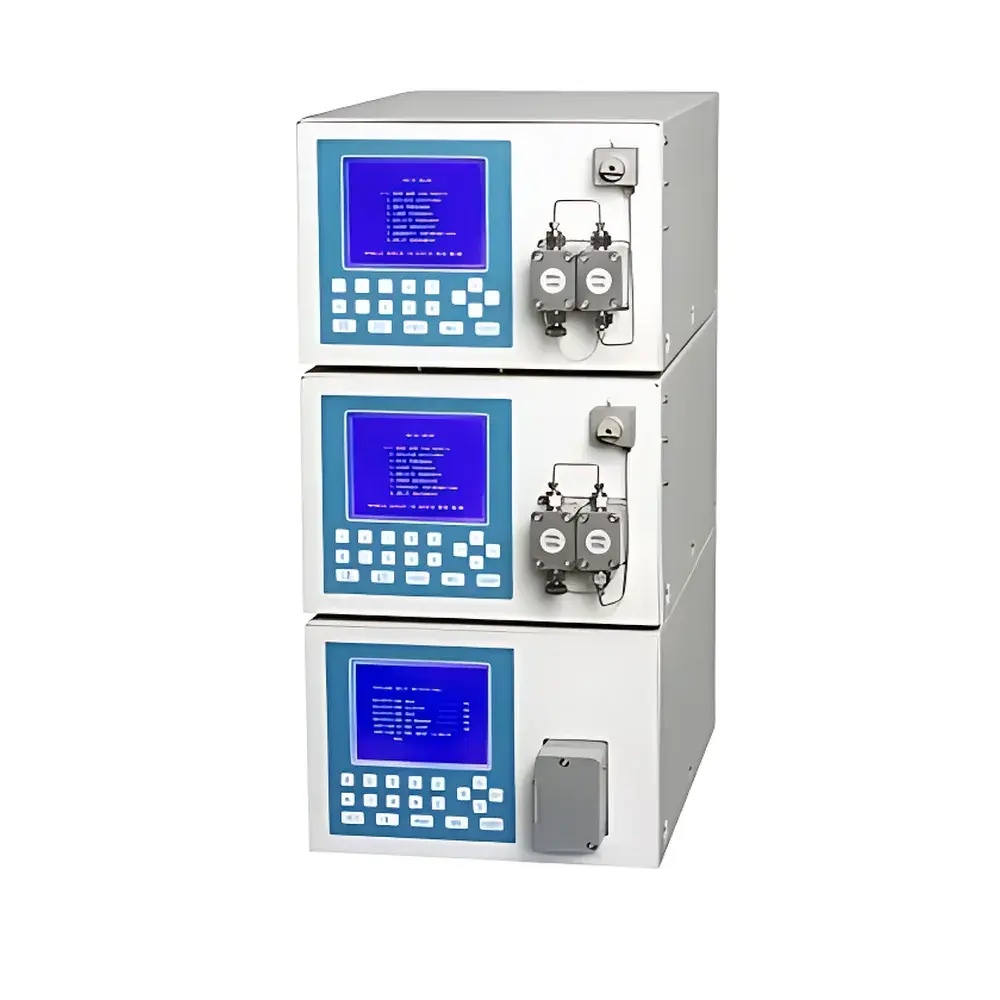
Kyocera LC3000A Preparative Liquid Chromatograph
| Brand | Kyocera |
|---|---|
| Origin | Beijing, China |
| Manufacturer Type | Authorized Distributor |
| Product Category | Domestic |
| Model | LC3000A Preparative Liquid Chromatograph |
| Max. Pressure (P3210) | 42 MPa |
| Max. Pressure (P3220) | 30 MPa |
| Flow Rate Range (P3210) | 0.001–9.999 mL/min |
| Flow Rate Range (P3220) | 0.01–49.99 mL/min |
| Flow Accuracy | ≤0.4% |
| Flow Precision (RSD) | ≤0.1% |
| UV/VIS Detector Wavelength Range | 190–700 nm |
| Wavelength Accuracy | ≤±2 nm |
| Wavelength Repeatability | 0.4 nm |
| Absorbance Range | 0–2 AU |
| Absorbance Error | <±5% |
| Baseline Noise (254 nm) | ≤1.5×10⁻⁵ AU (dynamic, 1 mL/min, MeOH/H₂O = 80:20) |
| Baseline Drift (254 nm) | ≤4×10⁻⁴ AU/h (dynamic, 1 mL/min, MeOH/H₂O = 80:20) |
| Time Constants | 0.1/0.2/0.5/1/2/5/10 s |
| Scan Modes | Programmable stop-and-go wavelength scanning (start/end λ and step size user-definable) |
Overview
The Kyocera LC3000A Preparative Liquid Chromatograph is a high-performance, dual-pump preparative-scale HPLC system engineered for robust fractionation, purification, and isolation of target compounds from complex mixtures in pharmaceutical, natural product, and fine chemical laboratories. Built upon the P3000A-series high-pressure analytical pump architecture—enhanced with automated pump head rinsing, low-pulsation fluid delivery, and precision-machined flow paths—the LC3000A delivers exceptional pressure stability and volumetric reproducibility across wide flow ranges. Its modular design integrates seamlessly with optional fraction collectors, column switching valves, and mass spectrometry interfaces, supporting both analytical method transfer and scalable process development. The system operates on the fundamental principle of differential partitioning between a stationary phase (e.g., C18, silica, or specialty resins) and a mobile phase under controlled gradient or isocratic elution, enabling selective retention and separation of analytes based on polarity, size, charge, or affinity.
Key Features
- Two high-pressure binary pump modules: P3210 (max. 42 MPa, 0.001–9.999 mL/min) and P3220 (max. 30 MPa, 0.01–49.99 mL/min), each featuring automatic pump head flushing to minimize carryover and extend seal life
- UV/VIS detector (UV3000A) with dual-lamp source (deuterium lamp standard; tungsten lamp optional) covering 190–700 nm, enabling broad-spectrum detection of aromatic, conjugated, and chromophore-bearing compounds
- Programmable wavelength scanning with fully configurable start/end wavelengths and step resolution (down to 1 nm increments), supporting spectral confirmation and peak purity assessment
- High-fidelity optical performance: baseline noise ≤1.5×10⁻⁵ AU at 254 nm (1 mL/min, MeOH/H₂O 80:20); drift ≤4×10⁻⁴ AU/h under identical conditions
- Flow accuracy ≤0.4% and repeatability (RSD) ≤0.1%, validated per ISO 11607-2 and ASTM D7212 protocols for quantitative method robustness
- Imported check valves and fluoropolymer-based sealing components ensure compatibility with aggressive solvents (e.g., THF, DCM, acetonitrile) and extended operational lifetime
Sample Compatibility & Compliance
The LC3000A accommodates a broad range of sample matrices—including crude extracts, reaction mixtures, fermentation broths, and synthetic intermediates—across column inner diameters from 10 mm to 50 mm (preparative scale) and particle sizes from 5 µm to 20 µm. It supports reversed-phase, normal-phase, ion-exchange, and size-exclusion chromatography modes. System hardware and firmware are designed to meet essential regulatory expectations for laboratory instrumentation: all critical parameters (flow rate, pressure, wavelength, absorbance) are logged with timestamped audit trails; detector signal output complies with analog (±1 V) and digital (RS-232/USB) interface standards required for integration into GLP- and GMP-compliant environments. While not pre-certified for FDA 21 CFR Part 11, the system architecture permits implementation of electronic signature workflows and data integrity controls when paired with validated third-party LIMS or CDS platforms.
Software & Data Management
The LC3000A operates via Kyocera’s proprietary ChromoView Pro control software, which provides real-time monitoring of pump status, detector response, pressure profiles, and valve positions. Method development tools include gradient editor with linear/nonlinear ramping, dwell volume compensation, and multi-step program sequencing. All chromatograms, spectra, and system logs are stored in open-format ASCII (.csv) and industry-standard .cdf files compatible with OpenLab CDS, Chromeleon, and Empower. Raw absorbance data includes full spectral snapshots at user-defined retention windows, facilitating post-run peak deconvolution and library matching. Audit trail functionality records operator ID, method changes, calibration events, and instrument errors—enabling traceability aligned with ISO/IEC 17025 clause 7.7 and USP Analytical Instrument Qualification guidelines.
Applications
- Purification of active pharmaceutical ingredients (APIs) and chiral intermediates prior to crystallization or formulation
- Isolation of bioactive natural products (e.g., flavonoids, alkaloids, terpenoids) from plant and microbial extracts
- Removal of catalyst residues and side-products in asymmetric synthesis workflows
- Preparative-scale separation of oligonucleotides and peptides for structural validation and biological testing
- Method scouting and robustness testing for subsequent transfer to analytical UHPLC or production-scale SFC systems
- Stability-indicating assays supporting ICH Q1–Q5 guideline compliance during forced degradation studies
FAQ
What column dimensions and flow rates are recommended for optimal resolution in preparative mode?
For 20–30 mm ID columns, use the P3220 pump at 10–30 mL/min with 5–10 µm particles; for 10 mm ID columns requiring higher resolution, select the P3210 pump at 1–5 mL/min.
Does the UV3000A detector support real-time spectral library matching?
No—spectral acquisition is stored for post-run analysis only; real-time matching requires external chemometric software integration via API.
Can the LC3000A be operated under GLP-compliant data integrity requirements?
Yes—when deployed with validated electronic lab notebook (ELN) or chromatography data system (CDS) software that enforces user authentication, audit trail retention, and electronic signatures.
Is the system compatible with aqueous mobile phases containing >95% water?
Yes—pump seals and check valves are rated for prolonged exposure to high-water-content buffers (e.g., 0.1% TFA in water), though regular maintenance is advised to prevent hydrolysis-related wear.
What is the minimum detectable absorbance change at 254 nm under standard conditions?
Based on baseline noise specifications (≤1.5×10⁻⁵ AU), the theoretical limit of detection (LOD) for a 10-mm pathlength cell is approximately 0.3 ng/µL for compounds with ε ≈ 10⁴ L·mol⁻¹·cm⁻¹.





