
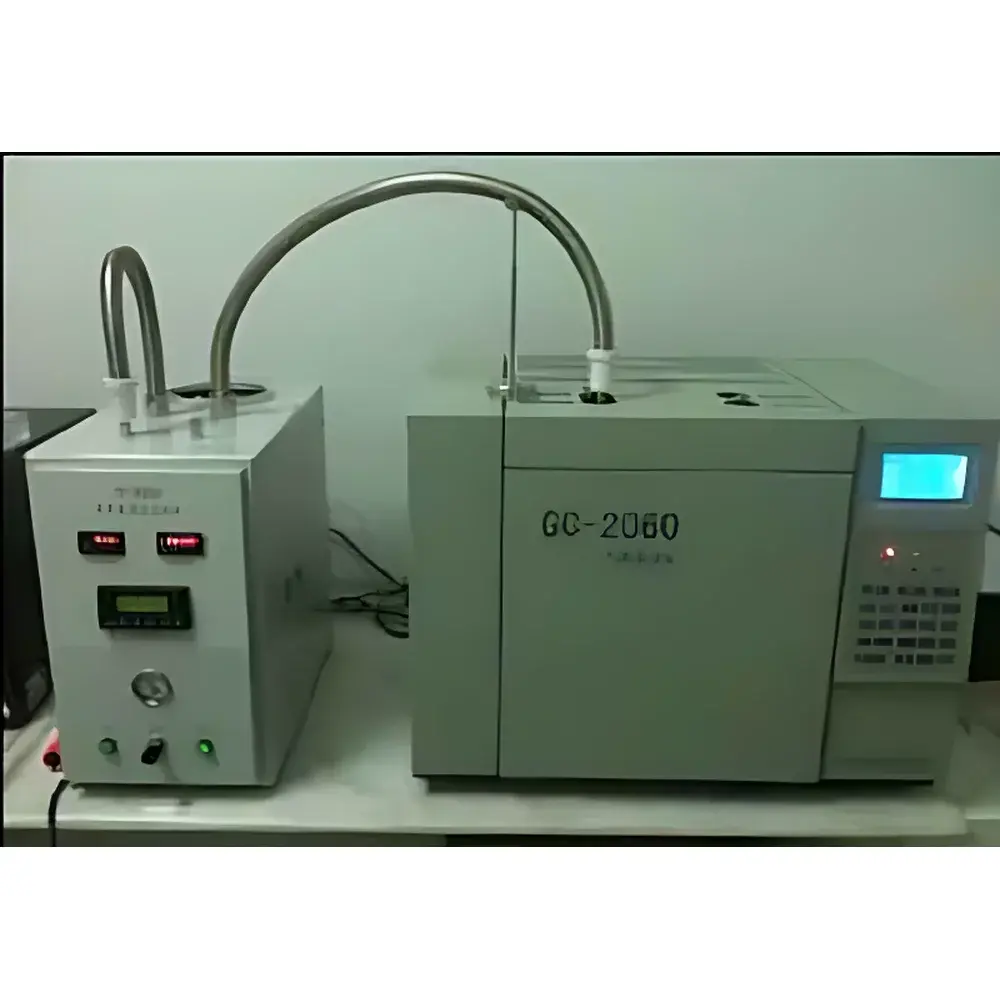
Kyocera TP-6000 Automated Static Headspace Sampler
| Brand | Kyocera |
|---|---|
| Origin | Beijing, China |
| Model | TP-6000 |
| Instrument Type | Static Headspace Sampler |
| Automation Level | Fully Automatic |
| Sample Vial Heating Range | Ambient to 450 °C |
| Valve & Transfer Line Temperature Control Range | Ambient to 210 °C (1 °C increment) |
| Quantitative Loop Volume | 1 mL |
| Vial Capacity | 9 positions |
| Vial Size | 10 mL |
| Temperature Stability | < ±0.5 °C |
| RSD for Peak Area | ≤1.5% (under optimized conditions) |
| Equilibration/Injection/Clean Time Range | 0–60 min (user-programmable) |
Overview
The Kyocera TP-6000 Automated Static Headspace Sampler is an engineered solution for the quantitative analysis of volatile and semi-volatile organic compounds (VOCs and SVOCs) in liquid, solid, and semi-solid matrices. It operates on the principle of static headspace equilibrium: samples are sealed in inert 10 mL crimp-top vials and heated to a precisely controlled temperature, allowing analytes to partition between the condensed phase (liquid or solid) and the vapor phase above it. Once thermodynamic equilibrium is achieved, a defined volume (1 mL) of the equilibrated headspace gas is transferred—via a thermostatted, electrically actuated sampling valve—directly into the injection port of a gas chromatograph (GC). This solvent-free, non-destructive extraction method eliminates matrix interference, reduces column contamination, and improves detection sensitivity and reproducibility for trace-level volatiles.
Key Features
- Dual-Mode Sampling Architecture: Supports both equilibrium (static) and pressurized headspace injection protocols, ensuring compatibility with a broad range of GC systems—including Agilent, Shimadzu, Thermo Fisher, and domestic GC platforms—without hardware modification.
- Independent Thermal Zones: Three independently controlled heating zones: (1) sample vial oven (ambient to 450 °C), (2) injection valve & quantitative loop (ambient to 210 °C), and (3) transfer line (ambient to 150 °C). Each zone features PID-based temperature regulation with ≤±0.5 °C stability and 1 °C resolution.
- Robust Vial Handling System: Nine-position carousel accommodates standard 10 mL headspace vials with aluminum crimp seals. The vial holder is constructed from high-thermal-conductivity alloy to minimize thermal gradient across positions and ensure uniform equilibration kinetics.
- Integrated Safety & Diagnostics: Over-temperature cutoff protection in the vial oven; real-time monitoring of valve actuation status, heater power draw, and temperature deviation alarms; automatic cooldown sequence post-run to extend component lifetime.
- Modular Flow Path Design: All wetted surfaces contact only inert materials (electropolished stainless steel, PTFE, and fused silica). The 1 mL fixed-volume loop is calibrated per ASTM D7699 and traceable to NIST-certified standards.
Sample Compatibility & Compliance
The TP-6000 is validated for use with aqueous solutions, polymer films, pharmaceutical tablets, foodstuffs (e.g., roasted coffee, fermented beverages), environmental solids (soil, sediment), and packaging materials. Its operational parameters align with regulatory methods including USP , EP 2.4.24, ISO 11843-2, and ASTM D6866 for residual solvent quantification. When integrated into a validated GC workflow, the system supports GLP-compliant data acquisition and meets audit requirements for 21 CFR Part 11 when paired with compliant chromatography data systems (CDS) that provide electronic signatures, audit trails, and user access controls.
Software & Data Management
The TP-6000 communicates via standard RS-232 or USB virtual COM port, enabling seamless integration with major GC vendor software (OpenLab CDS, Chromeleon, GCsolution) and third-party LIMS environments. Method parameters—including vial equilibration time, oven ramp profiles, injection duration, and purge cycles—are stored as encrypted .cfg files. All temperature setpoints, actual readings, valve timing events, and error logs are timestamped and exportable in CSV format for QA/QC review. No proprietary software installation is required; instrument control is fully embedded within host CDS method templates.
Applications
- Residual solvent analysis in pharmaceutical active ingredients and excipients (ICH Q3C guidelines)
- VOC profiling in drinking water, wastewater, and leachates (EPA Methods 502.2, 624, 8260)
- Flavor and aroma compound quantification in dairy, wine, and fruit products
- Off-gassing assessment of automotive interior materials and medical device packaging
- Forensic toxicology screening for ethanol, acetone, and chlorinated solvents in blood and tissue
- Quality control of adhesives, coatings, and printed inks for VOC emissions compliance (EU Directive 2004/42/EC)
FAQ
Is the TP-6000 compatible with split/splitless GC injectors?
Yes—it delivers a consistent 1 mL gas pulse suitable for both modes; optimal liner selection and carrier gas flow optimization are recommended per GC manufacturer specifications.
Can I use 20 mL vials with this system?
No—the mechanical design and thermal profile are optimized exclusively for 10 mL crimp-top vials per ASTM D7699 and ISO 17935. Adapter kits are not supported.
What maintenance intervals are recommended for long-term reliability?
Valve seal replacement every 10,000 injections; quarterly calibration verification of all three temperature zones using NIST-traceable dry-block calibrators; annual inspection of vial carousel alignment and drive belt tension.
Does the system support method transfer from other headspace platforms?
Yes—equilibration time, temperature, and pressure parameters are directly translatable; minor retention time shifts may occur due to differences in loop volume and transfer line dead volume, which can be compensated during GC method validation.
Is remote monitoring or network connectivity available?
The TP-6000 does not include Ethernet or Wi-Fi interfaces; however, its serial/USB interface enables integration into centralized lab automation networks via middleware servers running OPC UA or LabVIEW-based control layers.
Related Products





