
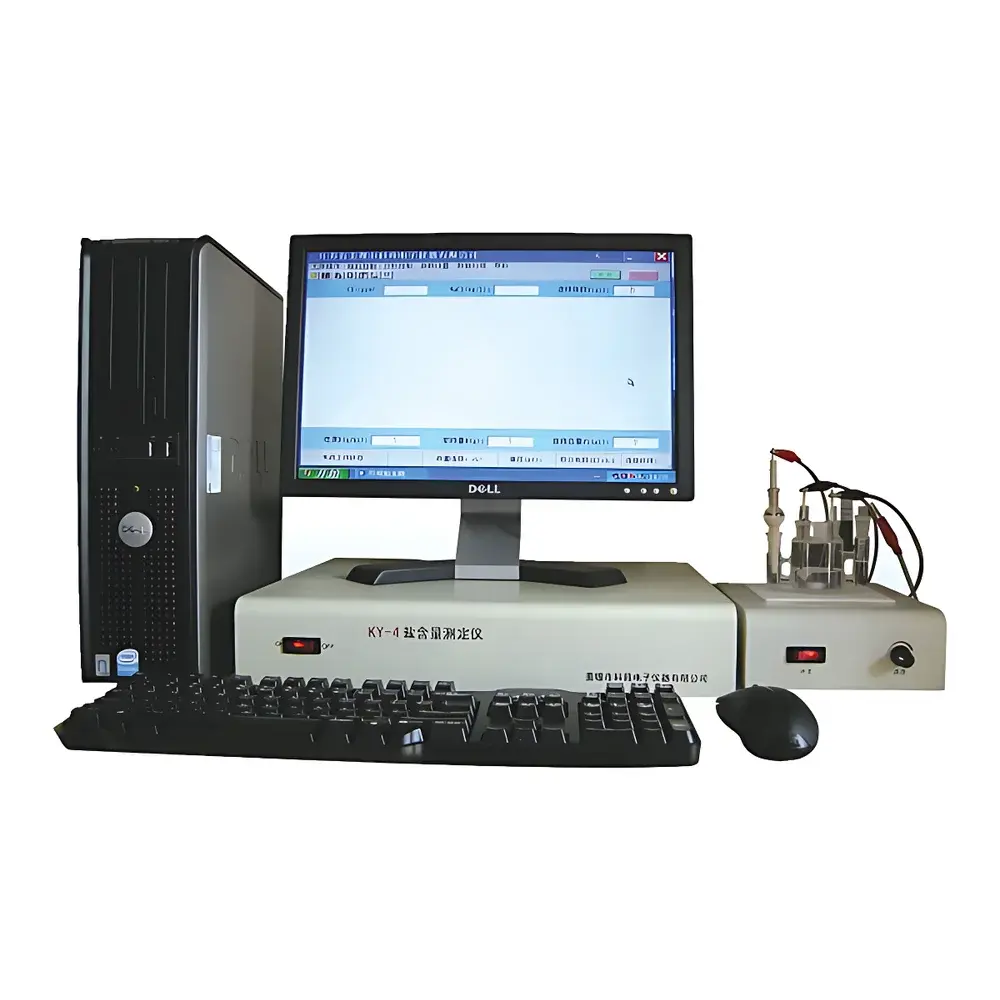
Kyoyuan KY-4 Microcoulometric Salt Content Analyzer
| Brand | Kyoyuan |
|---|---|
| Origin | Jiangsu, China |
| Manufacturer Type | Manufacturer |
| Country of Origin | China |
| Model | KY-4 |
| Pricing | Upon Request |
| Measurement Principle | Microcoulometric Titration (Electrogenerated Silver Ion Titration) |
| Compliance Standards | SY/T 0536–2008, GB/T 6532–2012, ASTM D3230–13 |
| Detection Range | 0.2–10,000 mg NaCl/L or mg Cl⁻/L |
| Detection Sensitivity | 0.2 mg NaCl/L |
| Signal Range | −999 to +1000 µV |
| Signal Resolution | 1 µV |
| Accuracy | <2 mg/L |
| Power Consumption | 40 W |
| Operating Environment | 10–40 °C, ≤80% RH, low electromagnetic interference |
Overview
The Kyoyuan KY-4 Microcoulometric Salt Content Analyzer is a dedicated petroleum laboratory instrument engineered for precise, trace-level quantification of inorganic chloride salts—primarily sodium chloride—in crude oil and related hydrocarbon streams. It operates on the fundamental principle of microcoulometric titration: chloride ions (Cl⁻), extracted from the sample into an aqueous phase via thermal extraction, are electrochemically titrated with silver ions (Ag⁺) generated in situ within a specialized titration cell. The Ag⁺ is produced by controlled electrolysis of a silver anode at a constant current; the endpoint is detected potentiometrically via a dual-reference electrode system that monitors the instantaneous redox potential shift as free Cl⁻ is depleted. The total charge consumed (in coulombs) during electrolysis is directly proportional to the mass of chloride present, enabling calculation of salt content (as NaCl or Cl⁻) based on Faraday’s law. This method eliminates the need for chemical reagent standardization, reduces analyst intervention, and delivers high reproducibility across wide dynamic ranges—making it suitable for both refinery feedstock screening and custody transfer compliance testing.
Key Features
- Microcoulometric detection architecture with constant-current electrolysis and real-time endpoint discrimination via high-resolution potentiometric signal monitoring (±1 µV resolution, −999 to +1000 µV range).
- Proprietary titration cell design featuring sintered glass frit (sand core) instead of conventional ion-selective membranes—eliminating membrane degradation, leakage, and associated baseline drift or false endpoints.
- Fully integrated microprocessor control system managing extraction timing, titration initiation, electrolysis pulse width modulation, endpoint validation, and automatic charge integration.
- Automated data acquisition and processing: direct calculation of NaCl or Cl⁻ concentration (mg/L), cumulative charge (C), and equivalent salt mass (g); results stored with timestamp, sample ID, and operator tag.
- Self-diagnostic routines for electrode integrity verification, cell background stability assessment, and electrolyte saturation status—supporting GLP-aligned operational readiness checks.
Sample Compatibility & Compliance
The KY-4 is validated for use with crude oils, topped crudes, condensates, and desalted intermediates per industry-standard preparation protocols (e.g., water extraction at elevated temperature under inert atmosphere). It conforms to multiple internationally recognized test methods: SY/T 0536–2008 (China Petroleum Industry Standard), GB/T 6532–2012 (Chinese National Standard for potentiometric titration), and ASTM D3230–13 (Standard Test Method for Salts in Crude Oil by Electrometric Titration). Its measurement range (0.2–10,000 mg NaCl/L) supports both low-salinity upstream samples and high-salinity production fluids requiring accurate desalting verification. All firmware logic and data handling pathways are structured to support audit-ready documentation—facilitating alignment with internal QA/QC procedures and regulatory expectations for traceability in refinery process control environments.
Software & Data Management
The embedded control interface provides real-time visualization of titration curves, cell voltage, current status, and integrated charge accumulation. Measurement parameters—including extraction duration, gain settings, and endpoint threshold—are user-configurable and saved per method template. Raw data and final reports are exportable via USB to CSV or PDF formats. While the system does not implement FDA 21 CFR Part 11-compliant electronic signatures or multi-tier user authentication out-of-the-box, its deterministic data flow (sensor → ADC → microcontroller → storage → print/export) ensures full traceability of every analysis event. Audit logs record all critical actions: method load, calibration reset, result override (if permitted), and power cycle events—enabling reconstruction of analytical history during internal or third-party GMP/GLP audits.
Applications
- Quantitative salt content verification in crude oil prior to atmospheric/vacuum distillation to prevent corrosion and fouling in preheat trains and furnaces.
- Monitoring desalter efficiency by comparing inlet and outlet salt concentrations in electrostatic or chemical desalting units.
- Supporting custody transfer specifications where contractual salt limits (e.g., <10 PTB or <100 mg NaCl/L) must be certified.
- Research and development of demulsifier formulations, where residual salt serves as a key performance indicator of water separation efficacy.
- Quality assurance of pipeline-spec crudes entering shared transportation infrastructure, ensuring compliance with API RP 1004 or regional transmission standards.
FAQ
What extraction solvent and procedure does the KY-4 require?
The instrument itself does not perform extraction—it interfaces with external thermal extraction units. Users must follow SY/T 0536–2008: typically, 20–50 g crude oil is mixed with 25 mL deionized water and heated at 80–90 °C for 10–15 minutes with mechanical agitation, followed by centrifugation to separate the aqueous phase for injection.
Can the KY-4 analyze solid or viscous residues such as tank bottoms or sludge?
No. It is designed exclusively for liquid-phase aqueous extracts derived from petroleum liquids. Solid matrices require prior dissolution or acid digestion—outside the scope of this analyzer’s validated use.
Is routine calibration required?
Not in the classical sense. Since quantification relies on Faraday’s constant and measured charge, no standard curve or volumetric calibration is needed. However, daily system suitability testing using a certified reference material (e.g., 100 mg/L NaCl in isopropanol/water) is recommended to verify extraction recovery and electrochemical response linearity.
How often should the titration cell be cleaned or regenerated?
The sand-core cell requires rinsing with deionized water after each analysis. Full disassembly and ultrasonic cleaning in dilute nitric acid (5% v/v) is advised every 50–100 analyses—or immediately if baseline drift exceeds ±5 µV or endpoint broadening occurs.






