
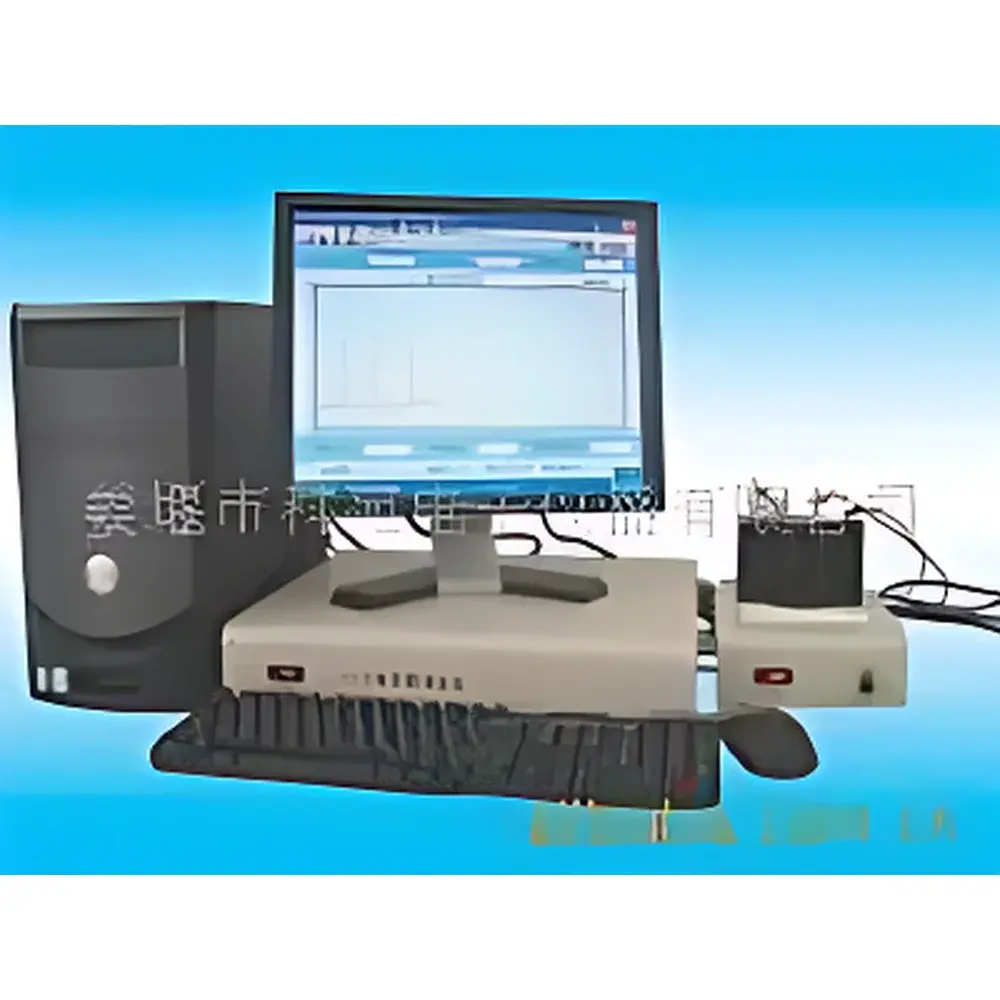
Kyoyuan KY-4 Microcoulometric Salt Content Analyzer
| Brand | Kyoyuan |
|---|---|
| Origin | Jiangsu, China |
| Manufacturer Type | Manufacturer |
| Country of Origin | China |
| Model | KY-4 |
| Price Range | USD 2,800–4,300 |
| Application Standard Compliance | SY/T 0536-2008, GB/T 6532-2012, ASTM D3230-2013 |
| Measurement Principle | Microcoulometric Titration (Ag⁺ generation via controlled electrolysis) |
| Sample Type | Liquid (crude oil, condensate, refinery streams) |
| Method | 电量法 (Coulometric Titration) |
| Salt Range | 0.2–10,000 mg/L as NaCl |
| Cl⁻ Range | 0.1 ppm–100% w/w |
| Bias Voltage Range | 0–500 mV (adjustable) |
| Accuracy | ±3% RSD |
| Sample Mass | 1.0 g ± 0.2 g |
| Power Consumption | 50 W |
| Operating Environment | 10–40 °C, ≤80% RH, low EMI |
| System Includes | KY-4 analyzer unit, dedicated PC with proprietary software |
| Optional Accessories | Thermostatic water bath, sample homogenizer |
Overview
The Kyoyuan KY-4 Microcoulometric Salt Content Analyzer is a dedicated petroleum laboratory instrument engineered for precise, trace-level quantification of inorganic chloride salts—expressed as NaCl—in crude oil, refined hydrocarbon streams, and related liquid feedstocks. It operates on the fundamental principle of microcoulometric titration: chloride ions (Cl⁻), extracted from the sample into an aqueous phase via thermal extraction, are introduced into a sealed titration cell. Within the cell, a controlled electrolytic current generates silver ions (Ag⁺) at the anode; these react stoichiometrically with Cl⁻ to form insoluble AgCl. The endpoint is detected potentiometrically via a dual-silver indicator electrode pair, and the total charge (coulombs) consumed during electrolysis is directly proportional to the moles of Cl⁻ present, per Faraday’s law. This method eliminates the need for standardized titrant solutions, reference standards, or manual endpoint judgment—delivering high reproducibility, minimal operator dependency, and compliance with internationally recognized test methods including SY/T 0536-2008, GB/T 6532-2012, and ASTM D3230-2013.
Key Features
- Microcoulometric detection architecture with real-time coulombic integration and automatic endpoint termination
- Patented titration cell design utilizing sintered glass frit (sand core) instead of ion-selective membranes—eliminating membrane degradation, leakage, and associated calibration drift
- Digitally adjustable bias voltage (0–500 mV) to optimize sensitivity across wide dynamic range—from sub-ppm chloride to saturated brine-equivalent concentrations
- Integrated Windows-based control software enabling full method setup, real-time parameter monitoring, automated calculation (NaCl and Cl⁻), and audit-ready result reporting
- Rugged industrial-grade electronics with isolated power supply and EMI-hardened signal conditioning for stable operation in refinery lab environments
- Pre-calibrated hardware architecture requiring no routine standardization—only periodic system suitability verification using certified reference materials
Sample Compatibility & Compliance
The KY-4 is validated for use with liquid petroleum matrices including crude oil, topped crudes, atmospheric and vacuum distillates, naphthas, and desalted effluents. Sample preparation follows standardized thermal water extraction per SY/T 0536-2008: a representative 1.0 g ± 0.2 g sample is mixed with extraction solvent (e.g., toluene/methanol), heated under reflux, and the aqueous phase separated and injected directly into the titration cell. The instrument meets essential regulatory expectations for salt-in-crude testing in upstream and downstream operations, supporting quality control per API RP 932-C (Corrosion Control in Refinery Crude Units) and process safety documentation requirements. While not inherently 21 CFR Part 11 compliant out-of-the-box, its data logging architecture supports implementation of electronic signature, audit trail, and user access controls when deployed within validated LIMS-integrated workflows adhering to GLP/GMP principles.
Software & Data Management
The KY-4 operates via Kyoyuan’s proprietary Windows application, providing a graphical interface for method configuration (bias voltage, integration time, blank subtraction), live display of titration curves and coulombic output, and automated conversion to NaCl (mg/L) or Cl⁻ (ppm or wt%). All raw measurement data—including timestamp, sample ID, operator ID, cell voltage, integrated charge, and calculated result—are stored in a structured local database with export capability to CSV or PDF. The software logs all user actions and parameter changes, forming a foundational audit trail. For enterprise deployment, the system supports OPC UA connectivity for integration into centralized SCADA or MES platforms, enabling batch-level salt trend analysis across multiple analyzers.
Applications
- Crude assay laboratories determining salt content prior to desalting unit feed allocation
- Refinery QC labs verifying desalter efficiency and detecting breakthrough of chlorides into fractionation trains
- Contract testing laboratories performing third-party salt certification per ASTM or ISO specifications
- R&D groups evaluating demulsifier performance and water-cut effects on salt extraction efficiency
- Storage terminal labs screening incoming crude cargoes for contractual salt limits and corrosion risk assessment
FAQ
What extraction solvents are recommended for crude oil samples?
Toluene/methanol (3:1 v/v) is the standard mixture specified in SY/T 0536-2008 and ASTM D3230-2013. Alternative solvent systems may be used only after method validation confirms equivalent extraction efficiency.
Does the KY-4 require daily recalibration?
No. The coulometric principle is inherently absolute—based on Faraday’s constant—and does not rely on reagent concentration. Daily system suitability testing with a trace-level Cl⁻ standard (e.g., 10 ppm NaCl) is recommended to verify electrode response and cell integrity.
Can the instrument measure organochlorides?
No. The KY-4 detects only inorganic chloride ions liberated during aqueous extraction. Organochloride compounds (e.g., chlorinated solvents, PCBs) require separate analysis by GC-ECD or XRF.
Is the titration cell reusable?
Yes. The sand-core cell is designed for repeated use over thousands of analyses. Routine cleaning with deionized water and methanol between samples is required; cell replacement is typically needed only after visible frit clogging or persistent baseline drift.
How is data integrity ensured during power interruption?
The embedded controller retains volatile measurement state in non-volatile memory. Upon restart, the software resumes data logging from the last confirmed integration point, preventing loss of ongoing titrations.





