
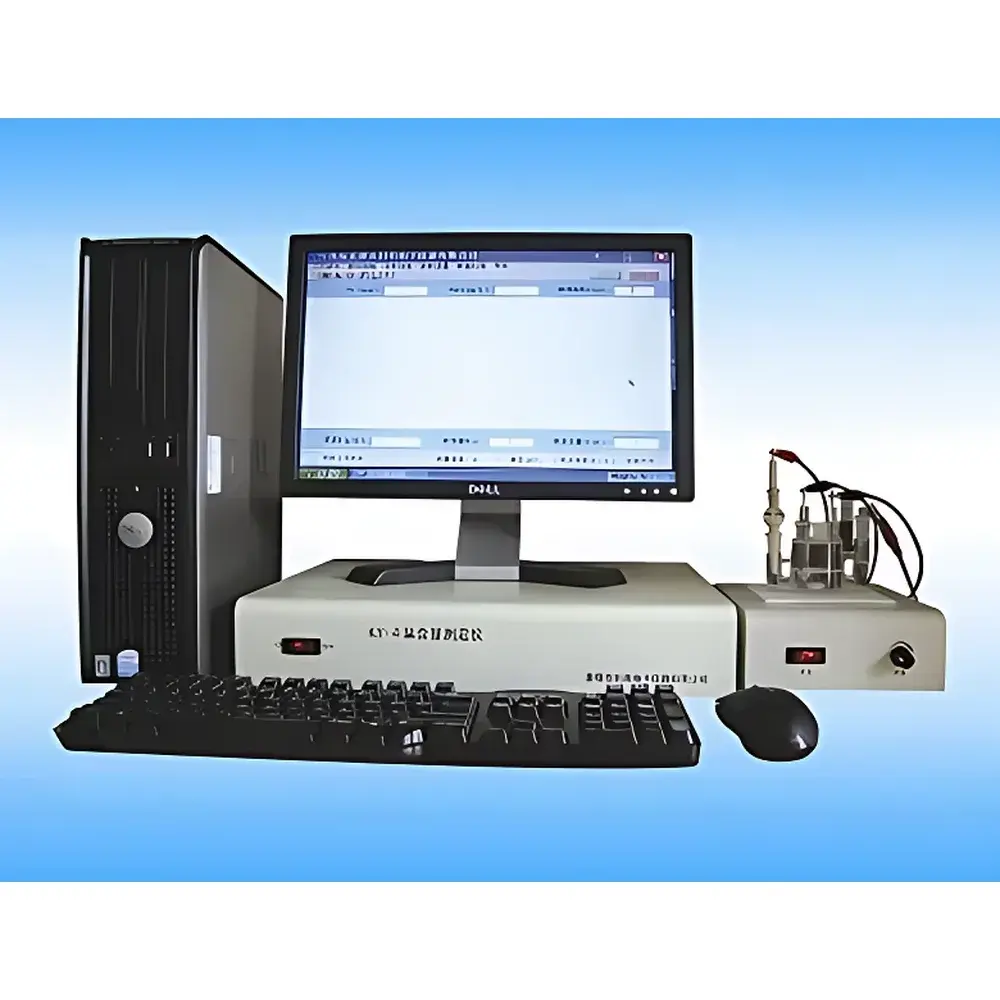
Kyuyuan KY-4 Microcomputer Salt Content Analyzer
| Origin | Jiangsu, China |
|---|---|
| Manufacturer Type | Authorized Distributor |
| Origin Category | Domestic (PRC) |
| Model | KY-4 |
| Price Range | USD 2,800 – 4,300 (FOB Jiangsu) |
| Measurement Principle | Coulometric Titration (Silver Nitrate Electrolysis) |
| Sample Type | Liquid |
| Method Standard Compliance | SY/T 0536–2008, GB/T 6532–2012, ASTM D3230–2013 |
| Bias Voltage Range | 0–500 mV (adjustable) |
| Salt Content Range | 0.2–10,000 mg/L as NaCl |
| Chloride Ion Range | 0.1 ppm to full percentage (w/w) |
| Accuracy | ±3% RSD |
| Sample Mass | 1.0 g ± 0.2 g |
| Power Consumption | 50 W |
| Operating Environment | 10–40 °C, ≤80% RH, low-EMI environment |
| Electrolytic Cell Design | Sintered Glass Frit (No Ion-Exchange Membrane) |
| Data Output | Real-time status monitoring, parameter logging, and result printing via integrated microcomputer interface |
Overview
The Kyuyuan KY-4 Microcomputer Salt Content Analyzer is a dedicated coulometric titration system engineered for precise quantification of inorganic chloride and total salt content in petroleum-derived liquids and industrial aqueous streams. It operates on the fundamental principle of controlled electrochemical generation of silver ions (Ag⁺) in a sealed titration cell, where Ag⁺ reacts stoichiometrically with chloride ions (Cl⁻) to form insoluble silver chloride (AgCl). The endpoint is detected potentiometrically via a dual-silver/silver-chloride reference electrode pair, and total charge consumed during electrolysis—measured in coulombs—is directly converted to chloride mass using Faraday’s law. This method eliminates the need for standardized titrant solutions, calibration curves, or manual endpoint detection, thereby enhancing reproducibility and reducing analyst dependency. Designed specifically for demanding upstream, midstream, and refining environments, the KY-4 meets the metrological requirements of SY/T 0536–2008 (China Petroleum Industry Standard), GB/T 6532–2012 (National Standard of PRC), and ASTM D3230–2013 (Standard Test Method for Salinity in Crude Oil by Electrical Conductivity), ensuring regulatory traceability in quality control and custody transfer applications.
Key Features
- Coulometric titration architecture with sintered glass frit–based electrolytic cell—replacing conventional ion-exchange membranes to eliminate membrane degradation, leakage, and false endpoints.
- Microprocessor-controlled bias voltage adjustment (0–500 mV), enabling optimization for diverse matrix viscosities and ionic strengths—including heavy crudes, residua, and emulsified production waters.
- Integrated real-time status display: simultaneous visualization of titration progress, current/voltage response, endpoint detection flag, and cumulative charge integration.
- Automatic calculation and unit conversion: outputs reported as Cl⁻ (ppm or %), NaCl-equivalent (mg/L), or total salinity (lb NaCl/bbl), configurable per user-defined reporting templates.
- Thermally stabilized sample introduction pathway with fixed-mass dosing (1.0 g ± 0.2 g) to minimize volumetric error associated with high-viscosity samples.
- Low-power design (50 W nominal) suitable for continuous operation in field laboratories, mobile analytical units, or refinery QC trailers without auxiliary cooling or UPS support.
Sample Compatibility & Compliance
The KY-4 accepts liquid-phase samples including crude oil (light to ultra-heavy), vacuum residue, desalter effluent, produced water, refinery process water, and industrial wastewater. Its robust electrolytic cell tolerates suspended solids up to 50 µm and total dissolved solids (TDS) exceeding 50,000 mg/L, provided samples undergo pre-filtration or centrifugation per SY/T 0536–2008 Section 6.2. All measurement protocols conform to the procedural rigor required for GLP-compliant testing environments; audit trails—including operator ID, date/time stamps, raw coulombic data, and final report generation—are retained in non-volatile memory. Instrument validation documentation supports IQ/OQ protocols aligned with ISO/IEC 17025:2017 clause 5.5 (Equipment) and satisfies evidence requirements for internal audits under API RP 2510 and ISO 9001:2015 Clause 7.1.5.
Software & Data Management
The embedded microcomputer provides local data acquisition, processing, and reporting without external PC dependency. All measurements are timestamped and stored with metadata: sample ID, operator code, method version, cell condition flag, and environmental log (ambient temperature/humidity). Export options include USB flash drive–based CSV dumps compatible with LIMS platforms (e.g., LabWare, Thermo Fisher SampleManager) and direct thermal printing of A4-format reports containing raw current-time profiles, endpoint confirmation plots, and uncertainty statements per GUM (JCGM 100:2008). No proprietary software licensing or cloud connectivity is required—ensuring full data sovereignty and compliance with ITAR/EAR export control restrictions applicable to petroleum instrumentation.
Applications
- Crude assay laboratories: routine salt screening prior to desalting unit feed qualification.
- Refinery process control: monitoring wash water salinity and desalter efficiency across multiple trains.
- Upstream operations: field-based analysis of produced water chloride for scaling risk assessment (e.g., CaSO₄, BaSO₄ saturation index modeling).
- Environmental compliance: verification of discharge water chloride against local limits (e.g., EPA 40 CFR Part 435, China’s GB 8978–1996).
- Research & development: evaluation of demulsifier performance via residual chloride tracking in separated aqueous phases.
- Contract laboratories: accredited testing services supporting API MPMS Chapter 10.8 and ISO 10426-1 cement slurry salinity specifications.
FAQ
What sample preparation is required prior to analysis?
Samples must be homogenized and heated to 60–80 °C to ensure complete phase separation; aqueous layers or extracted brines are introduced directly, while crude oils require hot water extraction per SY/T 0536–2008 Section 5.3.
Can the KY-4 measure bromide or iodide interference?
No—the instrument is calibrated exclusively for chloride-specific coulometric response; presence of Br⁻ or I⁻ will produce positive bias and requires halide-speciation via IC or ICP-MS prior to KY-4 use.
Is the electrolytic cell reusable, and what is its service life?
Yes—the sintered glass frit cell is cleaned in situ with 10% nitric acid and deionized water; typical lifetime exceeds 500 analyses when operated within specified bias and temperature ranges.
Does the system comply with FDA 21 CFR Part 11 requirements?
No—KY-4 lacks electronic signature capability and audit trail encryption; it is intended for industrial QC, not pharmaceutical GMP environments.
How often must the silver anode be replaced?
Under standard operating conditions (≤100 analyses/week), the consumable silver anode requires replacement every 6–12 months, depending on average chloride load and daily usage frequency.




