
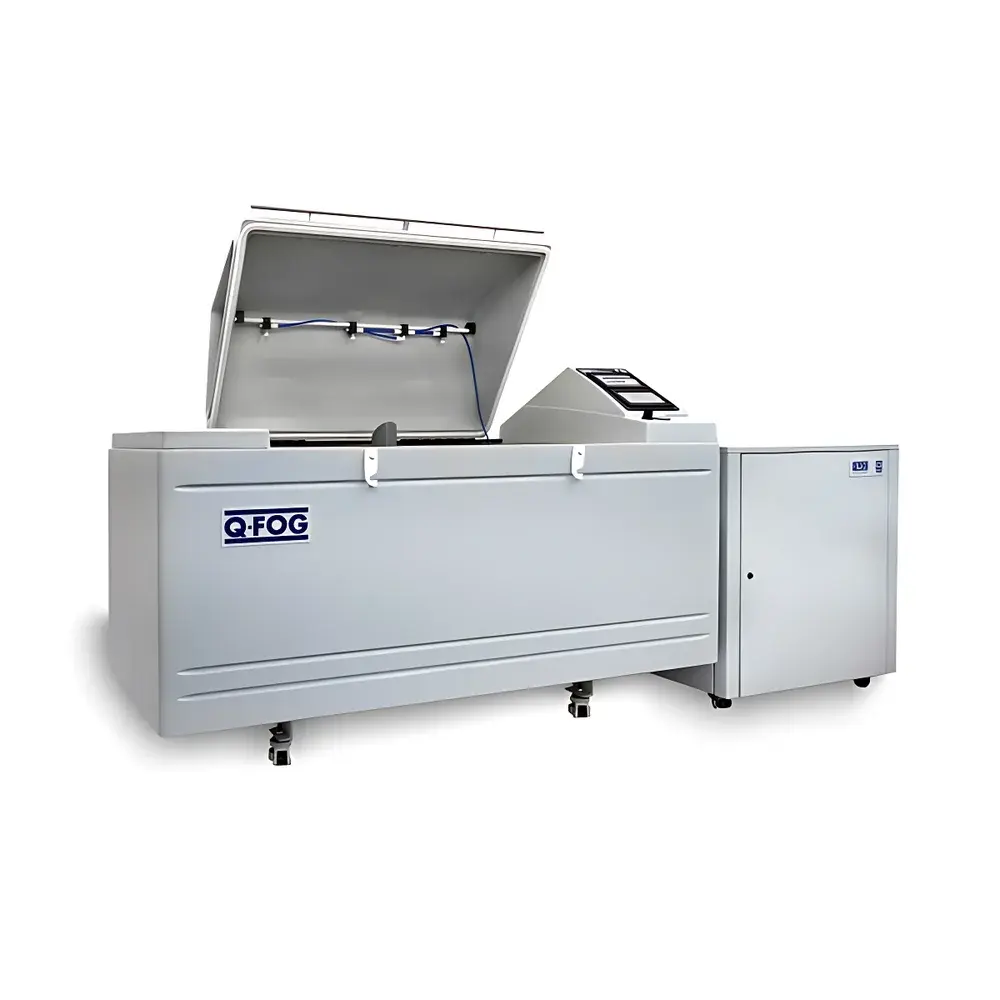
Q-LAB Q-FOG CRH Cyclic Corrosion Test Chamber
| Brand | Q-LAB |
|---|---|
| Origin | USA |
| Manufacturer Type | Original Equipment Manufacturer (OEM) |
| Product Category | Imported Instrument |
| Model | Q-FOG CRH |
| Spray Method | Dual-mode (Atomized Salt Fog + Programmable Spray) |
| Nozzle Pressure | 0.7–1.4 bar |
| Salt Deposit Rate | 1.0–2.0 mL / 80 cm² / h |
| Temperature Range | 35–70 °C |
Overview
The Q-LAB Q-FOG CRH Cyclic Corrosion Test Chamber is an engineered solution for accelerated corrosion testing under dynamically controlled environmental conditions. Unlike conventional salt spray chambers limited to static fog exposure, the CRH platform implements a true multi-parameter cyclic methodology—integrating precise temperature regulation, programmable relative humidity (RH) control (via air pre-conditioning and humidification modules), atomized salt fog generation, and high-flow water spray functionality. Its operational principle relies on sequential or overlapping exposure phases: salt fog (per ASTM B117 or ISO 9227), high-humidity condensation (per ISO 6270-2), dry-off periods with low-RH airflow, and optional water spray (e.g., for GMW 14872 or SAE J2334). This capability enables replication of real-world atmospheric degradation mechanisms—including electrochemical corrosion, crevice attack, and hygroscopic salt re-dissolution—across automotive, aerospace, coatings, and metal component industries.
Key Features
- Integrated RH control system using dedicated air pre-conditioner, moisture-controlled air delivery module, and precision misting nozzles—enabling stable RH setpoints from 30% to 95% at temperatures up to 70 °C.
- Dual-spray architecture: atomized salt fog (fine droplets, <10 µm median diameter) for standardized fog testing; and high-volume water spray (coarser droplets, adjustable flow rate via peristaltic pump) for rapid wetting in automotive CCT protocols.
- Configurable spray delivery: fixed central shower module or oscillating top-mounted spray bar—compliant with test method requirements mandating uniform impingement angle or coverage pattern (e.g., Ford CETP 00.00-L-467).
- Automated nozzle cleaning cycle prevents clogging—eliminating manual maintenance downtime common in legacy salt fog systems.
- Rapid thermal response enabled by internal chamber heaters and high-capacity cooling/drying fans; optional fast-ramp heating module supports ≤10 min transitions between 25 °C/30% RH and 60 °C/95% RH—critical for ISO 11997-1 and JASO M609 compliance.
- 120 L integrated solution reservoir with built-in salt particulate filter, level sensor, and audible/visual low-level alarm; compatible with external bulk feed systems for unattended 7+ day operation.
Sample Compatibility & Compliance
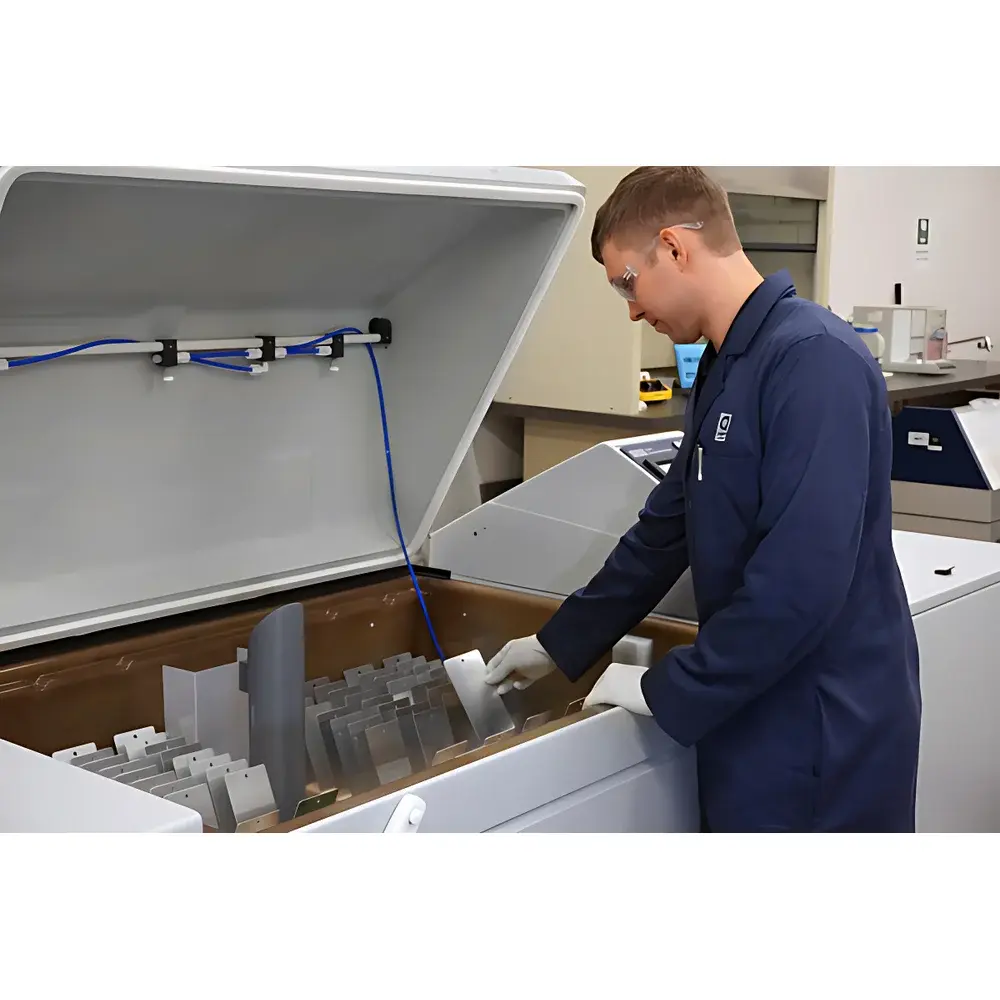
The Q-FOG CRH accommodates flat panels, assembled subcomponents, and full-size automotive parts (up to 600 L or 1100 L chamber volume variants). Its programmable exposure sequencing meets over 40 international corrosion standards—including GMW 14872, SAE J2334, Ford CETP, VW PV1210, Volvo VCS 1027, Renault D17 2025, JASO M609, ISO 11997-1/2, ISO 20623, and GB/T 24195. All CRH models support GLP-compliant operation: temperature and RH sensors are traceably calibrated (NIST-traceable reference instruments recommended), and calibration logs can be timestamped and exported. The system complies with IEC 61000-6-3 (EMC) and UL 61010-1 safety requirements.
Software & Data Management
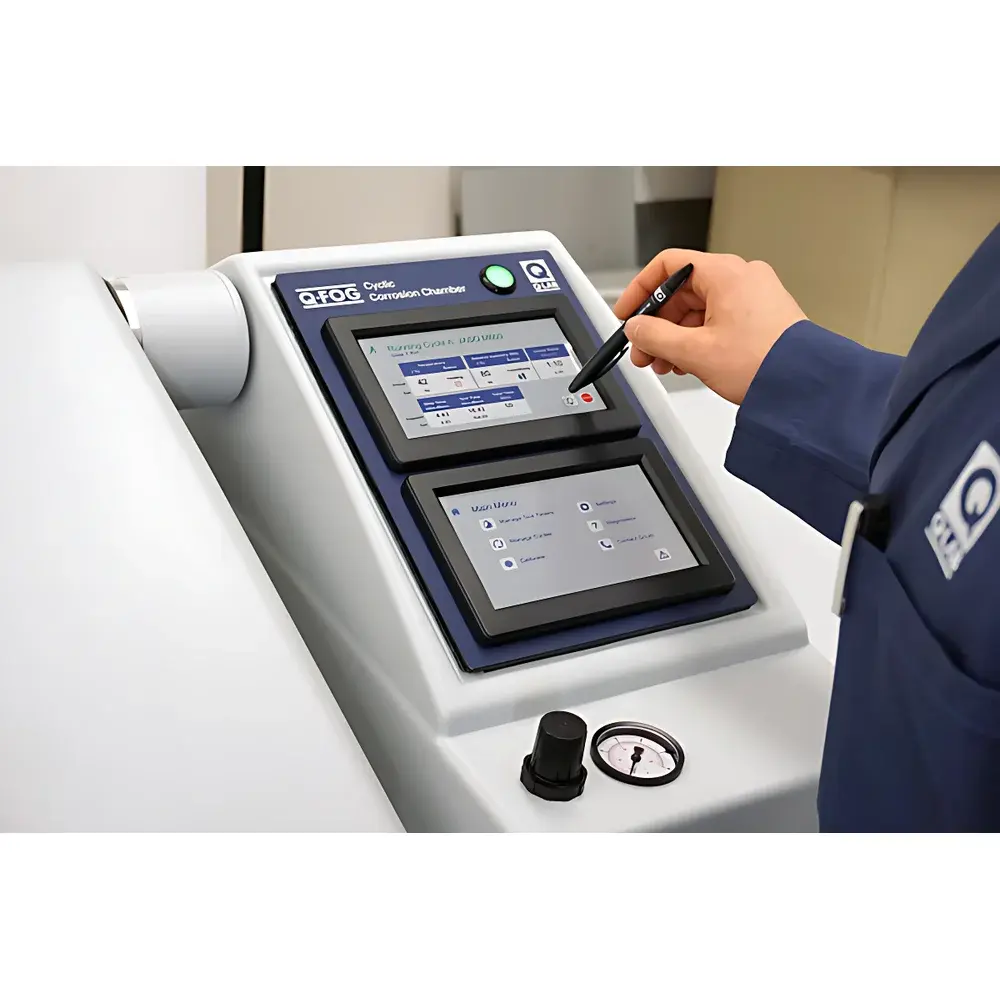
The embedded dual-color touchscreen controller runs Q-LAB’s proprietary firmware supporting 17 interface languages and intuitive cycle programming via drag-and-drop phase sequencing. Each test cycle stores full parameter metadata—including time-stamped temperature, RH, spray status, and fault diagnostics. USB export enables CSV-formatted data logging for audit trails and FDA 21 CFR Part 11–compatible validation (when paired with Q-LAB’s Virtual Bar Code software and external electronic signature workflow). Self-diagnostic functions include predictive service alerts, heater/fan performance monitoring, and automatic safety shutdown upon sensor deviation >±2 °C or >±5% RH. Firmware updates are deployed via USB without requiring vendor intervention.
Applications
- Automotive OEM qualification of painted steel, galvanized substrates, aluminum alloys, and battery enclosures under CCT protocols.
- Coatings R&D for cathodic delamination resistance, blistering kinetics, and scribe creep measurement per ASTM D1654.
- Validation of corrosion inhibitors and surface treatments for marine hardware and offshore infrastructure components.
- Quality assurance testing of consumer electronics housings, fasteners, and medical device enclosures exposed to coastal or industrial atmospheres.
- Research into synergistic degradation mechanisms involving chloride ingress, thermal cycling, and UV preconditioning (when integrated with Q-SUN xenon-arc systems).
FAQ
What water purity is required for reliable CRH operation?
Deionized water with resistivity ≥1 MΩ·cm is mandatory for both humidification and spray functions. Conductivity >1 µS/cm risks nozzle scaling and RH sensor drift.
Can the CRH perform Prohesion testing?
Yes—Q-FOG CRH-HSCR and HTCR configurations support alternating NaCl fog and acidic (0.01M H₂SO₄) spray cycles per ASTM G85 Annex A5.
Is external ventilation required?
Yes—exhaust ducting (minimum 150 mm diameter) must vent corrosive vapors outdoors per local occupational health regulations.
How often should temperature and RH sensors be calibrated?
Q-LAB recommends biannual calibration using NIST-traceable reference instruments; field verification can be completed in <5 minutes with a calibrated thermometer and insulated dew-point chamber.
Does the CRH support remote monitoring?
While not Ethernet-enabled by default, USB-logged data files can be scheduled for automated email transmission to designated QA servers or Q-LAB Technical Support for root-cause analysis.



