
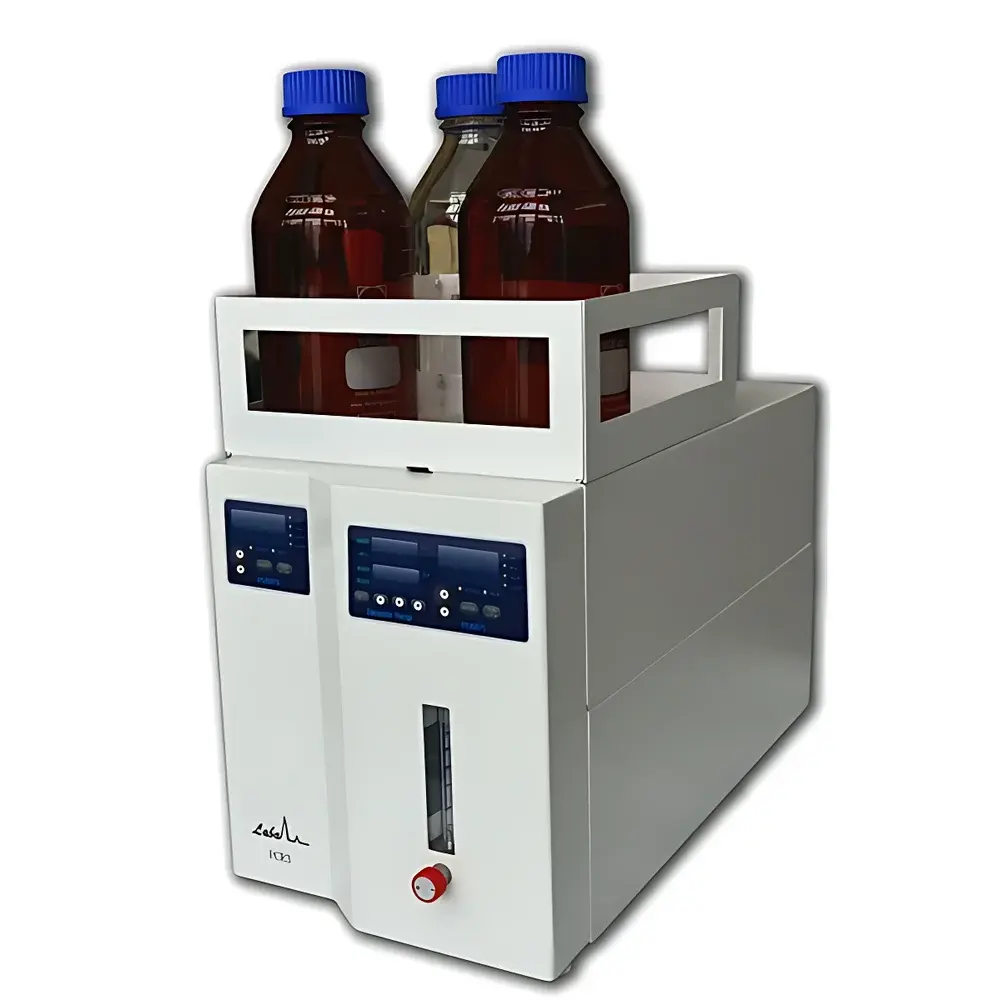
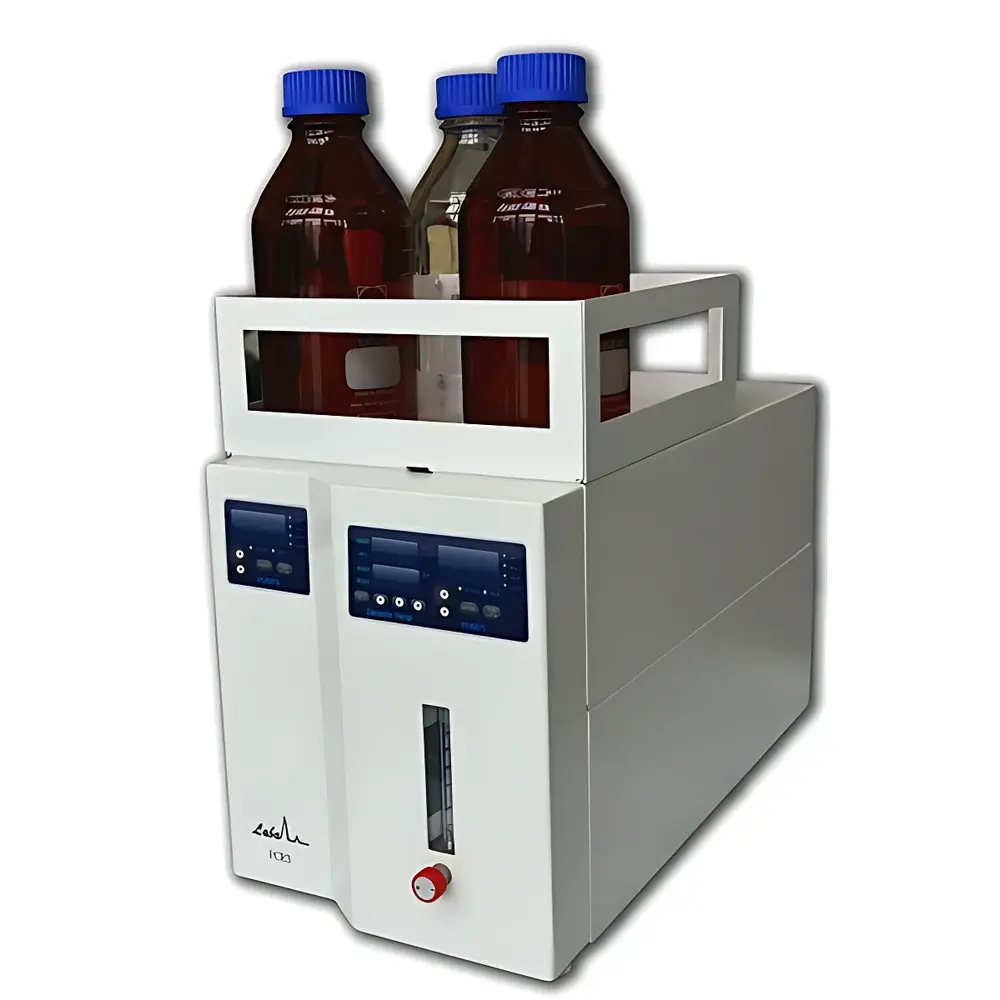
Laba PCR3 Third-Generation Post-Column Derivatization System
| Brand | Laba (Tianjin Laba Co., Ltd.) |
|---|---|
| Origin | USA |
| Model | PCR3 |
| Temperature Range | Ambient to 200 °C |
| Derivatization Reagent Flow Rate | 0.001–10 mL/min |
| Reaction Coil Material | PEEK |
| Pump Type | High-Precision Syringe-Type Piston Pump |
| Control Interface | Front-panel Keypad + PC via USB/RS-232 |
| Safety Features | Overpressure Shutdown, Leak Detection, Thermal Overload Protection |
| Reagent Delivery | Pressurized N₂-driven with Adjustable Flow Regulation and Splitting |
| Reactor Options | Modular, Customizable Volume (Standard: 0.5–5 mL), Multi-directional Mixing Geometry |
| Fluidic Path | Fully Chemically Inert (PEEK, Sapphire, Hastelloy C-276) |
| Cleaning | Integrated On-Line Solvent Flush Routine |
| Compliance | Designed for GLP/GMP environments |
Overview
The Laba PCR3 Third-Generation Post-Column Derivatization System is an engineered solution for enhancing detection sensitivity and selectivity in high-performance liquid chromatography (HPLC) applications where native analytes lack strong UV-Vis absorbance or fluorescence. It operates on the principle of continuous-flow chemical derivatization—introducing a precisely metered reagent stream into the post-column effluent, followed by controlled thermal reaction in a residence-time-optimized reactor coil. Unlike batch or pre-column approaches, the PCR3 enables real-time, stoichiometrically consistent derivatization under tightly regulated temperature and flow conditions—critical for quantitative analysis of mycotoxins, amino acids, carbamates, and other low-chromophore compounds. Its architecture reflects a fundamental redesign over prior generations, addressing systemic limitations in pressure stability, flow reproducibility (<0.1% RSD at 0.1 mL/min), and thermal uniformity across the reactor zone.
Key Features
- High-precision syringe-type piston pump delivering derivatization reagent at flow rates from 0.001 to 10 mL/min with <±0.15% accuracy and <0.05% pulse-free output—enabling sub-nanomole-level derivatization control.
- Thermally stabilized reaction module with PID-controlled heating block (ambient to 200 °C), ±0.3 °C temperature uniformity across the entire PEEK reaction coil volume, and <30-second thermal equilibration time.
- Fully inert fluidic path constructed from PEEK tubing, sapphire capillaries, and Hastelloy C-276 fittings—resistant to aggressive reagents including o-phthalaldehyde (OPA), ninhydrin, bromine, and iodine-based oxidants.
- Integrated N₂ gas management system featuring mass-flow-regulated pressurization, dual-stage pressure splitting, and real-time visual flow indication—preventing reagent oxidation and ensuring stable delivery from glass or HDPE reagent vials.
- Dual-mode operation interface: front-panel keypad with backlit LCD for standalone method execution, plus bidirectional RS-232/USB communication for remote parameter setting, event logging, and synchronization with HPLC data systems.
- On-line solvent flush protocol activated automatically after each run or manually via panel—reducing seal wear by >40% and extending maintenance intervals to ≥6 months under typical usage.
Sample Compatibility & Compliance
The PCR3 interfaces seamlessly with all major HPLC platforms—including Agilent 1260/1290, Waters ACQUITY/UPLC, Shimadzu Nexera, and Thermo Vanquish—via standard 1/16″ stainless steel or PEEK transfer lines. It supports both isocratic and gradient elution workflows without flow interruption or backpressure fluctuation. The system complies with ISO/IEC 17025 requirements for method validation in accredited laboratories and is routinely deployed in FDA-regulated environments for residue testing in food and feed matrices. When operated with validated software (e.g., Laba PCRCtrl v4.2), it meets ALCOA+ data integrity principles and supports 21 CFR Part 11-compliant electronic signatures, audit trails, and user-access controls—facilitating GMP/GLP audits.
Software & Data Management
The optional Laba PCRCtrl software provides full system orchestration: synchronized start/stop with HPLC acquisition, real-time monitoring of pump status, temperature deviation alerts, and automatic generation of run logs with timestamps, operator ID, and method checksums. All parameters—including flow rate, temperature setpoint, N₂ pressure, and flush cycle duration—are stored in encrypted SQLite databases with write-protection and version rollback capability. Export formats include CSV, PDF reports, and direct integration with Empower, Chromeleon, and OpenLab CDS via vendor-neutral API hooks.
Applications
The PCR3 is routinely applied in regulatory and research laboratories for trace-level quantification of: aflatoxins B₁, B₂, G₁, and G₂ in cereals and nuts using bromination derivatization (AOAC 2005.08); primary and secondary amino acids in biological fluids via OPA/ninhydrin chemistry (USP ); β-lactam antibiotics using iodine-mediated ring cleavage; and hydrazide-containing pharmaceuticals using carbonyl-selective labeling. Its modular reactor design permits rapid adaptation to emerging protocols—such as photochemical derivatization or enzyme-coupled reactions—without hardware modification.
FAQ
Can the PCR3 be used with UHPLC systems operating above 1000 bar?
Yes—the PEEK reaction coil and sapphire capillary connections are rated to 1200 bar, and the system introduces no additional backpressure beyond 15 bar under nominal flow conditions.
Is reactor volume customization available for kinetic studies requiring extended residence times?
Yes—standard coils range from 0.5 mL to 5 mL; custom coils up to 20 mL with helical geometry and optimized heat transfer profiles can be ordered with lead time.
Does the system support dual-reagent derivatization (e.g., sequential addition of two reagents)?
Yes—optional dual-pump configuration (PCR3-DP) allows independent control of two reagent streams with synchronized timing and temperature zoning.
How is leak detection implemented?
Capacitive micro-leak sensors are embedded in the reagent manifold baseplate; any detected leakage triggers immediate pump shutdown and visual/audible alarm.
What documentation is provided for IQ/OQ/PQ validation?
Factory-issued test certificates, traceable calibration records (NIST-traceable thermocouples and flow meters), and a complete URS-compatible validation protocol package are included with each unit.




