
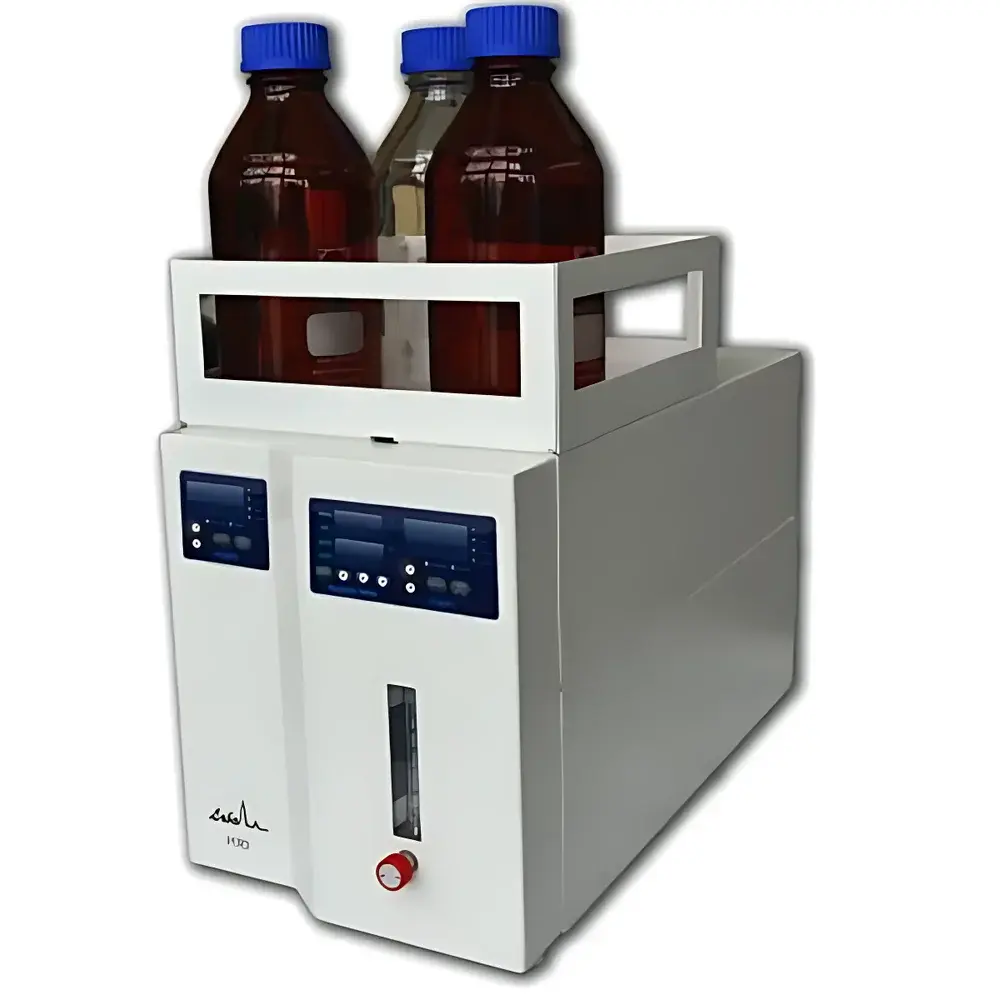
LABA PCR3 Post-Column Derivatization System
| Brand | LABA (Tianjin LABA) |
|---|---|
| Origin | USA |
| Manufacturer Type | Authorized Distributor |
| Product Category | Imported Instrument |
| Model | PCR 3 |
| Temperature Range | Ambient to 200 °C |
| Derivatization Reagent Flow Rate | 0.001–10.000 mL/min |
| Reaction Coil Material | Stainless Steel |
Overview
The LABA PCR3 Post-Column Derivatization System is an engineered solution for enhancing detection sensitivity and selectivity in high-performance liquid chromatography (HPLC) and ultra-high-performance liquid chromatography (UHPLC) workflows. It operates on the principle of post-column chemical derivatization—introducing a reactive reagent downstream of the analytical column but upstream of the detector—to convert non-chromophoric or weakly fluorescent analytes into detectable derivatives. Unlike pre-column derivatization, this approach eliminates sample loss, minimizes side reactions, and improves quantitative reproducibility by avoiding derivatization variability during sample preparation. The PCR3 is designed for robust integration into regulated and research-grade laboratories where method ruggedness, thermal stability, and flow precision are critical—particularly in food safety, environmental monitoring, and pharmaceutical quality control applications.
Key Features
- Modular architecture supporting single- or dual-reactor configurations with independent temperature control per zone
- Stainless steel reaction coils rated for continuous operation up to 200 °C, ensuring thermal stability for high-temperature derivatization reactions (e.g., o-phthalaldehyde (OPA), ninhydrin, iodine-based protocols)
- Two independently programmable syringe pumps with flow accuracy ±0.5% over 0.001–10.000 mL/min range, featuring self-cleaning mechanisms and integrated pulse dampeners for stable delivery
- Front-panel digital interface displaying real-time reagent flow rates, system pressure, setpoint and actual coil temperature, and status alerts
- Full PEEK fluidic path from reagent reservoirs through mixing tees and reaction coils to detector outlet—resistant to organic solvents, acids, and bases
- Reversible static mixer design minimizing band broadening while maximizing interfacial contact between eluent and derivatization reagent
- Quick-swap reactor modules secured with only two fittings; disposable heater cartridges eliminate thermal degradation buildup and reduce maintenance downtime
- RS232 serial interface enabling remote configuration and synchronization with HPLC system controllers or LIMS platforms
Sample Compatibility & Compliance
The PCR3 supports derivatization of small-molecule analytes across diverse matrices including food extracts, biological fluids, soil leachates, and water samples. It is routinely deployed in methods compliant with AOAC Official Methods of Analysis®, ASTM D8074 (for mycotoxin analysis), and ISO 15141 (for amino acid quantification). Its all-PEEK flow path meets USP material compatibility requirements, and its programmable pressure/temperature limits support GLP-compliant operation. While not inherently 21 CFR Part 11–certified, the system’s audit-trail-capable software interface (via optional PC control module) facilitates integration into FDA-regulated environments when paired with validated third-party data acquisition systems.
Software & Data Management
The PCR3 operates via front-panel controls or optional Windows-based software (LABA PC-Link v3.2), which provides full parameter logging—including timestamps, flow rate profiles, temperature ramps, and alarm events—for traceability. Data export is supported in CSV and XML formats compatible with laboratory information management systems (LIMS) and electronic lab notebooks (ELN). Software-defined method templates allow rapid recall of validated conditions for OPA-amino acid, iodine-aflatoxin, or ninhydrin-taurine assays. All firmware updates are delivered via secure USB key to maintain version control and system integrity.
Applications
- Amino acid analysis in infant formula and dietary supplements using OPA or ninhydrin chemistry
- Quantification of aflatoxins B1, B2, G1, and G2 in cereals and nuts via iodine-mediated derivatization followed by fluorescence detection
- Determination of glyphosate and AMPA in environmental water samples using FMOC-Cl derivatization
- Taurine measurement in energy drinks and meat products with post-column OPA reaction
- Analysis of carbamate pesticides (e.g., carbaryl, methomyl) in fruits and vegetables using alkaline hydrolysis coupled with OPA derivatization
- Residue testing of herbicides such as paraquat and diquat in soil extracts using sodium borohydride reduction and subsequent derivatization
FAQ
What types of detectors are compatible with the PCR3?
The system interfaces seamlessly with UV-Vis, fluorescence, electrochemical (ECD), and evaporative light scattering (ELSD) detectors—no signal attenuation or baseline disruption due to its low-diffusion static mixer and thermally stabilized flow path.
Can the PCR3 be used with UHPLC systems operating above 1000 bar?
Yes—the stainless steel reaction coils and PEEK tubing are rated for pressures up to 1200 bar; however, optimal performance is achieved when backpressure is managed via appropriate restrictor capillaries downstream of the reactor.
Is method transfer from older LABA models straightforward?
All PCR3 hardware interfaces and command syntax are backward-compatible with LABA PCR2 firmware; existing method files can be imported directly without recalibration.
How often does the disposable heater cartridge require replacement?
Under continuous operation at 120 °C, heater cartridges typically last ≥12 months; replacement intervals extend further at lower temperatures and intermittent use patterns.
Does the system support gradient-compatible derivatization?
Yes—its dual-pump architecture allows synchronized reagent flow modulation aligned with LC gradient profiles, preserving derivative stoichiometry across changing mobile phase compositions.



