
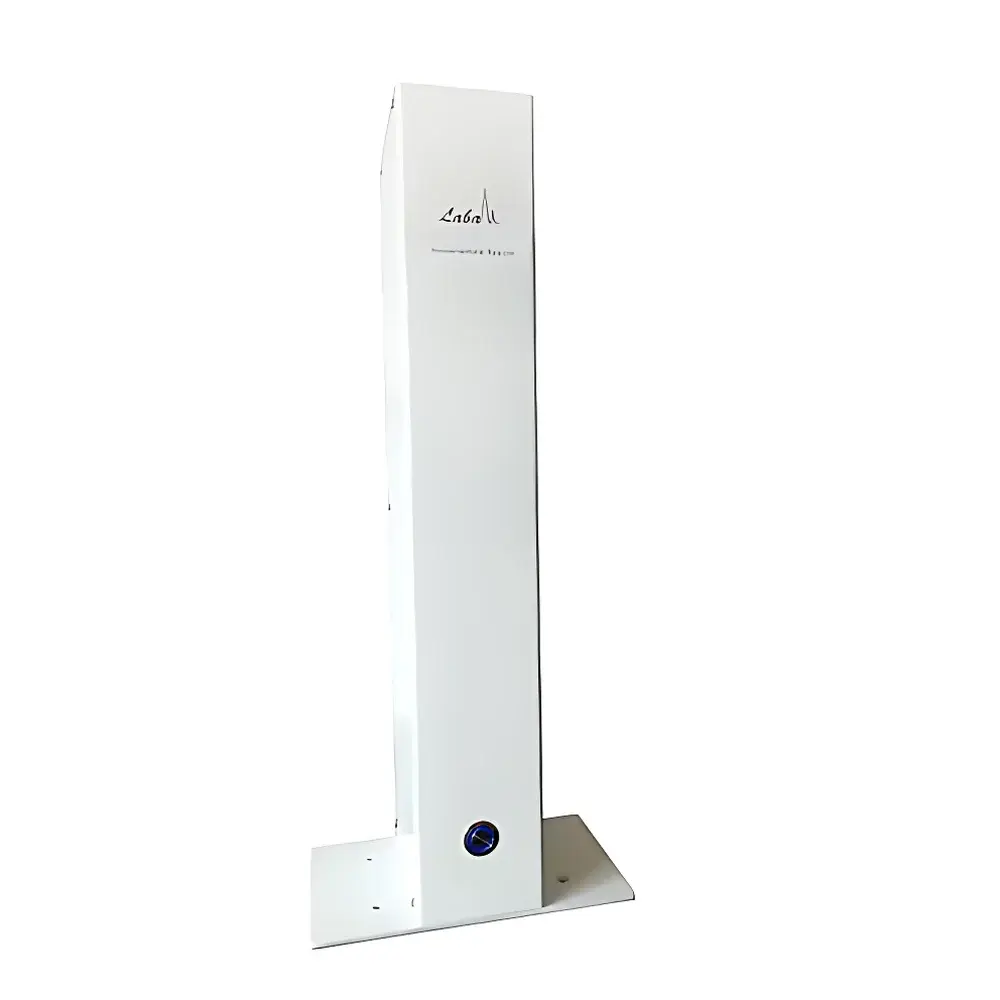
LABA PR-2 Photochemical Post-Column Derivatization System
| Brand | LABA (Tianjin LABA) |
|---|---|
| Origin | USA |
| Manufacturer Type | Authorized Distributor |
| Product Origin | Imported |
| Model | PR-2 |
| Temperature Range | Ambient to 200 °C |
| Derivatization Reagent Flow Rate | 0.001–10.000 mL/min |
| Reaction Coil Material | PEEK |
Overview
The LABA PR-2 Photochemical Post-Column Derivatization System is a precision-engineered, compact, and field-proven instrument designed for integration into high-performance liquid chromatography (HPLC) workflows requiring enhanced detection sensitivity—particularly for analytes with native low fluorescence or UV absorbance. Unlike reagent-based derivatization systems, the PR-2 employs continuous-flow photochemical activation using ultraviolet (UV) irradiation to induce structural modification of eluting compounds *after* chromatographic separation but *before* detection. This principle leverages controlled photolysis in a flow-through quartz or fused-silica reaction cell, enabling selective enhancement of fluorophore yield—most notably for aflatoxin B₁ and G₁—without introducing chemical reagents, catalysts, or post-reaction quenching steps. The system operates at ambient temperature up to 200 °C, allowing thermal stabilization of the reaction stream when required for kinetic control or volatility management. Its modular architecture ensures compatibility with all major HPLC platforms—including Agilent, Waters, Shimadzu, Thermo Fisher, and PerkinElmer—via standard 1/16″ stainless steel or PEEK tubing connections between column outlet and detector inlet.
Key Features
- True photochemical derivatization: No derivatizing reagents, solvents, or mixing valves—eliminates background noise, carryover risk, and reagent consumption costs
- Industrial-grade UV light source: High-stability, narrow-band UVC emission (254 nm typical) with calibrated irradiance output and extended service life (>5,000 hours)
- PEEK reaction coil: Chemically inert, pressure-rated to 400 bar, thermally stable from −20 °C to 200 °C, and compatible with aggressive mobile phases including acetonitrile, methanol, and acidic/basic buffers
- Programmable temperature control: Precision Peltier-heated reaction zone with ±0.5 °C stability across the full ambient-to-200 °C range
- Adjustable flow path geometry: Optimized residence time (typically 30–120 s) via coil length and internal diameter selection to maximize quantum yield for target analytes
- Plug-and-play integration: Requires only 120/230 V AC power and standard HPLC tubing; no external gas supply, pumps, or auxiliary controllers needed
Sample Compatibility & Compliance
The PR-2 is validated for use in regulated analytical environments where method robustness and data integrity are critical. It supports applications compliant with AOAC Official Method 2005.08, USDA-FSIS Directive 10,010.1, and EU Commission Regulation (EC) No 401/2006 for aflatoxin quantification in food and feed matrices. The system’s reagent-free operation eliminates variability associated with reagent batch qualification, simplifying method validation under GLP and GMP frameworks. All wetted materials—including PEEK tubing, quartz irradiation cell, and stainless-steel fittings—meet USP Class VI and FDA 21 CFR Part 11 requirements for trace-level analysis. Instrument firmware supports audit-trail-enabled operation when paired with compliant chromatography data systems (CDS), ensuring full traceability of temperature setpoints, runtime logs, and lamp-on duration.
Software & Data Management
While the PR-2 operates as a standalone hardware module without embedded software, it is fully interoperable with third-party CDS platforms via analog voltage output (0–5 V) for lamp status monitoring and digital I/O signals for synchronization with detector acquisition triggers. Optional RS-232 or USB-to-serial interface modules enable remote temperature setpoint adjustment and real-time lamp operational logging—critical for 21 CFR Part 11-compliant workflows requiring electronic records. Data generated during PR-2-assisted runs—including peak area enhancement ratios (e.g., 5–10× increase in aflatoxin B₁ fluorescence response), retention time stability (<0.02 min RSD), and baseline noise reduction—are directly exportable from CDS for statistical evaluation per ISO/IEC 17025:2017 clause 7.7.
Applications
The PR-2 delivers measurable performance advantages in several regulated and research-driven applications: quantitative determination of aflatoxins (B₁, B₂, G₁, G₂) in cereals, nuts, spices, and dairy products per AOAC and ISO 16050; analysis of hydrazide-containing pharmaceuticals (e.g., isoniazid) via UV-enhanced detection; detection of carbamate pesticides (e.g., carbaryl) using post-column photoactivation prior to fluorescence readout; and trace-level monitoring of mycotoxin metabolites in biological fluids. Its reagentless design also makes it ideal for hyphenated techniques such as LC–MS/MS where chemical derivatization may interfere with ionization efficiency or introduce adduct formation artifacts.
FAQ
Does the PR-2 require hazardous or unstable derivatization reagents?
No. The PR-2 uses only UV photolysis—no chemical reagents, catalysts, or quenching agents are introduced into the flow path.
Can the PR-2 be used with gradient HPLC methods?
Yes. Its flow-independent photochemical mechanism maintains consistent derivatization efficiency across changing mobile phase compositions and flow rates within the specified 0.001–10.000 mL/min range.
Is lamp intensity calibration traceable to NIST standards?
Yes. Each UV source is factory-calibrated using NIST-traceable radiometric sensors, and calibration certificates are provided with every unit.
What maintenance is required for long-term operation?
Annual lamp replacement and visual inspection of the quartz reaction cell for fouling or etching—no routine fluidic servicing or seal replacement is necessary due to the absence of valves or pumps.
How does the PR-2 impact method transfer between laboratories?
Its hardware-only architecture and lack of reagent dependencies significantly reduce inter-laboratory variability, supporting successful method transfer per ICH Q5C and USP ⟨1225⟩ guidelines.




