
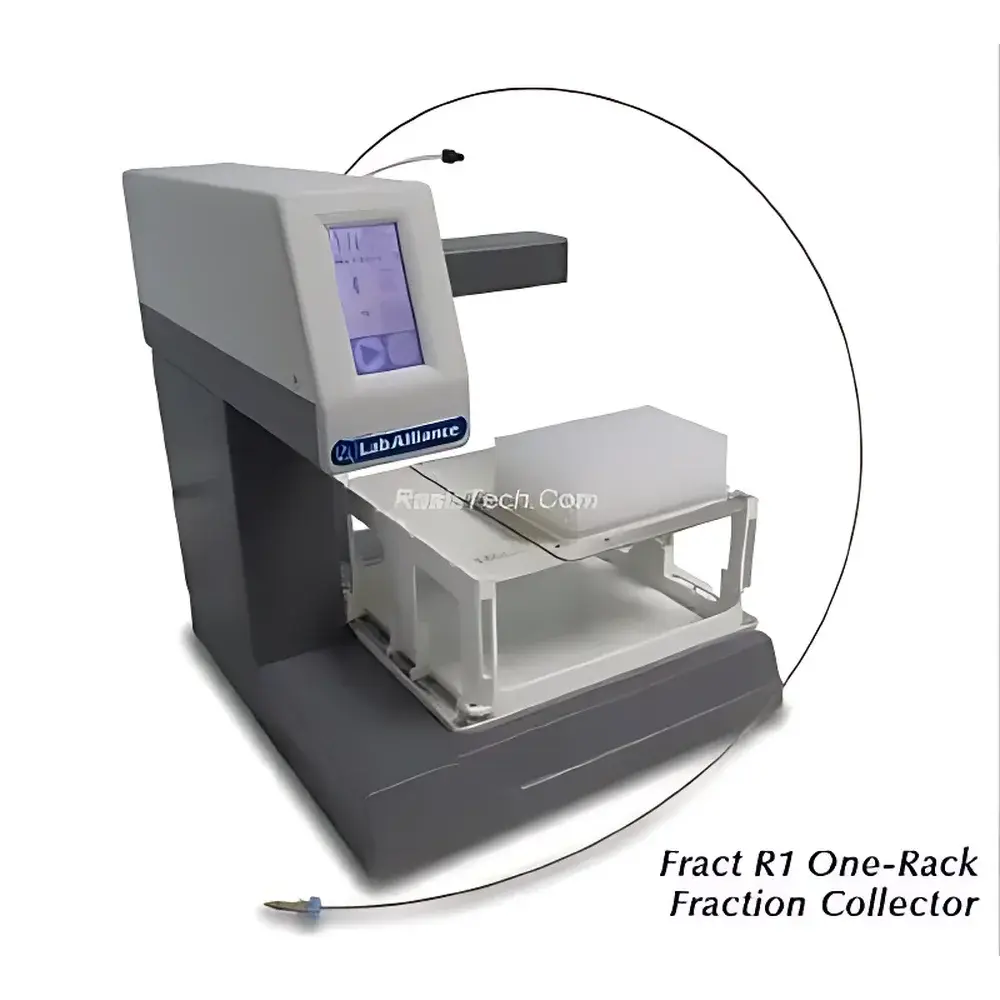
Laballiance Fract R1 Fraction Collector
| Brand | Laballiance |
|---|---|
| Origin | USA |
| Model | R1 |
| Dimensions | 35.6 × 31.1 × 33.0 cm (H×W×D) |
| Weight | 7.7 kg (without rack) |
| Max Flow Rate | 100 mL/min |
| Delay Volume | Micro-liter level (valve positioned at outlet of flow path) |
| Communication | Ethernet (TCP/IP) & RS-232 |
| Power | 100/117 VAC or 234 VAC, 50/60 Hz |
| Rack Options | 144×12 mm tubes |
Overview
The Laballiance Fract R1 Fraction Collector is a precision-engineered, benchtop fraction collection system designed for integration with preparative liquid chromatography (prep-LC), flash chromatography, and biomolecule purification workflows. It operates on a timed or peak-triggered collection principle, utilizing a high-speed, low-dead-volume switching valve positioned directly at the column effluent outlet—minimizing system dwell volume and preserving chromatographic integrity during fractionation. Its modular rack architecture supports diverse vessel formats without mechanical adaptation, enabling seamless transitions between small-scale peptide purification (e.g., 1.5 mL microtubes) and large-volume protein elution (e.g., 50 mL centrifuge tubes). Built for reproducibility in regulated environments, the Fract R1 delivers deterministic fraction timing with sub-second valve actuation and real-time status feedback via its integrated control interface.
Key Features
- Robust cast-aluminum chassis providing mechanical stability and thermal inertia for consistent operation across extended runs.
- Intuitive icon-driven touchscreen interface with graphical display of active rack layout, current fraction position, elapsed time, and valve status.
- Low-delay-volume fluidic design: switching valve mounted at the flow path exit reduces extra-column dispersion; total delay volume is limited to tubing contribution only—critical for sharp peak collection in gradient separations.
- Dual communication protocols: native Ethernet connectivity (TCP/IP) enables remote monitoring and control via laboratory network infrastructure; RS-232 serial port supports legacy instrument integration and PLC-based automation.
- Scalable rack compatibility: accepts eight standardized tube/vial configurations—from 12 mm test tubes (144-position) to 28 mm diameter sample vials (36-position)—all accommodated within the same footprint without hardware modification.
- Compliant power supply: auto-sensing 100–234 VAC input (50/60 Hz) ensures global deployment readiness without voltage conversion hardware.
Sample Compatibility & Compliance
The Fract R1 supports analytical and preparative-scale fractionation across pharmaceutical, academic, and biotechnology laboratories. Its rack geometry and valve timing are validated for use with common chromatographic solvents (including acetonitrile, methanol, aqueous buffers, and DMSO-containing mobile phases) and biological matrices (e.g., cell lysates, affinity-purified antibodies, synthetic peptides). While not certified as GMP-compliant out-of-the-box, the system’s deterministic collection logic, audit-ready event logging (via Ethernet-connected host software), and support for external TTL or analog trigger inputs make it suitable for GLP-aligned workflows. When integrated with chromatography data systems (CDS) that comply with FDA 21 CFR Part 11, the Fract R1 contributes to traceable, time-stamped fraction metadata generation—including start/stop times, valve actuation events, and rack position indices.
Software & Data Management
The Fract R1 operates autonomously via its embedded firmware but is fully interoperable with third-party chromatography software platforms through standardized communication protocols. Ethernet-based TCP/IP control allows integration with Empower, Chromeleon, OpenLAB CDS, or custom Python/Node.js scripts using socket-level commands. All collection events—including fraction start time, duration, tube index, and trigger source (timer, UV threshold, or external signal)—are timestamped with millisecond resolution and can be logged to a network-accessible CSV or JSON endpoint. No proprietary software license is required for basic operation; optional Laballiance-developed configuration utilities provide rack mapping visualization and method export/import functionality for method transfer between instruments.
Applications
- Preparative HPLC and flash chromatography fraction collection for natural product isolation, synthetic intermediate purification, and metabolite enrichment.
- Protein and peptide purification workflows involving ion exchange, size exclusion, or reversed-phase chromatography—particularly where low dead volume and precise retention-time alignment are essential.
- Automated multi-step fraction pooling strategies (e.g., combining early-eluting impurities into waste, collecting target peaks into discrete tubes, and diverting late-eluting aggregates to separate containers).
- Method development studies requiring parallel collection across multiple rack types to evaluate solvent compatibility, evaporation rates, or downstream assay suitability.
- Integration into automated purification platforms (e.g., alongside fraction-evaporators or robotic liquid handlers) via TTL synchronization and Ethernet command scripting.
FAQ
Does the Fract R1 support external UV or conductivity triggers?
Yes—the system accepts TTL-level digital signals (5 V logic) and analog voltage inputs (0–10 V) for peak-triggered collection, compatible with most commercial UV-Vis detectors and conductivity meters.
Can I change racks mid-run without interrupting collection?
No—rack replacement requires pausing the collection sequence and manually reinitializing the position counter; however, the system retains all prior fraction metadata and resumes indexing from the next available tube upon restart.
Is the switching valve chemically resistant to aggressive solvents?
The standard valve uses PEEK and stainless steel wetted materials, rated for compatibility with HPLC-grade organic solvents, dilute acids/bases (pH 2–12), and common buffer systems; halogenated solvents (e.g., chloroform, DCM) require optional Hastelloy components.
What is the minimum programmable fraction duration?
The shortest user-defined collection interval is 0.1 seconds, limited by valve actuation speed and firmware cycle time—not by mechanical constraints.
Is firmware update capability available over Ethernet?
Yes—firmware upgrades are delivered as signed binary packages and installed via secure HTTP POST to the device’s embedded web server, with rollback support and version verification.
Related Products





