
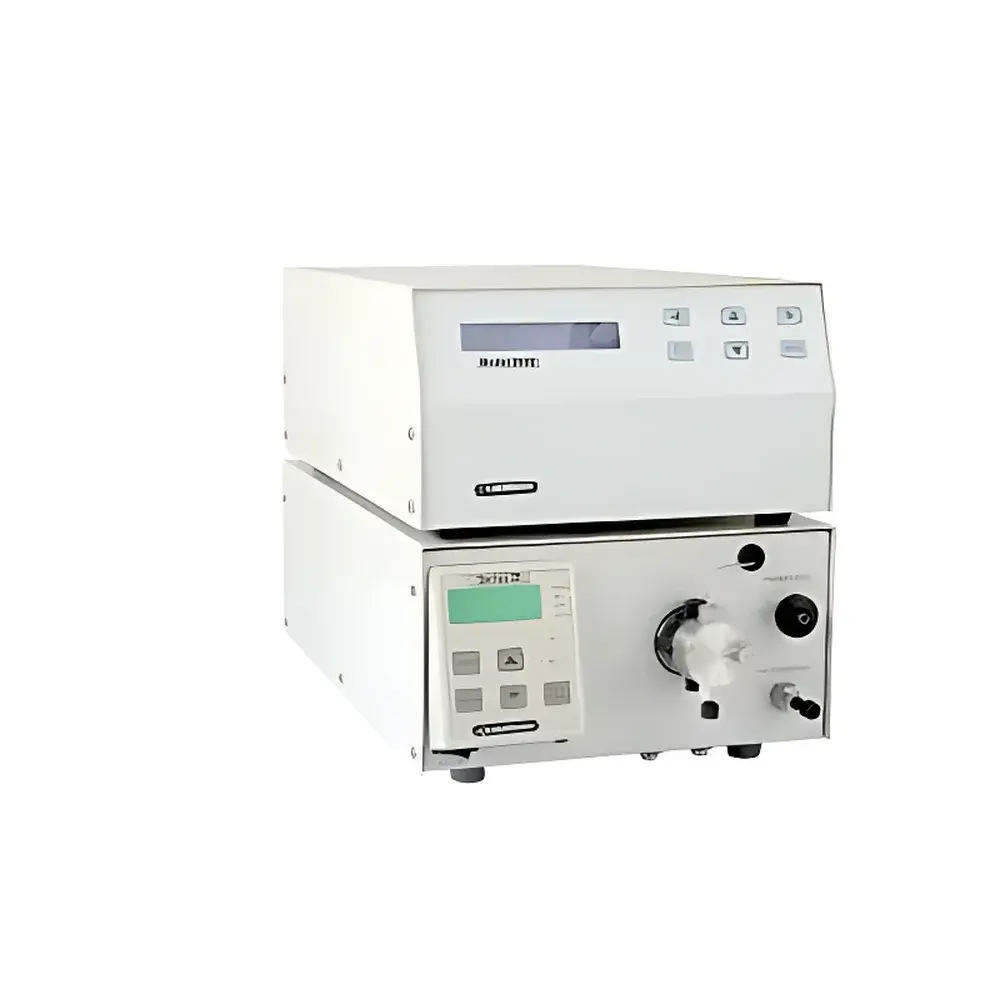
Laballiance PC-2000 Single-Channel HPLC System
| Brand | Laballiance |
|---|---|
| Origin | USA |
| Model | PC-2000 |
| Instrument Type | Conventional High-Performance Liquid Chromatograph |
| Flow Rate Range | 0.001–40 mL/min |
| Maximum Pressure | 6000 psi |
| Sample Injection Positions | 120 |
| Injection Volume Range | 1–100 µL |
| Column Oven Temperature Range | (Ambient + 10 °C) to 99 °C |
| UV-Vis Wavelength Range | 190–800 nm |
| Data Acquisition Frequency | 100 Hz |
Overview
The Laballiance PC-2000 Single-Channel HPLC System is a robust, entry-level high-performance liquid chromatography platform engineered for precision, reliability, and operational simplicity in routine analytical environments. Designed around classical isocratic elution principles, the system employs a single high-pressure reciprocating pump coupled with a fixed-wavelength or variable-wavelength UV-Vis detector to deliver consistent retention time reproducibility and baseline stability across extended run sequences. Its architecture follows established ASTM D7215 and ISO 17025-aligned design practices for chromatographic instrumentation—emphasizing mechanical rigidity, low dwell volume (< 500 µL), and thermally stable fluidic pathways. The system is purpose-built for laboratories requiring regulatory-compliant data integrity in QC/QA workflows, academic method development, and stability-indicating assays where gradient complexity is not required at initial deployment. Its modular construction allows seamless future expansion to binary gradient capability without hardware replacement of the core pump or detector.
Key Features
- Patented low-dead-volume pulse-dampening pump technology delivering true pulse-free flow across the full 0.001–40 mL/min range—validated per USP flow pulsation criteria;
- Triple-range flow calibration modes (0.001–5 mL/min, 0.01–10 mL/min, 0.1–40 mL/min) enabling precise control for both analytical-scale separations and semi-preparative applications;
- Sapphire-coated piston rods with integrated online piston seal cleaning mechanism—extending service intervals beyond 10,000 injections under standard mobile phase conditions;
- Type III pump configuration featuring real-time pressure transduction with ±0.5% FS accuracy and digital pressure readout directly on front-panel display;
- Thermostatically controlled column compartment maintaining temperature uniformity within ±0.3 °C across the 10–99 °C operating range—critical for retention time repeatability in GLP-compliant studies;
- UV-Vis detector with 190–800 nm spectral coverage, 100 Hz data acquisition rate, and <0.0005 AU/hr baseline drift specification (measured at 254 nm, 1 s response time);
- 120-position autosampler with programmable injection volume (1–100 µL), needle wash station, and sealed sample tray to minimize solvent evaporation during unattended operation.
Sample Compatibility & Compliance
The PC-2000 supports reversed-phase, normal-phase, ion-exchange, and size-exclusion chromatographic modes when paired with appropriate columns (e.g., C18, phenyl-hexyl, silica, or SEC standards). It accommodates common HPLC solvents including water, acetonitrile, methanol, THF, and chloroform—compatible with both aqueous and organic mobile phases up to 100% strength. All wetted components are chemically resistant stainless steel (316 SS) or PEEK, ensuring compatibility with pH 1.5–12 mobile phases over extended use. The system meets essential requirements for FDA 21 CFR Part 11 compliance when operated with Laballiance ChromaLink™ software configured with audit trail, electronic signature, and user role management. It is routinely deployed in laboratories adhering to ISO/IEC 17025, USP , and ICH Q2(R2) validation frameworks for method transfer and system suitability testing.
Software & Data Management
Controlled exclusively via Laballiance ChromaLink™ v4.x workstation software, the PC-2000 provides full instrument control, sequence definition, real-time chromatogram visualization, peak integration, and report generation. ChromaLink™ implements secure database architecture with encrypted project files, timestamped raw data storage (.lcd format), and configurable PDF report templates aligned with ALCOA+ principles. Audit trail functionality records all parameter changes, method modifications, and user logins with immutable timestamps. Data export options include CSV, AIA (.cdf), and XML formats for LIMS integration. Software validation packages—including IQ/OQ documentation, test scripts, and traceability matrices—are available upon request for GxP-regulated environments.
Applications
- Routine quality control of pharmaceutical actives and excipients per USP monographs;
- Purity assessment and assay quantification in small-molecule synthesis labs;
- Stability-indicating method development for forced degradation studies;
- Food additive analysis (e.g., preservatives, sweeteners, colorants) per AOAC 995.12 protocols;
- Environmental contaminant screening (e.g., PAHs, pesticides) using EPA Method 8330B-compatible conditions;
- Academic teaching platforms for chromatography fundamentals, calibration curve construction, and resolution optimization exercises.
FAQ
Can the PC-2000 be upgraded to a binary gradient system?
Yes—the system’s pump manifold and electronics architecture support field upgrade to a dual-pump binary gradient configuration using Laballiance’s certified retrofit kit (P/N GRAD-PC2000-BIN). No chassis modification or detector replacement is required.
Is the UV detector capable of wavelength scanning?
The standard detector operates in fixed-wavelength or time-programmed wavelength-switching mode. Optional diode-array detection (DAD) modules are available as field-installable upgrades with 190–800 nm full-spectrum acquisition capability.
What column dimensions are supported by the integrated column oven?
The oven accommodates standard analytical columns up to 250 mm length × 4.6 mm ID, as well as narrow-bore (2.1 mm ID) and semi-preparative (10 mm ID) formats with optional adapter kits.
Does the system meet GLP audit requirements?
When deployed with ChromaLink™ in validated configuration—including enabled audit trail, electronic signatures, and documented change control procedures—the PC-2000 satisfies core GLP data integrity expectations per OECD Principles of Good Laboratory Practice.
What maintenance intervals are recommended for the pump seals?
Under typical use (acetonitrile/water mobile phases, ≤4000 psi average pressure), sapphire piston seals require inspection every 6 months and replacement every 12–18 months—significantly extending service life compared to conventional ceramic or ruby alternatives.





