
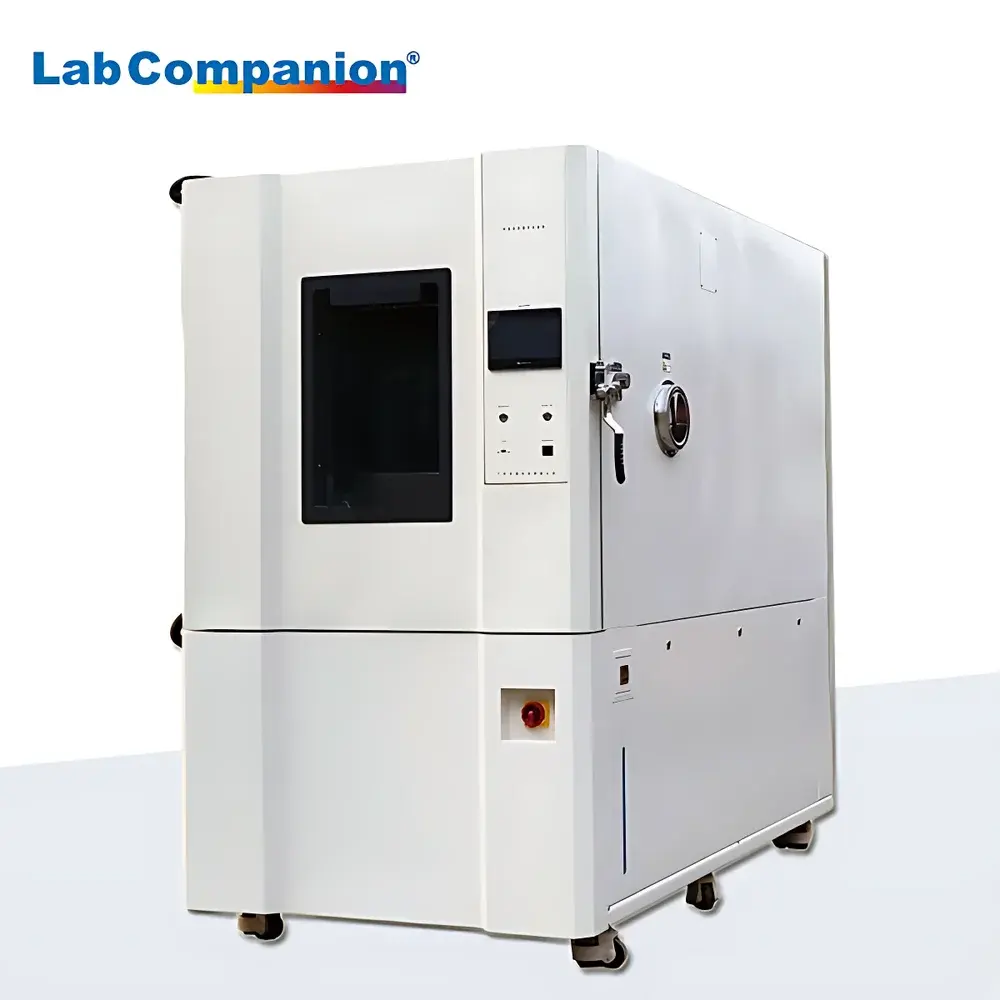
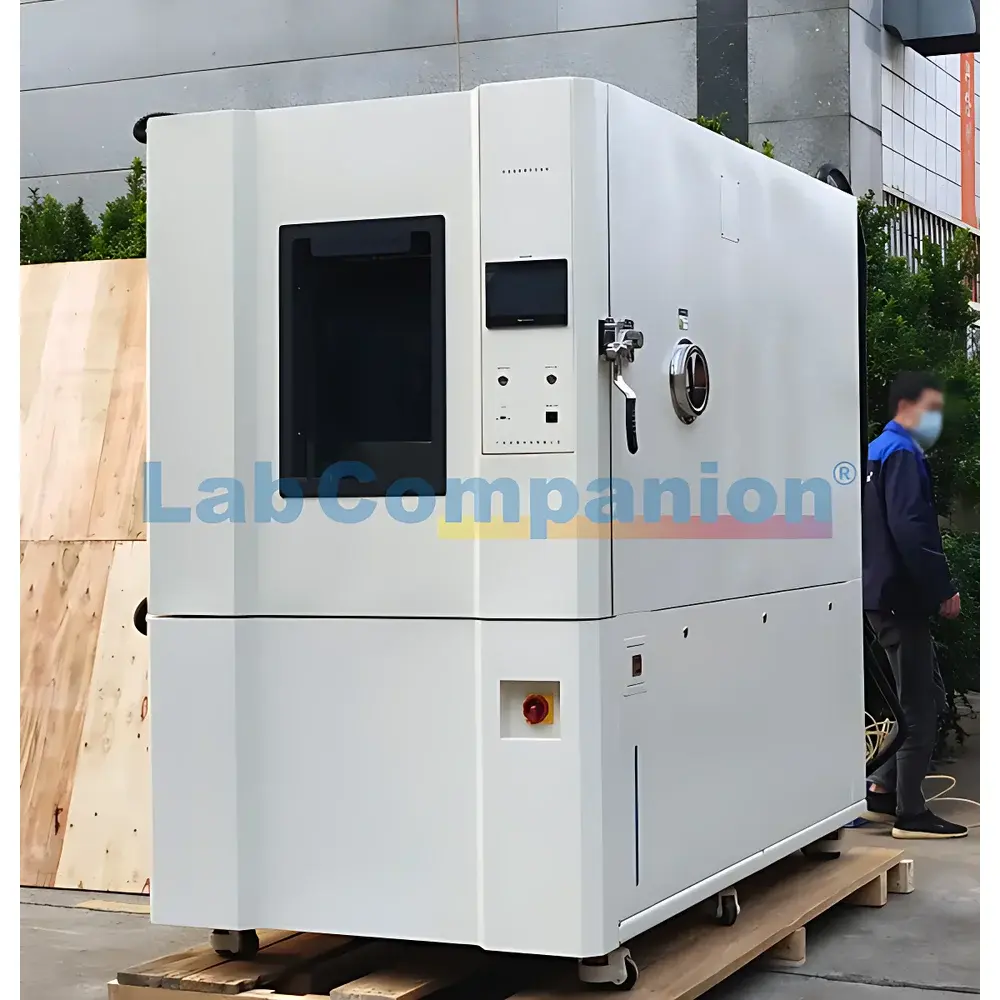
LabCompanion TH-608-12 Temperature Cycling Test Chamber
| Brand | LabCompanion |
|---|---|
| Origin | Guangdong, China |
| Manufacturer | Hongzhan Technology Co., Ltd. |
| Model | TH-608-12 |
| Temperature Range | −70 °C to +150 °C |
| Temperature Fluctuation | ±0.5 °C |
| Temperature Uniformity | ≤2.0 °C |
| Temperature Deviation | ±2.0 °C |
| Heating Rate | 1–25 °C/min (linear or non-linear) |
| Cooling Rate | 1–25 °C/min (linear or non-linear) |
| Internal Chamber Dimensions | 800 × 950 × 800 mm (W × H × D) |
Overview
The LabCompanion TH-608-12 Temperature Cycling Test Chamber is an engineered environmental simulation system designed for rigorous thermal stress evaluation of materials, components, and electronic assemblies under controlled, repeatable, and programmable temperature profiles. Based on forced-air convection with dual-stage refrigeration and high-efficiency electric heating, the chamber delivers precise thermal transitions across a wide operational range from −70 °C to +150 °C. Its architecture supports both linear and non-linear ramping protocols—critical for simulating real-world thermal cycling conditions encountered in aerospace qualification, automotive electronics validation, semiconductor reliability screening (e.g., JEDEC JESD22-A104), and accelerated aging per MIL-STD-810H Method 503.5. The chamber complies with structural and performance requirements aligned with IEC 60068-2-14 (Test N: Change of Temperature) and ISO 16750-4 (Road vehicles — Environmental conditions and testing for electrical and electronic equipment).
Key Features
- High-fidelity thermal control with ±0.5 °C fluctuation and ≤2.0 °C uniformity across the 800 × 950 × 800 mm working volume—validated per ASTM E744 and IEC 60068-3-5
- Programmable ramp rates from 1 to 25 °C/min in both heating and cooling directions, enabling compliance with rapid thermal cycling (RTC) test profiles required by AEC-Q200 and IPC-9701
- Dual-stage cascade refrigeration system with environmentally compliant R404A/R23 mixed refrigerant, ensuring stable sub-zero operation down to −70 °C without liquid nitrogen dependency
- Industrial-grade stainless-steel interior with reinforced insulation, corrosion-resistant exterior cladding, and sealed door gasketing for long-term stability and low leakage rate
- Integrated safety interlocks including over-temperature cutoff, compressor high-pressure protection, and door-open alarm—certified to UL 61010-1 and CE EN 61000-6-2/6-3
- Modular controller architecture supporting optional Ethernet/IP, RS485 Modbus RTU, and USB data logging interfaces
Sample Compatibility & Compliance
The TH-608-12 accommodates samples up to 50 kg load capacity (distributed), with unobstructed airflow design ensuring representative thermal exposure for PCBs, battery modules, sensors, optoelectronic packages, and molded plastic housings. It meets the physical and procedural prerequisites for GLP-compliant environmental testing when operated with validated calibration records and audit-trail-enabled software (see Software & Data Management). Chamber performance verification adheres to ISO/IEC 17025-accredited calibration practices, with traceable NIST-traceable reference sensors. Routine qualification follows internal SOPs aligned with ISO 17025 Annex C and ASTM E2293 for thermal chamber verification.
Software & Data Management
The standard LabCompanion TC-Studio v3.2 control software provides intuitive profile programming, real-time multi-channel monitoring (chamber setpoint, chamber actual, load sensor input), and automated pass/fail logic based on user-defined tolerance bands. All operational events—including setpoint changes, alarms, power interruptions, and manual interventions—are time-stamped and logged with operator ID tagging. Audit trail functionality satisfies FDA 21 CFR Part 11 requirements when configured with electronic signatures and role-based access control. Raw data export is supported in CSV and XML formats; optional integration with LIMS platforms via OPC UA or RESTful API enables centralized test data governance in regulated QA/QC environments.
Applications
- Thermal cycling qualification of automotive ECUs per ISO 16750-4 and GMW3172
- Reliability assessment of lithium-ion battery cells and packs under repeated charge/discharge thermal stress
- Pre-conditioning of optical components prior to vibration or shock testing
- Material coefficient-of-thermal-expansion (CTE) characterization via dimensional metrology during controlled ramp-hold cycles
- Validation of conformal coating integrity and solder joint fatigue resistance in avionics assemblies
- Environmental stress screening (ESS) of high-reliability electronics for defense and space applications (MIL-STD-883 Method 1010)
FAQ
What is the maximum sample weight the TH-608-12 can accommodate without compromising thermal uniformity?
The chamber maintains specified uniformity and stability with up to 50 kg of thermally inert mass evenly distributed on the standard stainless-steel shelf. Load-specific validation is recommended for high-thermal-mass or low-emissivity samples.
Does the system support custom thermal profiles with hold times, dwell steps, and conditional branching?
Yes—TC-Studio v3.2 supports up to 99 segments per profile, including ramps, holds, loops, and jump-to-step commands. Conditional logic (e.g., “if T > 120 °C then trigger external relay”) is available in advanced license mode.
Is third-party calibration and IQ/OQ/PQ documentation available?
LabCompanion provides factory IQ/OQ documentation templates and partners with ISO/IEC 17025-accredited service providers for on-site PQ execution and certified calibration reports traceable to national standards.
Can the chamber be integrated into an existing MES or test automation framework?
Yes—via Modbus TCP, OPC UA, or HTTP-based REST API, the controller supports bi-directional communication for start/stop command, parameter readback, and status polling within automated test sequences.
What maintenance intervals are recommended for optimal long-term performance?
Compressor oil and filter replacement every 24 months; condenser coil cleaning quarterly; annual verification of sensor drift and refrigerant charge pressure—per maintenance schedule outlined in the Technical Manual Rev. 4.1.



