
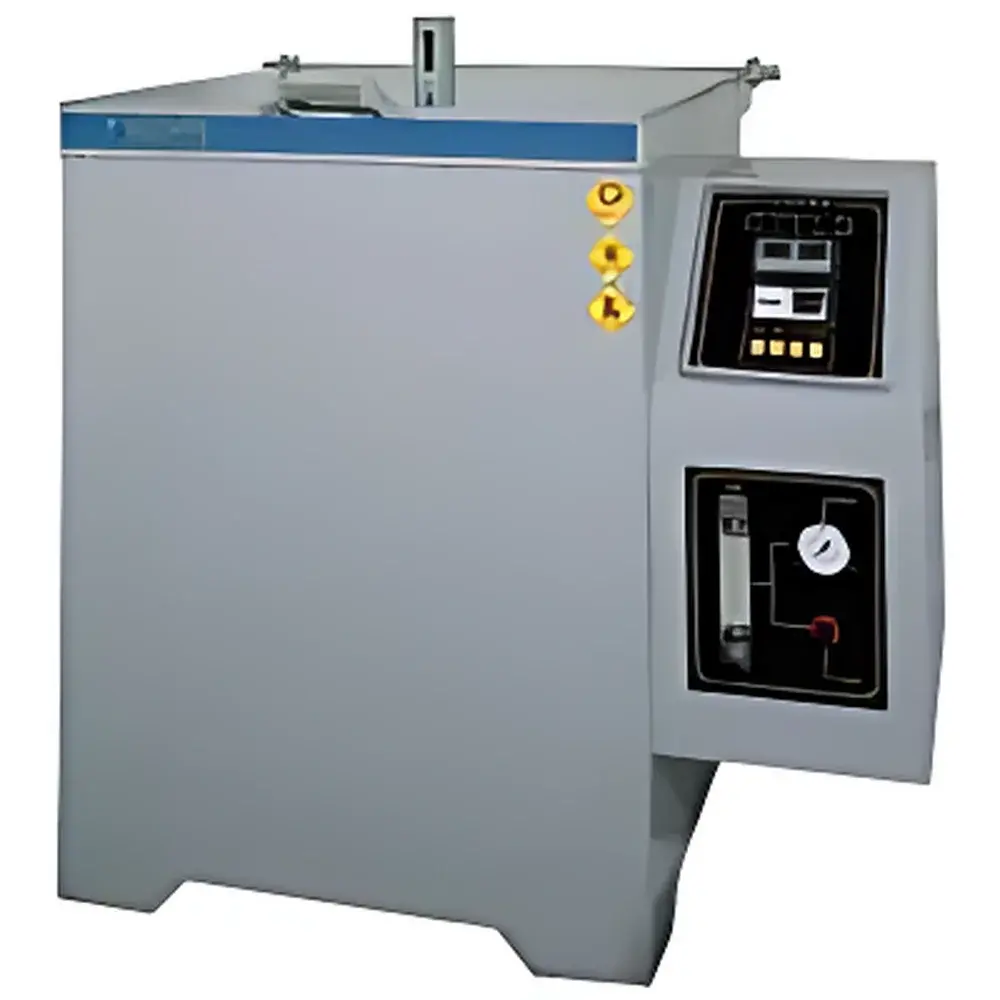
LabCompanion HC-80 High-Low Constant Temperature Chamber
| Brand | LabCompanion |
|---|---|
| Origin | Guangdong, China |
| Manufacturer Type | Direct Manufacturer |
| Product Category | Domestic |
| Model | HC Series |
| Pricing | Upon Request |
| Internal Volume | 80 L |
| Internal Dimensions (W×H×D) | 400 × 500 × 400 mm |
| Temperature Range | 0 to +150 °C |
| Temperature Uniformity | ≤ ±2.0 °C |
| Temperature Fluctuation | ±0.5 °C |
| Heating Rate | 0 → +150 °C in ≤20 min (~3 °C/min) |
| Cooling Rate | +20 → 0 °C in ≤20 min (~1 °C/min) |
| Refrigerant | R507 (HFC-based, ozone-friendly) |
| Control System | VT9620 Fixed-Setpoint PID Controller (Taiwan-made, LED display, ±0.1 °C resolution) |
| Construction | SUS304 stainless steel interior & exterior with powder-coated cold-rolled steel option |
| Insulation | High-density polyurethane foam + fiberglass |
| Cooling Method | Single-stage or cascade mechanical compression (air-cooled condenser) |
| Safety Protections | Independent over-temperature cut-off, low-water alarm, compressor overload/overcurrent protection, high-pressure refrigerant switch, earth leakage circuit breaker, phase failure detection |
Overview
The LabCompanion HC-80 High-Low Constant Temperature Chamber is an engineered environmental test system designed for precise, stable thermal conditioning of industrial components and materials under controlled static temperature conditions. It operates on the principle of forced-air convection thermoregulation, integrating a dual-mode refrigeration architecture—either single-stage or cascade compression—to ensure reliable performance across its full operational range of 0 to +150 °C. Unlike cycling chambers, the HC-80 is optimized for fixed-setpoint operation, delivering high thermal stability (±0.5 °C fluctuation) and uniformity (≤±2.0 °C deviation) within its 80 L working volume. Its design supports long-duration storage, transport simulation, and functional evaluation of electronic assemblies—including PCBs, lithium-ion batteries, LCD modules, optical fibers, and semiconductor packaging—under sustained thermal stress without humidity modulation.
Key Features
- Energy-efficient architecture reducing power consumption by up to 30% and water usage by 20% versus conventional units, enabled by intelligent load-matching algorithms and high-efficiency compressors.
- Imported hermetic rotary compressors (European and U.S.-sourced), paired with environmentally compliant R507 refrigerant, meeting global ODP-zero and low-GWP regulatory requirements.
- Robust chamber construction using electropolished SUS304 stainless steel for internal surfaces and either SUS304 or electrostatically coated cold-rolled steel for external cladding—ensuring corrosion resistance and cleanroom-compatible surface integrity.
- Dual independent thermal circuits with BTHC (Balanced Thermal Heat Compensation) regulation enable simultaneous yet decoupled heating and cooling actuation, minimizing overshoot and stabilizing setpoints rapidly.
- Optimized airflow management via centrifugal blower and multi-directional ducting eliminates thermal stratification and dead zones, achieving ≥90% volumetric temperature uniformity per IEC 60068-3-5.
- Taiwan-sourced VT9620 fixed-setpoint controller featuring LED display, ±0.1 °C resolution, auto-tuning PID logic, selectable forward/reverse control action, and real-time thermal ramp visualization.
- Comprehensive safety layering: independent over-temperature cutoff (mechanical backup), refrigerant high-pressure switch, phase-loss detection, earth leakage protection, and automatic fault-lockout with audible/visual alarm.
Sample Compatibility & Compliance
The HC-80 accommodates standard test specimens up to 400 mm (W) × 500 mm (H) × 400 mm (D), with two adjustable stainless-steel shelves and a 50 mm diameter cable port fitted with silicone gasketing for signal or power feedthrough. It complies with key international and national standards governing thermal testing integrity, including GB/T 10589–1989 (Low-Temperature Test Chamber Specifications), GB/T 10592–1989 (High-Low Temperature Chamber Requirements), GB/T 2423.1–2021 (Test Aa/Ab: Cold), GB/T 2423.2–2021 (Test Bb: Dry Heat), and MIL-STD-810G Method 502.2 (Low Temperature) and Method 507.2 (Temperature Shock). While not inherently humidity-controlled, its thermal profile repeatability supports GLP-aligned validation protocols when used in conjunction with documented calibration procedures traceable to NIST or CNAS-accredited laboratories.
Software & Data Management
As a fixed-setpoint system, the HC-80 does not include embedded data logging or network connectivity in its base configuration. However, it supports optional RS-485/Modbus RTU communication interface for integration into centralized facility monitoring systems (e.g., SCADA or MES platforms). When equipped with the programmable controller upgrade, users gain access to time-stamped event logs—including setpoint changes, alarm triggers, and safety interlock activations—with audit trail capability suitable for basic GMP documentation needs. All firmware operations adhere to deterministic real-time execution principles, ensuring no race conditions or control loop latency during extended unattended operation.
Applications
The HC-80 serves as a foundational tool in quality assurance and reliability engineering workflows across electronics manufacturing, aerospace component qualification, automotive ECU validation, and medical device material screening. Typical use cases include pre-conditioning of solder paste prior to reflow profiling, accelerated aging of polymer encapsulants under thermal soak, burn-in stabilization of MEMS sensors, thermal shock pre-screening of optoelectronic subassemblies, and shelf-life verification of battery electrolyte formulations. Its rapid thermal response and mechanical durability make it especially suited for production-line incoming inspection labs where throughput, repeatability, and minimal operator intervention are critical.
FAQ
What is the difference between “constant temperature” and “temperature cycling” operation in this chamber?
The HC-80 is engineered exclusively for fixed-setpoint (constant temperature) operation—not programmable ramp-and-soak or cycling profiles. Its control architecture and thermal mass are optimized for stability, not dynamic transitions.
Can the HC-80 be validated for ISO/IEC 17025-compliant calibration?
Yes—when paired with third-party accredited temperature mapping services (using ≥9-point sensor arrays per IEC 60068-3-5), the chamber meets traceability and uncertainty requirements for laboratory accreditation.
Is R507 refrigerant compatible with standard service infrastructure?
R507 is a zeotropic blend requiring dedicated recovery equipment and certified technicians; it is not interchangeable with R404A or R134a systems without component replacement.
Does the unit support external data acquisition via analog output?
No analog voltage/current outputs are provided natively; only digital Modbus RTU (RS-485) is available as an optional add-on.
What maintenance intervals are recommended for optimal long-term performance?
Compressor oil analysis every 2,000 operating hours, condenser coil cleaning quarterly, and annual verification of safety interlocks and sensor calibration against reference standards.



