
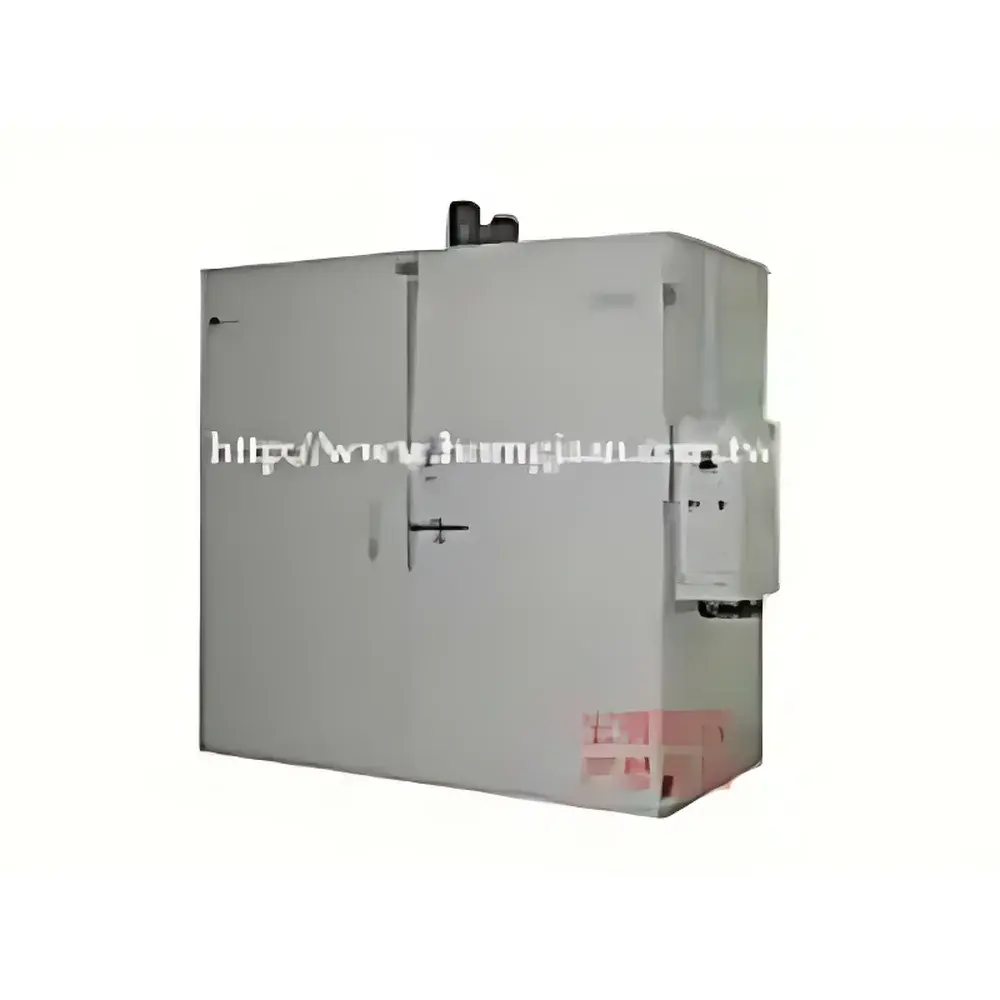
LabCompanion HH Series 5 Large-Scale High-Temperature Aging Oven
| Brand | LabCompanion |
|---|---|
| Model | HH Series 5 |
| Type | Forced-Air High-Temperature Aging Test Chamber |
| Temperature Range | RT+10°C to 300°C |
| Temperature Uniformity | ±3°C (at 200°C, steady state) |
| Temperature Fluctuation | ±0.5°C |
| Temperature Resolution | 0.1°C |
| Heating Rate | RT to 100°C in ≤15 min |
| Max Operating Temp | 300°C |
| Internal Dimensions (W×D×H) | 450 × 550 × 550 mm |
| External Dimensions (W×D×H) | 600 × 710 × 845 mm |
| Standard Shelves | 2 adjustable stainless steel trays |
| Power Supply | AC 220 V, 50 Hz |
| Rated Power | 1.8 kW |
| Controller | Microprocessor-based digital PID temperature controller with timer (1–9999 min) |
| Interface | RS485 for data logging and PC connectivity |
| Construction | Interior – mirror-finish SUS430 stainless steel (≥1.2 mm) |
Overview
The LabCompanion HH Series 5 Large-Scale High-Temperature Aging Oven is a precision-engineered environmental test chamber designed for accelerated thermal aging, moisture removal, pre-baking of components, and long-duration stability testing in R&D laboratories, quality control departments, and manufacturing facilities. It operates on the principle of forced-air convection, utilizing a high-reliability centrifugal blower capable of continuous operation at elevated temperatures—up to 300°C—to ensure uniform heat distribution throughout the working chamber. The chamber’s thermal architecture follows DIN-compliant design principles inspired by legacy German industrial oven standards, emphasizing structural rigidity, thermal inertia minimization, and long-term calibration stability. Unlike basic drying cabinets, this unit integrates metrologically traceable temperature control with real-time monitoring capabilities, making it suitable for applications requiring adherence to ASTM D5422, ISO 188, IEC 60068-2-2, and MIL-STD-810H thermal aging protocols.
Key Features
- Robust dual-wall construction: 1.2 mm thick mirror-finished SUS430 stainless steel interior welded via TIG process for corrosion resistance and cleanability; 1.5 mm SECC exterior with electrostatic epoxy powder coating for mechanical durability and chemical resistance.
- Precision temperature regulation: Microprocessor-based PID controller with 0.1°C resolution, ±0.5°C fluctuation tolerance, and programmable timer (1–9999 minutes), supporting unattended overnight or multi-day aging cycles.
- Optimized airflow dynamics: Horizontally oriented recirculating duct system with tangential inlet and rear-mounted high-temp fan ensures laminar, turbulence-free air movement—critical for minimizing thermal gradients across large sample loads.
- Thermal integrity engineering: 100 mm thick ultra-fine glass fiber insulation (thermal conductivity <0.04 W/m·K at 200°C) combined with compression-molded silicone door gasket maintains consistent chamber integrity under repeated thermal cycling.
- Industrial connectivity: Standard RS485 interface compliant with Modbus RTU protocol enables integration with SCADA systems, centralized lab data loggers, or custom Python/LabVIEW acquisition software for audit-ready temperature history recording.
Sample Compatibility & Compliance
The HH Series 5 accommodates bulk samples including printed circuit boards (PCBs), polymer composites, battery cell modules, ceramic substrates, and coated metal specimens—up to 35 kg total load capacity. Its internal volume (0.136 m³) supports stacked trays or custom fixtures without compromising airflow symmetry. All materials in contact with the chamber interior meet RoHS Directive 2011/65/EU restrictions. The unit complies with EN 61000-6-3 (EMC emission) and EN 61000-6-2 (immunity), and its temperature performance is validated per ISO/IEC 17025-accredited procedures using NIST-traceable reference thermometers. Optional IQ/OQ documentation packages are available to support GLP and GMP validation workflows per FDA 21 CFR Part 11 requirements.
Software & Data Management
While the embedded controller provides local setpoint management and real-time display of measured vs. target temperature, full data traceability is achieved through third-party logging solutions interfaced via RS485. Users may deploy open-source tools such as QCustomPlot-based dashboards or commercial platforms like WinCC OA or LabVIEW DAQmx to acquire time-stamped temperature profiles with millisecond-level timestamp resolution. Audit trails include operator ID (via optional RFID login), parameter change logs, alarm event timestamps, and automatic CSV export—enabling compliance with ISO 9001 clause 8.5.2 (Identification and traceability) and ISO 13485 clause 7.5.10 (Production process verification records).
Applications
- Accelerated life testing of elastomers, adhesives, and encapsulants per ASTM D865 and ISO 11358.
- Pre-conditioning of lithium-ion battery electrodes prior to calendaring or cell assembly.
- Residual solvent removal from pharmaceutical tablet coatings under controlled thermal ramping (USP <661>).
- Stress-relief annealing of machined aluminum housings used in aerospace avionics enclosures.
- Calibration reference chamber for secondary temperature sensors in metrology labs.
FAQ
What is the maximum allowable ambient temperature for continuous operation?
The unit is rated for uninterrupted use in environments between +5°C and +40°C, with relative humidity ≤80% non-condensing.
Can the chamber be operated under inert gas purging?
Yes—two dedicated 6 mm NPT ports (inlet and exhaust) are provided for nitrogen or argon purging; optional mass flow controller integration is supported.
Is the temperature sensor calibrated at point-of-sale?
Each unit ships with a factory calibration certificate referencing PT100 output against a Fluke 1524 thermometer at three points (100°C, 200°C, 300°C), traceable to NIST standards.
Does the controller support ramp-soak programming?
No—the standard microcontroller supports only single-setpoint operation with timer-based shutdown; multi-segment profiling requires external PLC integration via RS485.
What maintenance intervals are recommended for optimal thermal performance?
Blower motor bearings should be inspected every 12 months; door gasket integrity must be verified quarterly; and chamber uniformity mapping (per ISO 17025 Annex C) is advised biannually for regulated environments.
Related Products



