
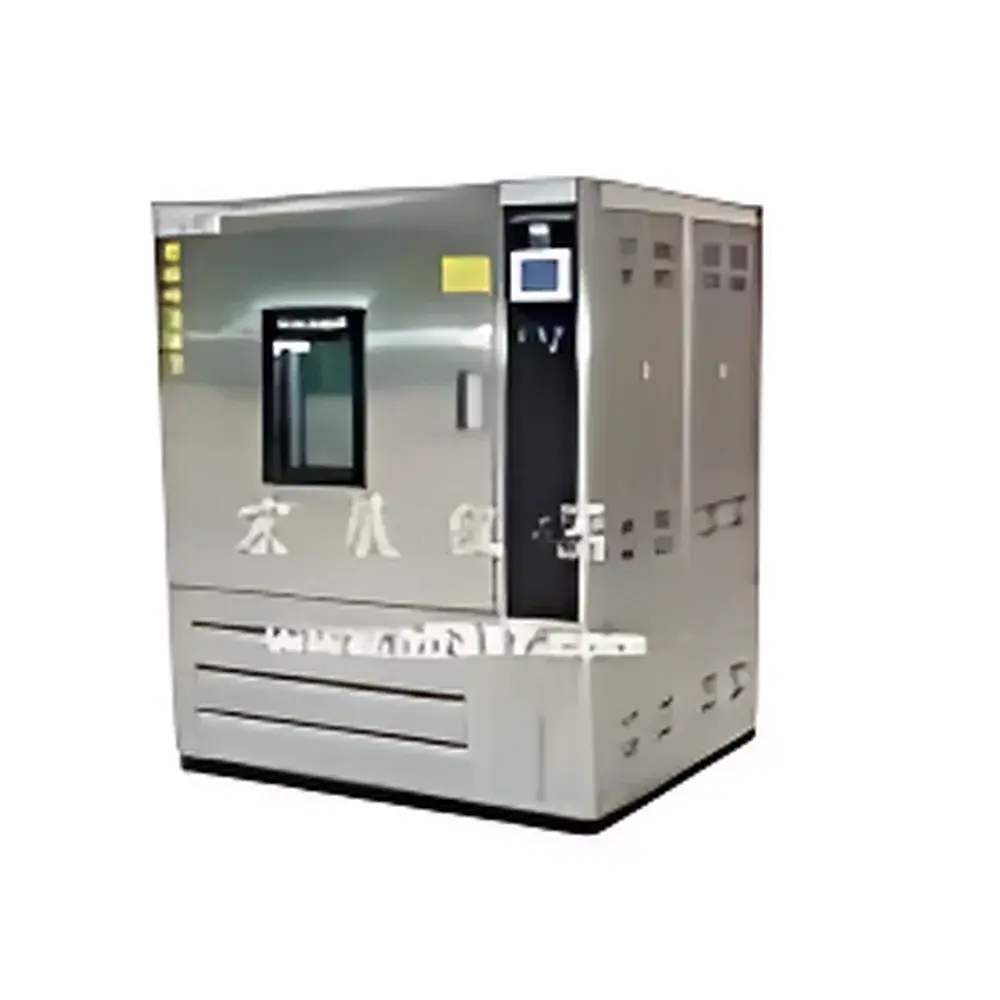
LabCompanion LC Series Programmable Thermal Cycling Environmental Test Chamber
| Brand | LabCompanion |
|---|---|
| Model | LC |
| Origin | Guangdong, China |
| Manufacturer | Yes |
| Country of Origin | China |
| Temperature Range Options | −70 °C to 150 °C (customizable) |
| Temperature Uniformity | ≤ ±2 °C |
| Temperature Fluctuation | ±0.5 °C |
| Ramp Rate | 0.7–1.0 °C/min (average) |
| Time Setting Range | 0–9999 hours |
| Power Supply | AC 380 V |
| Compliance | GB/T 2423.1–2001, GB/T 2423.2–2001, GB/T 2423.4–2001, GB/T 10592–1989, GJB 150.3–1986, GJB 150.4–1986 |
| Refrigeration System | Twin-circuit or single-circuit low-temperature refrigeration with imported components (Danfoss/Embraco compressors optional |
| standard | original French Tecumseh/Tecumseh-derived units) |
| Interior Material | SUS304 stainless steel mirror finish |
| Exterior Material | A3 steel with electrostatic powder coating |
| Viewing Window | Heated, double-layer tempered glass with interior LED lighting |
| Test Port | Φ50 mm |
| Controller | Fuji Electric programmable PID microcomputer controller (18-segment program, repeatable cycles) |
| Display Resolution & Accuracy | ±0.1 °C |
| Safety Protections | Over-temperature, phase loss/reverse-phase, overload, refrigerant high-pressure, timed operation, leakage current, fault-triggered shutdown |
Overview
The LabCompanion LC Series Programmable Thermal Cycling Environmental Test Chamber is an engineered solution for precise, repeatable simulation of dynamic temperature stress conditions in laboratory and industrial quality assurance environments. Designed around a dual-circuit or optimized single-circuit refrigeration architecture—featuring high-reliability compressors (standard: original French Tecumseh units), imported oil separators, electromagnetic valves, sight glasses, and dry filters—the chamber delivers stable thermal performance across wide operating ranges from −70 °C to +150 °C. Its core function is to subject electronic components, automotive modules, aerospace materials, and consumer appliances to controlled, programmable thermal cycling per internationally recognized test protocols. The system operates on the principle of forced-air convection using multi-blade centrifugal fans and symmetrically designed air ducts that ensure uniform temperature distribution (≤ ±2 °C deviation) and rapid recovery (< 5 min typical) after door opening. All structural elements—including the inner chamber (SUS304 stainless steel mirror finish), outer casing (A3 steel with durable powder coating), and heated double-glazed observation window—are fabricated via CNC machining to maintain dimensional integrity and long-term sealing reliability.
Key Features
- Programmable 18-segment thermal profile capability with unlimited cycle repetition, managed via Fuji Electric’s microprocessor-based PID controller offering ±0.1 °C display resolution and adaptive power modulation.
- Multi-zone airflow management system with adjustable inlet/outlet ducting and balanced pressure design to eliminate thermal stratification and ensure spatial uniformity within the working volume.
- Integrated safety architecture including over-temperature cutoff, phase-loss detection, compressor high-pressure lockout, timed operation termination, ground-fault interruption, and automatic fault logging with audible/visual alerts.
- Standard Φ50 mm cable port with silicone gasket seal, enabling real-time monitoring of DUTs under test without compromising chamber integrity.
- Structural rigidity ensured by CNC-formed chassis, non-reactive door handles, and reinforced viewing window assembly with embedded heating elements to prevent condensation during low-temperature operation.
Sample Compatibility & Compliance
The LC Series accommodates a broad spectrum of test specimens—from printed circuit boards and lithium-ion battery packs to polymer housings and sensor assemblies—without requiring mechanical modification of the chamber interior. Its thermal performance conforms to multiple national and military standards, including GB/T 2423.1–2001 (cold testing), GB/T 2423.2–2001 (dry heat), GB/T 2423.4–2001 (temperature cycling), and GB/T 10592–1989 (technical specifications for environmental chambers). It further supports compliance verification against GJB 150.3–1986 (low-temperature) and GJB 150.4–1986 (high-temperature) for defense-related qualification. While not inherently 21 CFR Part 11 compliant, the system supports external data acquisition systems capable of audit-trail generation when paired with validated third-party software and calibrated reference thermocouples traceable to NIST standards.
Software & Data Management
The onboard Fuji controller provides local programming, real-time trend display, and error-code diagnostics but does not include built-in Ethernet or USB export functionality. Optional RS-485 or RS-232 interfaces enable integration with SCADA platforms or custom LabVIEW/Python-based data loggers. For regulatory environments requiring electronic records, users may configure external PLC-linked acquisition modules with timestamped CSV output, password-protected user roles, and configurable alarm thresholds—all aligned with GLP/GMP documentation practices. Printer interface compatibility (via optional parallel port module) permits hard-copy generation of cycle reports and pass/fail summaries for internal QA review.
Applications
This chamber serves as a foundational tool in product development and validation workflows across regulated and non-regulated sectors. In automotive electronics, it validates ECU resilience under repeated thermal shock between −40 °C soak and +85 °C dwell. In medical device manufacturing, it supports accelerated aging studies per ISO 11607 for packaging integrity assessment. Aerospace suppliers use it for component-level screening per RTCA/DO-160 Section 4. Consumer appliance OEMs apply it to verify thermostat calibration stability and plastic housing warpage limits over 1,000-cycle endurance tests. Academic researchers employ its programmability to model diurnal thermal gradients in photovoltaic module degradation studies or polymer crystallization kinetics under modulated cooling ramps.
FAQ
What temperature ranges are available as standard configurations?
Standard models cover −70 °C to +150 °C; intermediate variants (e.g., −20 °C to +150 °C, −40 °C to +150 °C) are also offered. Non-standard ranges can be engineered upon request.
Is remote monitoring supported out-of-the-box?
No native Ethernet or Wi-Fi connectivity is included; however, serial communication (RS-485/RS-232) allows integration with centralized facility monitoring systems via Modbus RTU or custom protocol drivers.
How is temperature uniformity verified and maintained?
Uniformity is achieved through aerodynamic duct design, multi-directional airflow, and high-inertia thermal mass construction. Verification follows GB/T 10592–1989 procedures using nine-point sensor mapping at three load conditions (empty, 1/3 volume, full volume).
Can the chamber be used for humidity-controlled testing?
No—this is a dry thermal cycling chamber only. Humidity capability requires separate purchase of a combined temperature/humidity model (e.g., LabCompanion LH Series).
What documentation accompanies shipment?
Each unit ships with factory calibration certificate (traceable to national standards), electrical safety test report, mechanical inspection record, GB-compliance declaration, and Fuji controller user manual in English.



