
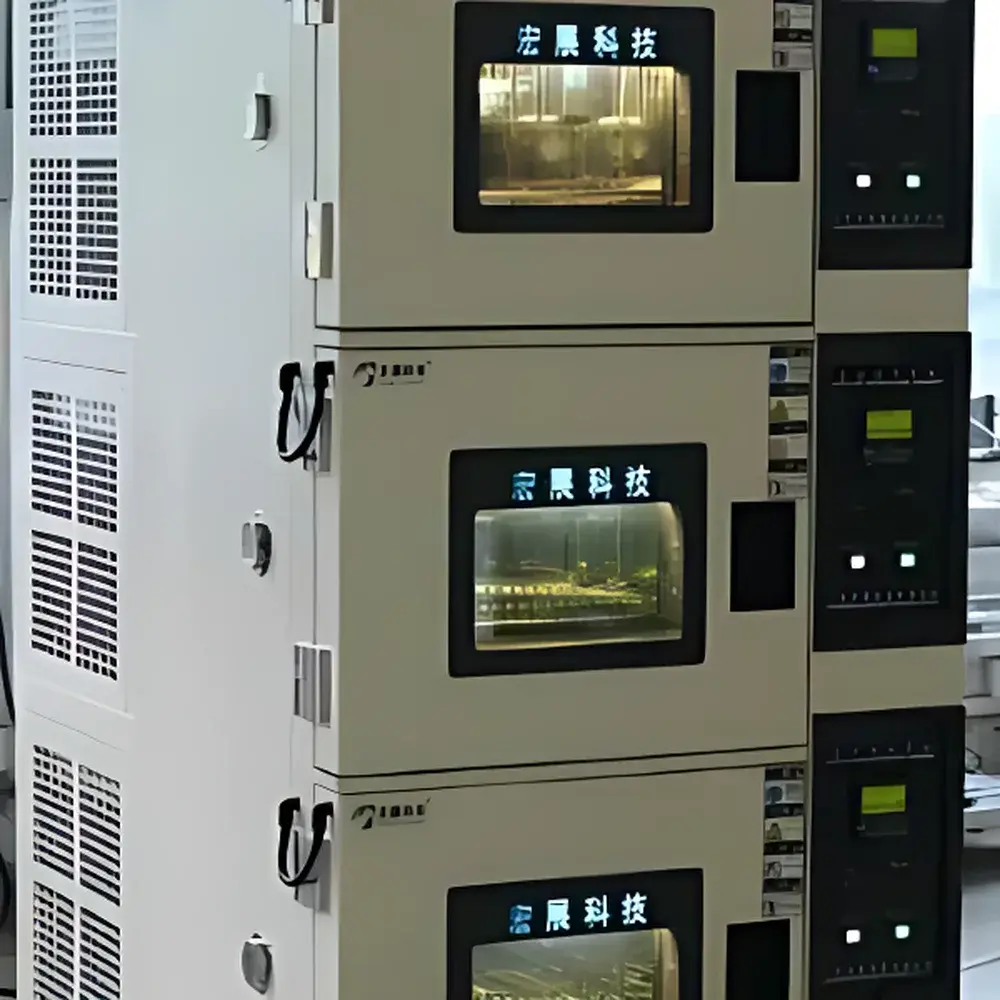
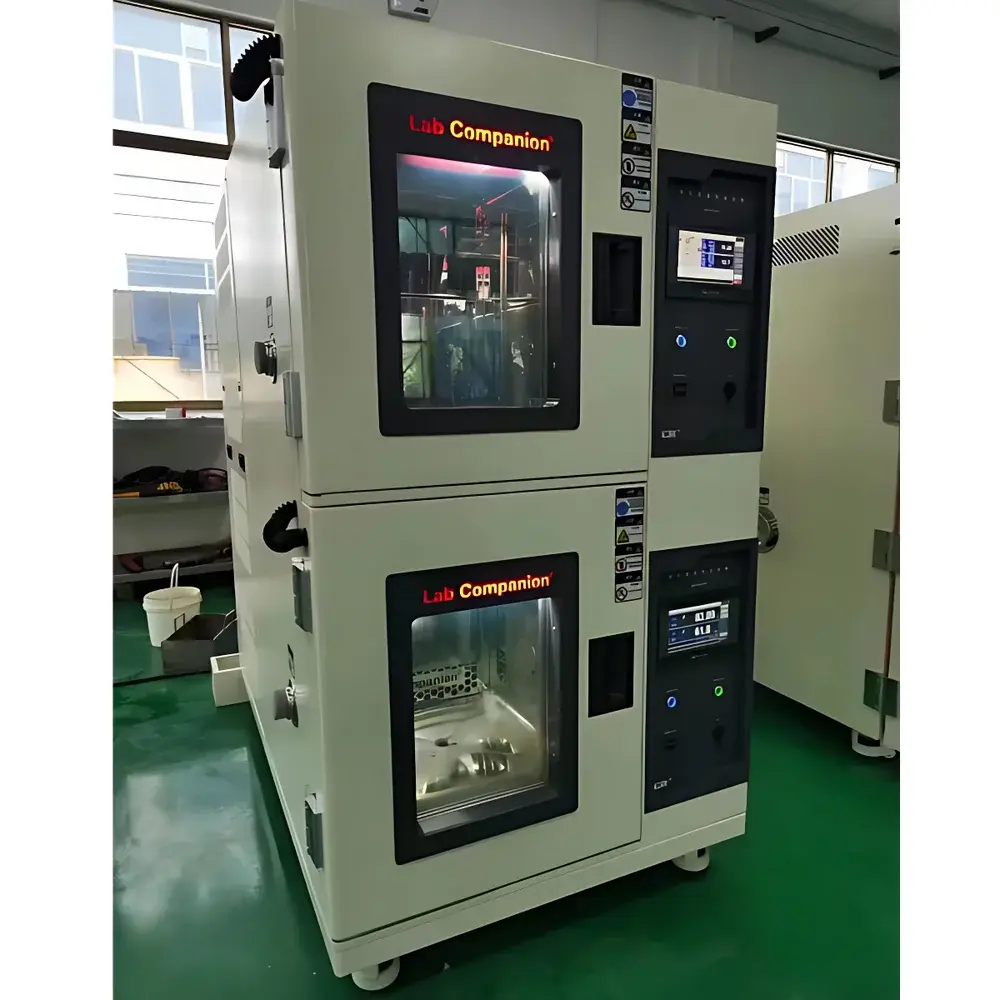
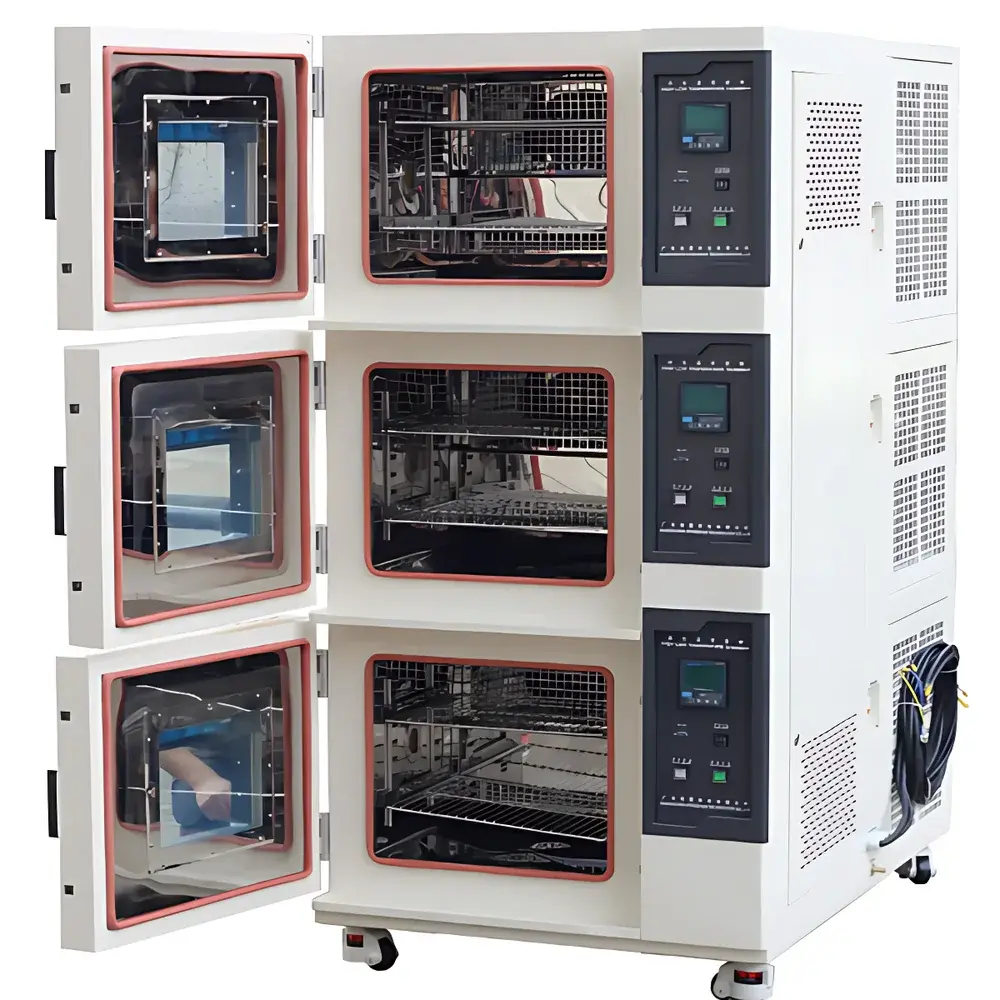
LabCompanion PL-80-3C Triple-Layer Explosion-Proof High-Low Temperature Environmental Test Chamber
| Brand | LabCompanion |
|---|---|
| Origin | Guangdong, China |
| Manufacturer Type | Direct Manufacturer |
| Country of Origin | China |
| Model | PL-80-3C |
| Temperature Range | −40 °C to +150 °C |
| Refrigeration Method | Compressor-Based Cooling |
| Explosion-Proof Design | Yes |
| Temperature Fluctuation | ±0.5 °C |
| Temperature Uniformity | ±2.0 °C |
| Temperature Deviation | ±2.0 °C |
| Heating Rate | 1.0–3.0 °C/min |
| Cooling Rate | 1.2 °C/min |
| Internal Chamber Dimensions (W×D×H) | 400 mm × 500 mm × 400 mm |
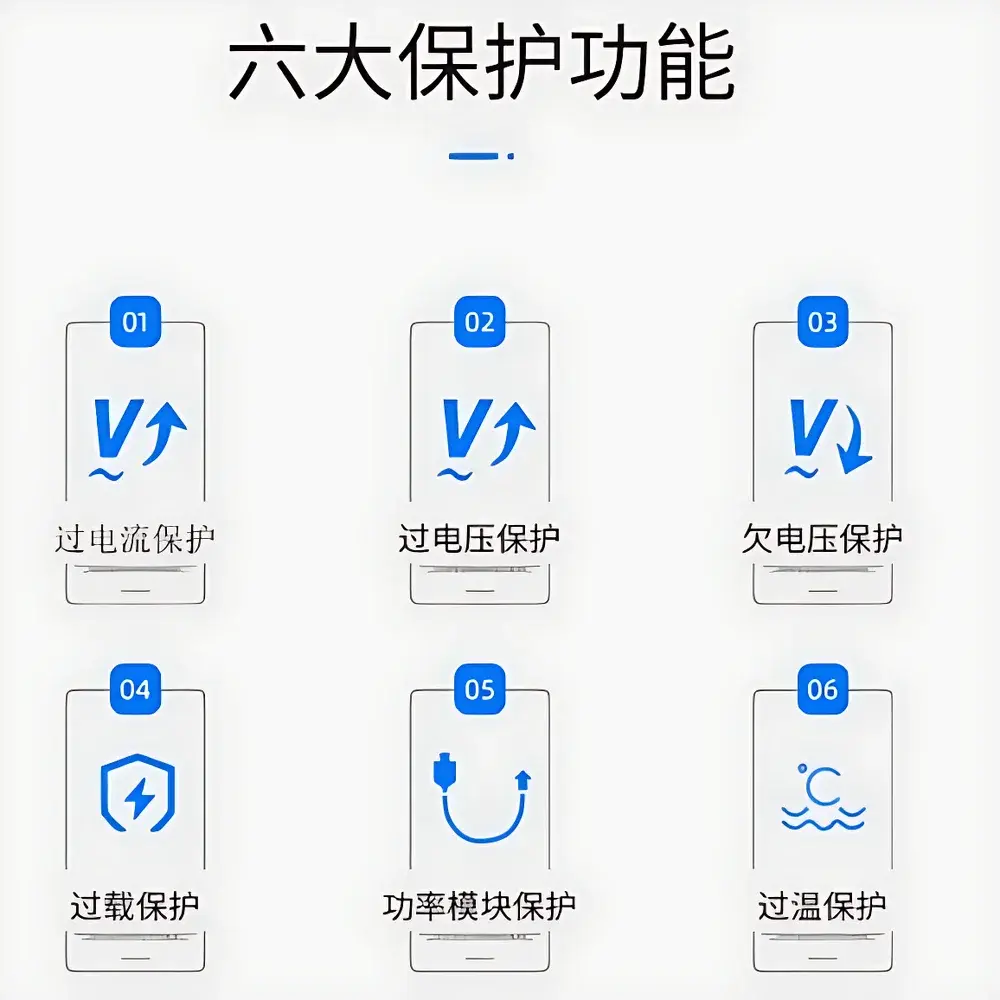
| Safety Features | Explosion-proof door lock, hydrogen gas sensor, pressure-relief vent, automatic CO₂ fire suppression system with smoke detection, anti-heat-accumulation design, dual dry-bulb/wet-bulb humidity control |
Overview
The LabCompanion PL-80-3C Triple-Layer Explosion-Proof High-Low Temperature Environmental Test Chamber is an engineered solution for rigorous thermal stress evaluation of lithium-ion and other electrochemical energy storage systems under controlled, intrinsically safe conditions. Designed specifically for battery safety validation, this chamber integrates triple-layer structural reinforcement with certified explosion-resistant engineering per IEC 60079-0 and GB 3836.1 standards. It operates on the principle of forced-air convection with independent refrigeration and heating circuits, enabling precise simulation of extreme thermal profiles—from deep freeze at −40 °C to high-temperature soak at +150 °C—while continuously monitoring internal atmosphere composition. Unlike standard environmental chambers, the PL-80-3C incorporates real-time hydrogen concentration sensing (0–4% LEL), dynamic pressure regulation via mechanical relief valves, and fail-safe CO₂ discharge triggered by optical smoke detection—critical for mitigating thermal runaway propagation during abuse testing.
Key Features
- Triple-layer reinforced stainless steel chamber construction with explosion-rated viewing window and Class II, Division 1 certified door locking mechanism
- Integrated hydrogen gas sensor with 1-second response time and configurable alarm thresholds compliant with UL 2580 and UN 38.3 Section 5.1.2 requirements
- Automated CO₂ fire suppression system activated upon smoke detection; includes redundant solenoid valve control and post-discharge ventilation purge sequence
- Pressure-relief vent assembly mounted on ceiling panel, calibrated to open at ≤15 kPa overpressure to prevent structural rupture during rapid gas generation
- Anti-heat-accumulation airflow manifold ensuring uniform thermal distribution and minimizing localized hot spots near cell terminals or busbars
- Dual-sensor humidity control using traceable NIST-calibrated dry-bulb and wet-bulb thermistors for long-duration cycling stability (up to 999 hr continuous operation)
- Modular water reservoir with slide-out drawer design, accessible from front base panel, supporting deionized water refill without tooling or chamber disassembly
Sample Compatibility & Compliance
The PL-80-3C accommodates single-cell (prismatic, cylindrical, pouch), module-level, and small-pack configurations up to 30 kg total mass. Its interior volume (0.08 m³) supports standardized mounting fixtures per ISO 12405-2 and SAE J2464 test protocols. All electrical interfaces—including thermocouple feedthroughs, voltage/current monitoring ports, and gas sampling lines—are routed through hermetically sealed, ATEX-certified bulkhead connectors. The system meets GB/T 10589–2008, GB/T 10586–2006, and IEC 60068-2-1/2/14 environmental test standards. Full audit trail logging satisfies GLP/GMP documentation requirements per FDA 21 CFR Part 11 when paired with optional validated software packages.
Software & Data Management
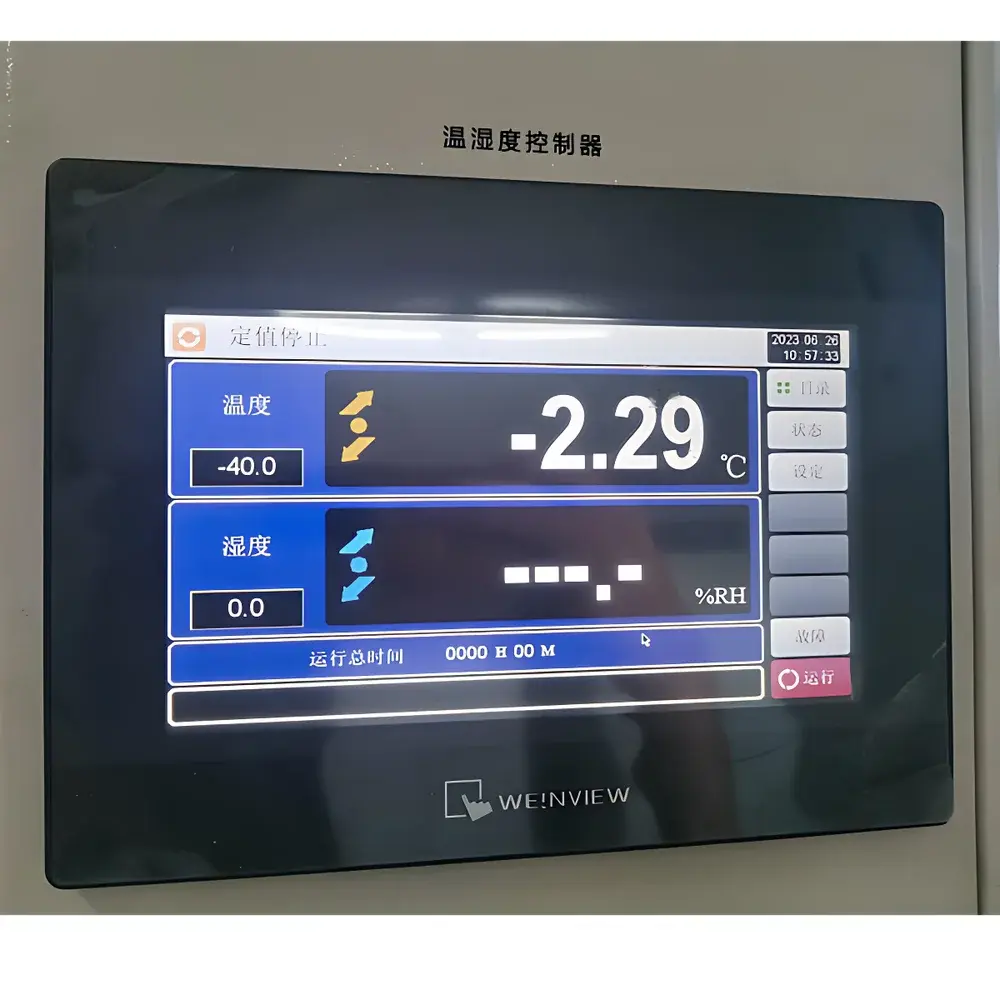
Equipped with LabCompanion’s TC-Link v4.2 controller firmware, the chamber delivers synchronized acquisition of temperature, pressure, hydrogen concentration, and fire event timestamps at 1 Hz resolution. Data export formats include CSV, XML, and PDF reports with embedded digital signatures. Optional Ethernet/IP and Modbus TCP interfaces enable integration into centralized MES or LIMS platforms. Calibration records, maintenance logs, and user access permissions are stored locally with SHA-256 hashing and role-based authentication. Firmware updates follow secure OTA protocols with cryptographic signature verification to ensure integrity across regulatory audits.
Applications
- Thermal runaway propagation testing per UL 9540A and IEEE 1679.2
- High-low temperature cycling per IEC 62660-1 and GB/T 31486
- Storage stability assessment under elevated temperature and humidity (e.g., 45 °C / 90% RH for 1000 hr)
- Abuse tolerance validation including overcharge, external short circuit, and mechanical crush under thermal preconditioning
- Pre-conditioning of battery management system (BMS) components prior to functional safety validation (ISO 26262 ASIL-B)
- Material compatibility screening for electrolytes, separators, and thermal interface materials
FAQ
What safety certifications does the PL-80-3C hold for battery testing applications?
It complies with GB 3836.1–2010 (Explosion-Proof Electrical Equipment), IEC 60079-0:2018, and incorporates design elements aligned with UL 2580 Annex D and UN 38.3 Section 5.1.2.
Can the chamber operate in humidity-controlled mode while maintaining explosion-proof integrity?
Yes—the wet-bulb sensor assembly and steam generator are fully isolated within the secondary containment layer, and all humidification components are rated for Class II, Group C/D atmospheres.
Is remote monitoring and emergency shutdown supported via network interface?
Standard Ethernet connectivity enables real-time telemetry and hardware-triggered emergency venting via SNMP traps or custom API calls, with configurable notification escalation paths.
How frequently must the CO₂ suppression system be serviced or refilled?
The 5 kg CO₂ cylinder supports ≥12 full discharge cycles; pressure monitoring and low-level alerts are logged automatically and trigger preventive maintenance workflows.
Does the controller support programmable ramp-soak profiles with conditional branching based on sensor inputs?
Yes—TC-Link v4.2 allows up to 99 segments per profile, with logic-based transitions (e.g., “hold until H₂ 12 kPa”).



