
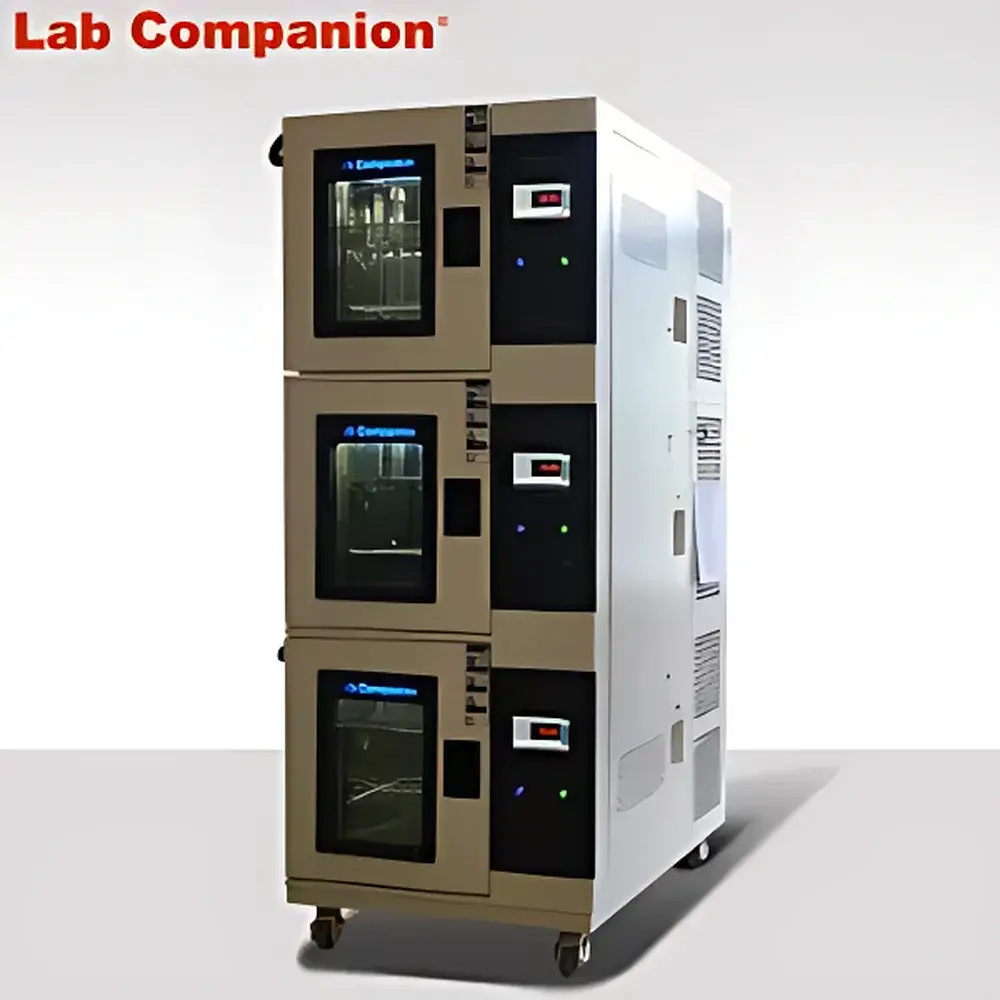
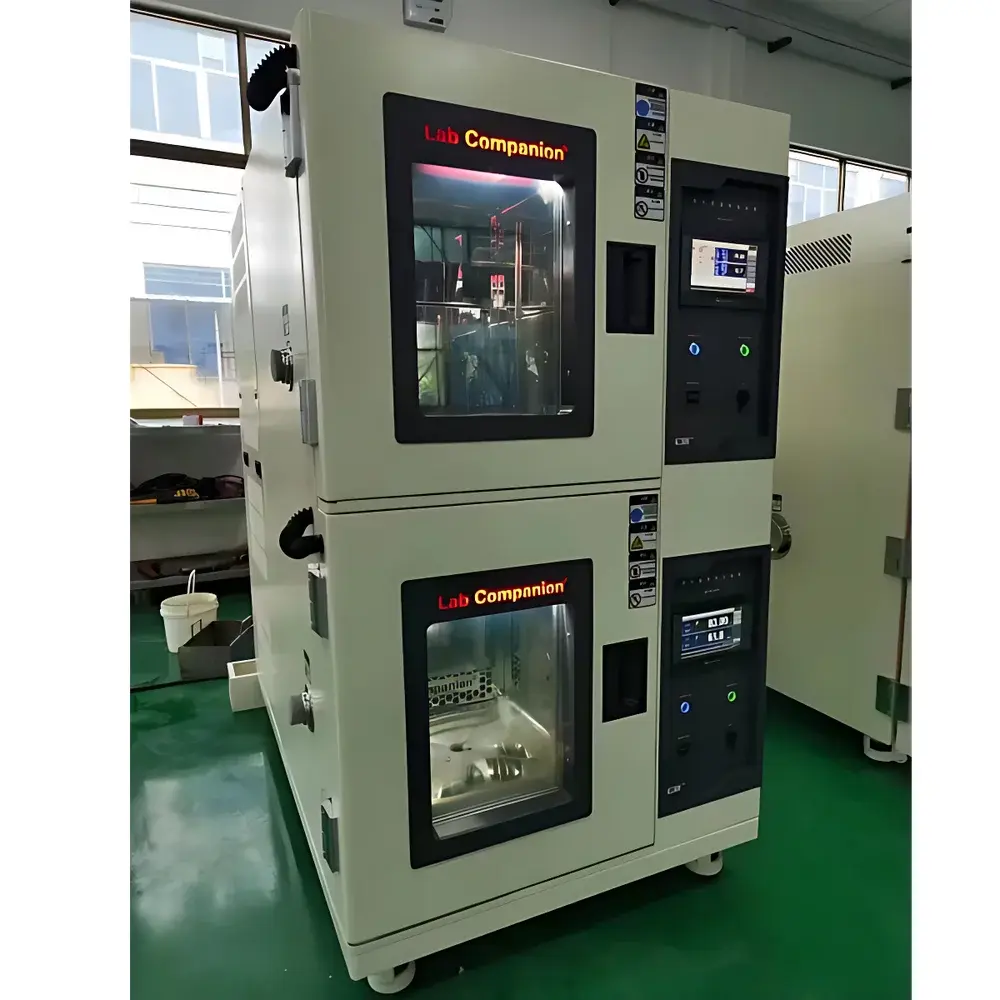
LabCompanion PR-80-2C Dual-Layer High-Low Temperature & Humidity Environmental Test Chamber
| Brand | LabCompanion |
|---|---|
| Origin | Guangdong, China |
| Manufacturer Type | Direct Manufacturer |
| Temperature Range | -20 °C to +150 °C |
| Refrigeration Method | Mechanical Compression Cooling |
| Explosion-Proof | Standard (Non-Explosion-Proof) |
| Temperature Fluctuation | ±0.5 °C |
| Temperature Uniformity | ±2.0 °C |
| Temperature Deviation | ±2.0 °C |
| Heating Rate | 1.0–3.0 °C/min |
| Cooling Rate | 1.2 °C/min |
| Internal Chamber Dimensions (W×D×H) | 500 × 400 × 400 mm |
Overview
The LabCompanion PR-80-2C is a dual-layer high-low temperature and humidity environmental test chamber engineered for laboratories with constrained floor space but demanding multi-condition validation requirements. Unlike conventional single-chamber systems, this vertically stacked configuration integrates two thermally isolated test compartments within a single structural footprint—each independently controllable for temperature and humidity—enabling concurrent testing under distinct environmental profiles. The chamber operates on the principle of forced-air convection combined with precision PID-controlled refrigeration (via hermetic scroll compressors) and electric heating elements, ensuring stable thermal gradients and repeatable climatic conditions across both layers. Designed in accordance with ISO 16750-4 (road vehicles), IEC 60068-2 (environmental testing), and GB/T 10586 (Chinese national standard for environmental chambers), the PR-80-2C supports standardized qualification protocols for electronic components, PCB assemblies, medical device packaging, and automotive ECUs.
Key Features
- Dual independent test zones housed in a compact vertical architecture—reducing total laboratory footprint by up to 45% compared to two standalone chambers.
- High-fidelity temperature control with ±0.5 °C fluctuation and ±2.0 °C uniformity (measured per IEC 60068-3-5 at 16 reference points per chamber).
- Robust mechanical refrigeration system utilizing environmentally compliant R404A/R23 cascade refrigerants for reliable operation down to –20 °C.
- Independent PID controllers for each layer, supporting programmable ramp-soak profiles, cycle repetition, and deviation alarms.
- Double-wall insulated construction with vacuum-insulated panels (VIPs) and silicone-sealed double-glazed observation windows to minimize thermal bridging and condensation.
- Standard RS485 interface with Modbus RTU protocol; optional Ethernet/IP or Profibus-DP for integration into centralized facility monitoring systems.
Sample Compatibility & Compliance
The PR-80-2C accommodates small-to-medium form factor samples—including IC packages, mobile phone modules, MEMS sensors, LED drivers, and polymer-based medical disposables—without cross-contamination between layers. Each chamber features removable stainless-steel shelves (304 grade), non-corrosive interior surfaces, and removable drip trays for condensate management. The system complies with GLP and GMP documentation requirements when paired with optional audit-trail-enabled software (see Software & Data Management). It meets electrical safety standards per IEC 61010-1 and electromagnetic compatibility per EN 61326-1. While rated as standard (non-explosion-proof), optional ATEX Zone 2 or IECEx-certified variants are available upon request for solvent-vapor environments.
Software & Data Management
LabCompanion’s proprietary ECO-View™ software (v4.2+) provides real-time multichannel monitoring, automated data logging at user-defined intervals (1s–60min), and configurable alarm notifications via email/SNMP. All operational parameters—including setpoints, actual values, compressor status, and door-open events—are timestamped and stored with SHA-256 hash integrity verification. The software supports 21 CFR Part 11-compliant user role management (Administrator, Operator, Reviewer), electronic signatures, and immutable audit trails—fully traceable for FDA inspections or ISO 9001 internal audits. Export formats include CSV, PDF test reports, and XML-compatible datasets for LIMS integration.
Applications
- Accelerated life testing of consumer electronics under alternating thermal stress (e.g., JEDEC JESD22-A104D).
- Pre-conditioning of lithium-ion battery cells prior to electrochemical cycling (UN 38.3 thermal preconditioning).
- Stability assessment of pharmaceutical primary packaging per ICH Q1A(R2) guidelines.
- Thermal shock screening of solder joints using synchronized dual-zone ramp profiles.
- Validation of adhesive bond strength retention across temperature-humidity cycles (ASTM D1002, ISO 4587).
- Environmental stress screening (ESS) of avionics subassemblies per MIL-STD-810H Method 501.7/502.7.
FAQ
Can both chambers operate at different temperature setpoints simultaneously?
Yes—the PR-80-2C features fully independent control systems for each layer, enabling simultaneous operation at disparate temperatures (e.g., –10 °C in upper chamber, +85 °C in lower chamber) without thermal crosstalk.
Is humidity control available on this model?
The PR-80-2C is configured as a high-low temperature-only chamber. For combined temperature/humidity capability, consider the PR-80-2CH variant, which adds ultrasonic humidification and desiccant-based dehumidification modules.
What is the maximum sample load weight per chamber?
Each chamber supports a static load capacity of 30 kg distributed evenly across three adjustable shelves; dynamic loading must not exceed 20 kg to maintain airflow uniformity and thermal stability.
Does the system include calibration certification?
A factory-as-built NIST-traceable calibration certificate (covering temperature sensors and controller accuracy) is included. On-site IQ/OQ/PQ validation support and annual recalibration services are available through LabCompanion’s global service network.
How is maintenance access designed for the dual-layer configuration?
Front-access service panels allow full mechanical and electrical inspection of compressors, fans, heaters, and controllers without disassembly of the chamber structure—minimizing downtime during routine PM or component replacement.



