
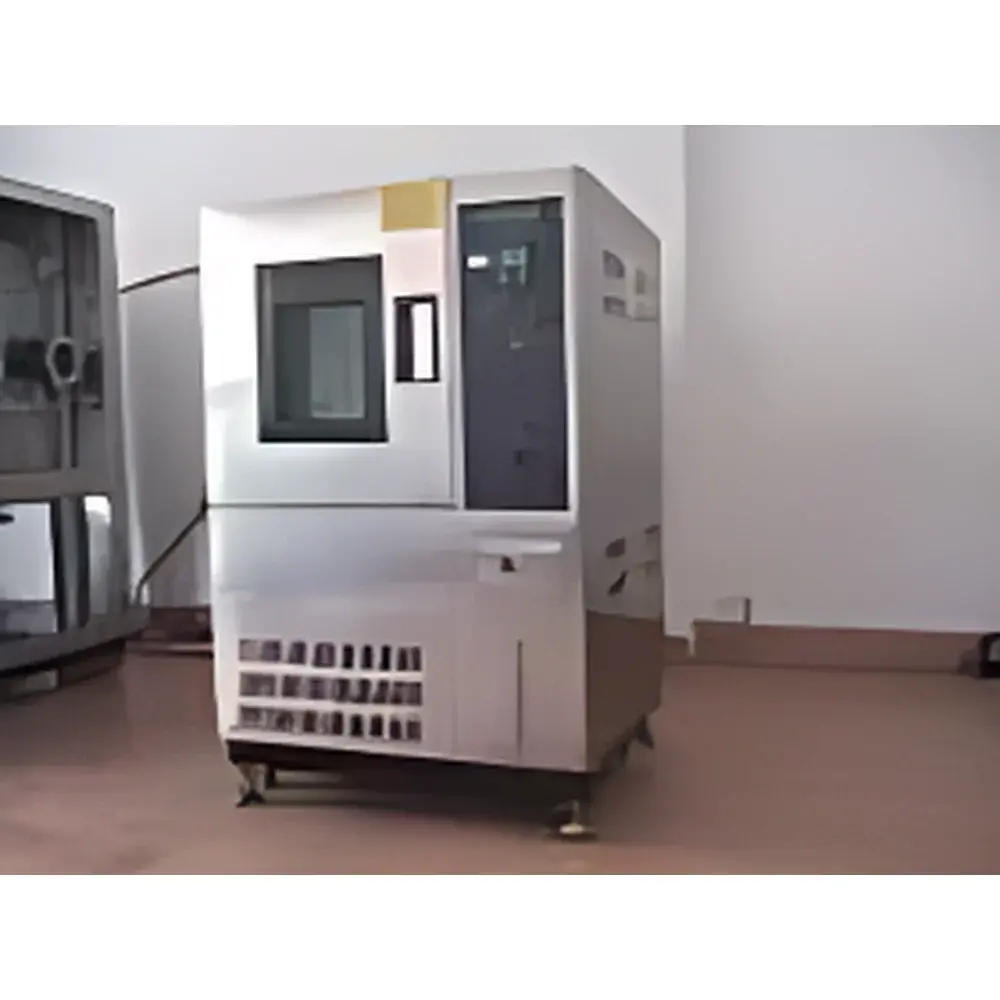
LabCompanion P-Series-3 Thermal Shock & Humidity Environmental Test Chamber
| Brand | LabCompanion |
|---|---|
| Origin | Guangdong, China |
| Manufacturer Type | Direct Manufacturer |
| Model | P-Series-3 |
| Temperature Range | 0°C to 100°C |
| Humidity Range | 30–98% RH |
| Temp. Uniformity | ≤ ±2°C |
| Temp. Stability | ≤ ±0.5°C |
| Humidity Deviation | +2 / –3% RH |
| Heating Rate (0→100°C) | ~35 min |
| Cooling Rate (100→0°C) | ~40 min |
| Control System | Imported Microcomputer-Based Integrated Temp./RH Controller |
| Sensor | PT100 Platinum Resistance |
| Heating | Independent Nickel-Chromium Alloy Heaters |
| Humidification | External Stainless Steel Surface Evaporation System |
| Dehumidification | Evaporator Coil Dew-Point Contact Method |
| Refrigeration | Dual-Stage Air-Cooled Compressor System (Original Tecumseh/Tecumseh France) |
| Insulation | Rigid Polyurethane Foam + Ultra-Fine Glass Fiber |
| Power Supply | AC 380V ±10%, 50 ±0.5 Hz, 3-Phase 5-Wire |
| Safety Protections | Over-Temp, Leakage, Short-Circuit, Motor Overheat, Compressor Overpressure, Phase Failure, Water-Level Monitoring, Power-Fail Memory |
Overview
The LabCompanion P-Series-3 Thermal Shock & Humidity Environmental Test Chamber is an engineered solution for accelerated reliability testing under dynamically alternating thermal and hygrothermal stress conditions. Designed in accordance with fundamental principles of thermodynamic equilibrium and moisture diffusion kinetics, the chamber supports rigorous evaluation of material stability, seal integrity, solder joint fatigue, coating adhesion, and electronic component performance across rapid temperature transitions and sustained humidity exposure. Its dual-stage refrigeration architecture—featuring original Tecumseh compressors, Italian Castel solenoid valves, and Taiwanese Guanya oil separators—ensures stable low-temperature operation down to 0°C while maintaining precise dew-point-based dehumidification control. The integrated microcomputer controller employs PID algorithms with auto-tuning capability to regulate both temperature and relative humidity independently, minimizing cross-coupling effects during complex cycling profiles such as those defined in IEC 60068-2-14 (thermal shock), IEC 60068-2-30 (damp heat cyclic), and MIL-STD-810H Method 507.5.
Key Features
- Robust dual-stage air-cooled refrigeration system with original French Tecumseh compressors, engineered for long-term operational stability under repeated thermal cycling.
- Independent heating, humidification, and dehumidification subsystems—each thermally and electrically isolated—to enhance test repeatability, reduce energy consumption, and extend service life.
- High-efficiency centrifugal circulation fan with multi-wing impeller and low-noise AC motor ensures uniform airflow distribution; temperature and humidity uniformity maintained within ≤ ±2°C and +2/–3% RH respectively across full working volume.
- Double-layer insulated viewing window with built-in LED lighting enables real-time visual monitoring without thermal leakage or condensation interference.
- Stainless steel (SUS304) interior chamber with mirror-finish surface and phosphated, electrostatically sprayed carbon steel exterior provide corrosion resistance and structural rigidity compliant with ISO 9001 manufacturing standards.
- Comprehensive safety architecture includes over-temperature cutoff, water-level detection, compressor high-pressure shutdown, phase failure protection, and non-volatile memory retention for setpoint recovery after power interruption.
Sample Compatibility & Compliance
The P-Series-3 accommodates a wide range of sample geometries—from PCB assemblies and automotive sensors to polymer housings and medical device enclosures—within its standardized internal dimensions (e.g., 800 × 700 × 900 mm for HP-500 variant). Its modular test port configuration (25 mm, 50 mm, and 100 mm diameter options) supports external instrumentation integration for real-time electrical parameter logging during environmental stress. The chamber meets essential requirements of GB/T 2423.1–2001 (cold testing), GB/T 2423.2–2001 (dry heat), and GB/T 2423.3–1993 (damp heat, steady-state), and is routinely validated against ASTM D4332 (conditioning containers) and ISO 16750-4 (road vehicles—environmental conditions). Optional calibration certificates traceable to NIM (National Institute of Metrology, China) are available upon request for GLP-compliant laboratories.
Software & Data Management
Equipped with an imported microcomputer-based integrated controller featuring a capacitive touchscreen interface, the system supports programmable multi-step cycles with up to 99 segments per profile and 999 total cycles. Real-time data logging at user-selectable intervals (1–600 seconds) is stored internally with ≥100-hour capacity. Optional analog output (4–20 mA) enables connection to third-party SCADA systems or chart recorders. For audit-ready environments, optional software modules support FDA 21 CFR Part 11 compliance—including electronic signatures, operator access levels, and immutable audit trails for all parameter modifications and alarm events. Data export is supported via USB flash drive in CSV format compatible with MATLAB, Python pandas, and statistical process control (SPC) platforms.
Applications
- Accelerated aging of lithium-ion battery modules under combined thermal cycling and high-humidity exposure to assess electrolyte decomposition and SEI layer evolution.
- Validation of conformal coating integrity on aerospace-grade avionics boards per DO-160 Section 25 (temperature/humidity).
- Qualification of packaging materials for pharmaceutical primary containers under ICH Q1A(R2) stability protocols involving intermediate and accelerated storage conditions.
- Testing of optical lens assemblies for fogging resistance and adhesive bond strength retention after 1,000-hour damp heat exposure at 85°C/85% RH.
- Reliability screening of automotive ECUs subjected to 200+ cycles between –40°C and +125°C with intermediate 85% RH dwell phases per AEC-Q200 stress categories.
FAQ
What standards does the P-Series-3 comply with for thermal shock testing?
It supports execution of IEC 60068-2-14 (Method Na) and MIL-STD-810H Method 507.5 through precise ramp-rate control and minimized chamber recovery time (< 5 minutes post-door opening).
Can the chamber be calibrated to national metrological standards?
Yes—NIM-traceable calibration certificates (including temperature, humidity, and uniformity verification) are available as an add-on service with documented uncertainty budgets.
Is remote monitoring supported?
Standard Ethernet port enables Modbus TCP communication for integration into facility-wide environmental monitoring networks; optional Wi-Fi module available for cloud-based status alerts.
What maintenance intervals are recommended for the refrigeration system?
Compressor oil and refrigerant charge verification every 24 months; desiccant filter replacement every 18 months; full system leak check and vacuum integrity validation annually.
Does the controller support custom alarm logic beyond default thresholds?
Yes—the advanced firmware allows user-defined alarm conditions based on rate-of-change limits, duration-based deviation windows, and interlocked sensor fault detection (e.g., simultaneous RH sensor drift + heater current anomaly).



