
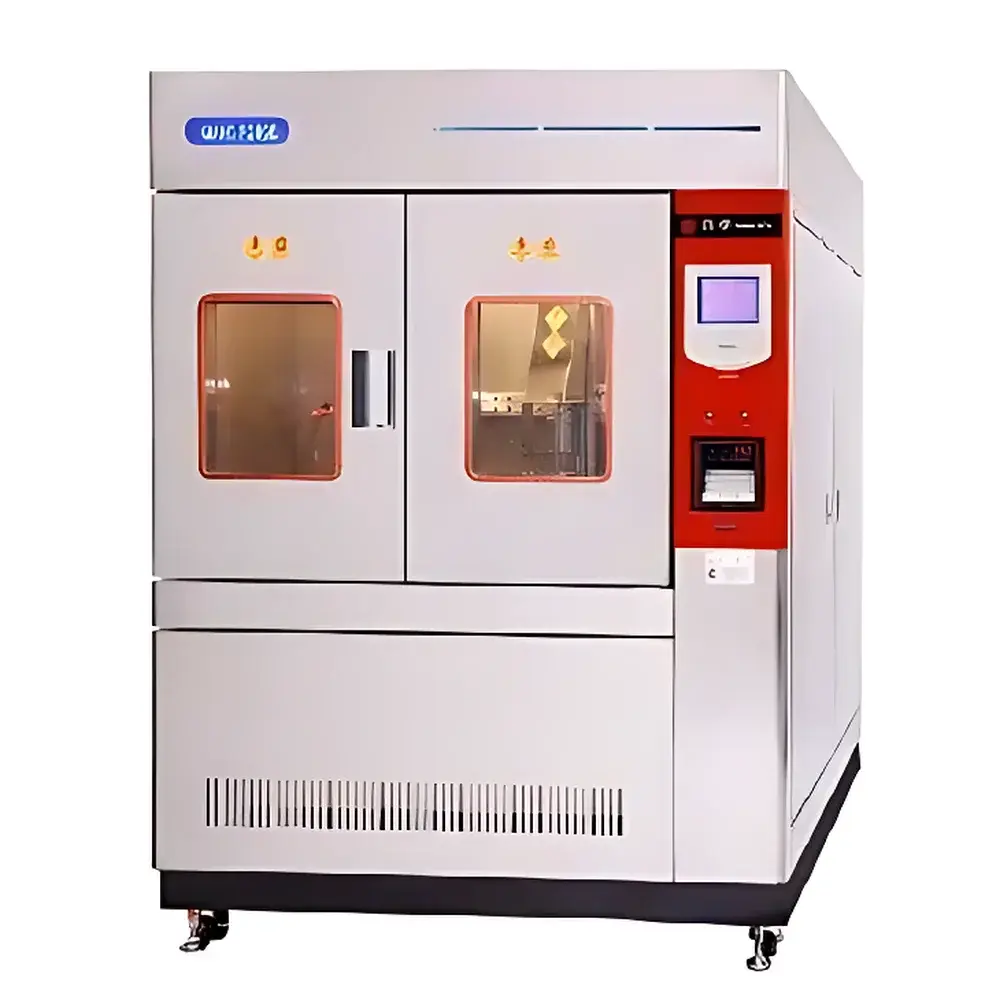
LabCompanion TS Series Thermal Shock Test Chamber
| Brand | LabCompanion |
|---|---|
| Model | TS Series |
| Origin | Guangdong, China |
| Manufacturer Type | Direct Manufacturer |
| Category | Environmental Test Chamber (Thermal Shock) |
| Temperature Range | –55 °C to +150 °C |
| Temperature Transition | Dual-zone air-driven basket transfer |
| Control Interface | 6.4" TFT color touchscreen (PID control, PT100 sensors) |
| Cooling System | Two-stage cascade refrigeration (R-507/R-23) |
| Compliance | GB/T 2423.1, GB/T 2423.2, GB/T 2423.22, GJB 150.5, GJB 360.7, GJB 367.2 |
| Data Connectivity | LAN, USB, RS-485 |
| Safety Features | Dual overtemperature protection, compressor high-pressure/overheat cutoff, airflow monitoring, emergency stop, compressed-air pressure interlock |
| Optional | Temperature data logger, additional stainless-steel shelves, remote monitoring software |
Overview
The LabCompanion TS Series Thermal Shock Test Chamber is an engineered environmental stress screening (ESS) system designed for rapid, reproducible temperature transition testing of electronic components, aerospace hardware, automotive modules, and military-grade electronics. It operates on the principle of two independent, thermally isolated chambers — a high-temperature zone (up to +200 °C) and a low-temperature zone (down to –65 °C) — with a pneumatically actuated stainless-steel test basket that transfers samples between zones in under 10 seconds. This mechanical switching architecture eliminates reliance on air-mixing or forced convection transitions, ensuring minimal thermal inertia and high fidelity to defined shock profiles. The chamber meets rigorous qualification requirements for early-life failure detection (infant mortality screening), solder joint reliability validation, and material coefficient-of-thermal-expansion (CTE) mismatch evaluation. Its dual-zone design supports both standardized thermal shock cycles (e.g., MIL-STD-810H Method 503.5) and custom multi-step profiles incorporating dwell, ramp, and recovery phases.
Key Features
- Two-stage cascade refrigeration system using environmentally compliant R-507 and R-23 refrigerants, enabling stable operation at –65 °C without liquid nitrogen dependency
- High-efficiency plate-type heat exchangers and brazed stainless-steel condensers for long-term thermal stability and reduced maintenance intervals
- 6.4-inch TFT color touchscreen controller with intuitive Chinese/English bilingual interface, supporting up to 1,000 user-defined test programs
- Real-time PID temperature regulation with ±0.1 °C resolution and ±2 °C uniformity across the working volume (per IEC 60068-3-5)
- Integrated LAN and USB 2.0 interfaces for remote parameter upload/download, live monitoring, automated reporting, and audit-trail-capable data logging
- Compressed-air-driven basket actuation with pressure-sensor interlock and fail-safe mechanical stops to prevent misalignment during thermal cycling
- Dual independent overtemperature protection circuits — one embedded in the controller, one hardwired — compliant with IEC 61000-4-11 for functional safety
- Pre-cooling and pre-heating functions activated automatically prior to scheduled test initiation, minimizing cycle start delay and improving throughput
Sample Compatibility & Compliance
The TS Series accommodates test specimens up to 225 L internal volume (model-dependent), with standard 50 mm diameter cable ports and optional feedthrough configurations for powered-in situ testing. Internal chamber construction uses SUS304 stainless steel with polyurethane + glass wool insulation, ensuring corrosion resistance and low thermal leakage. All models comply with national and defense standards including GB/T 2423.1–1989 (cold), GB/T 2423.2–1989 (dry heat), GB/T 2423.22–1989 (temperature change), GJB 150.5A–2009 (military thermal shock), and GJB 360B–2009 (method 205). While not certified to ISO/IEC 17025, the system supports GLP/GMP-aligned operation through configurable event logging, password-protected parameter editing, and electronic signature-ready report generation — features essential for regulated QC laboratories conducting qualification per IPC-J-STD-020 or JEDEC JESD22-A104.
Software & Data Management
The embedded controller firmware provides full traceability: all setpoints, actual temperatures, alarm events, door status, compressor run time, and cycle completion timestamps are recorded internally with timestamped CSV export via USB. Optional PC-based LabCompanion ThermalSuite™ software extends functionality with real-time graphing, statistical process control (SPC) charting (X-bar/R), deviation alerting, and PDF report templating aligned with ISO 9001 documentation requirements. Data files include digital signatures and checksums to satisfy FDA 21 CFR Part 11 expectations for electronic records. Remote access is secured via TLS 1.2 encryption; no cloud storage is performed unless explicitly enabled by the end-user.
Applications
This thermal shock chamber is routinely deployed in reliability engineering labs for: accelerated life testing of PCB assemblies and BGAs; validation of conformal coating integrity; qualification of MEMS devices and optoelectronic packages; screening of adhesive bonds and encapsulants for delamination risk; and verification of thermal management solutions in EV power electronics. In aerospace, it supports DO-160 Section 4.5 (temperature shock) compliance testing. Automotive applications include AEC-Q200 stress grading of passive components and ISO 16750-4 environmental robustness verification. The system’s ability to execute programmable dwell-ramp-dwell sequences also supports research into thermo-mechanical fatigue mechanisms in heterogeneous materials.
FAQ
What is the typical temperature transition time between zones?
Transition from hot to cold (or vice versa) is completed within ≤10 seconds for the basket movement, with temperature recovery to setpoint achieved in ≤5 minutes post-transfer (per GB/T 2423.22 definition).
Can the chamber operate as a standalone high-temperature or low-temperature test unit?
Yes — the high-temperature and low-temperature zones function independently, allowing use as a conventional thermal chamber when shock cycling is not required.
Is compressed air supply mandatory?
Yes. A clean, oil-free, 0.5–0.7 MPa compressed air source is required for basket actuation; an optional integrated air compressor is available as an accessory.
Does the system support automated data archiving to a network server?
Yes — via Ethernet connection, the controller can push log files to a designated SMB/CIFS share or FTP server at user-defined intervals.
Are calibration certificates provided with shipment?
Factory calibration reports (traceable to NIM China) are included; third-party ISO/IEC 17025 calibration services are available upon request.



