
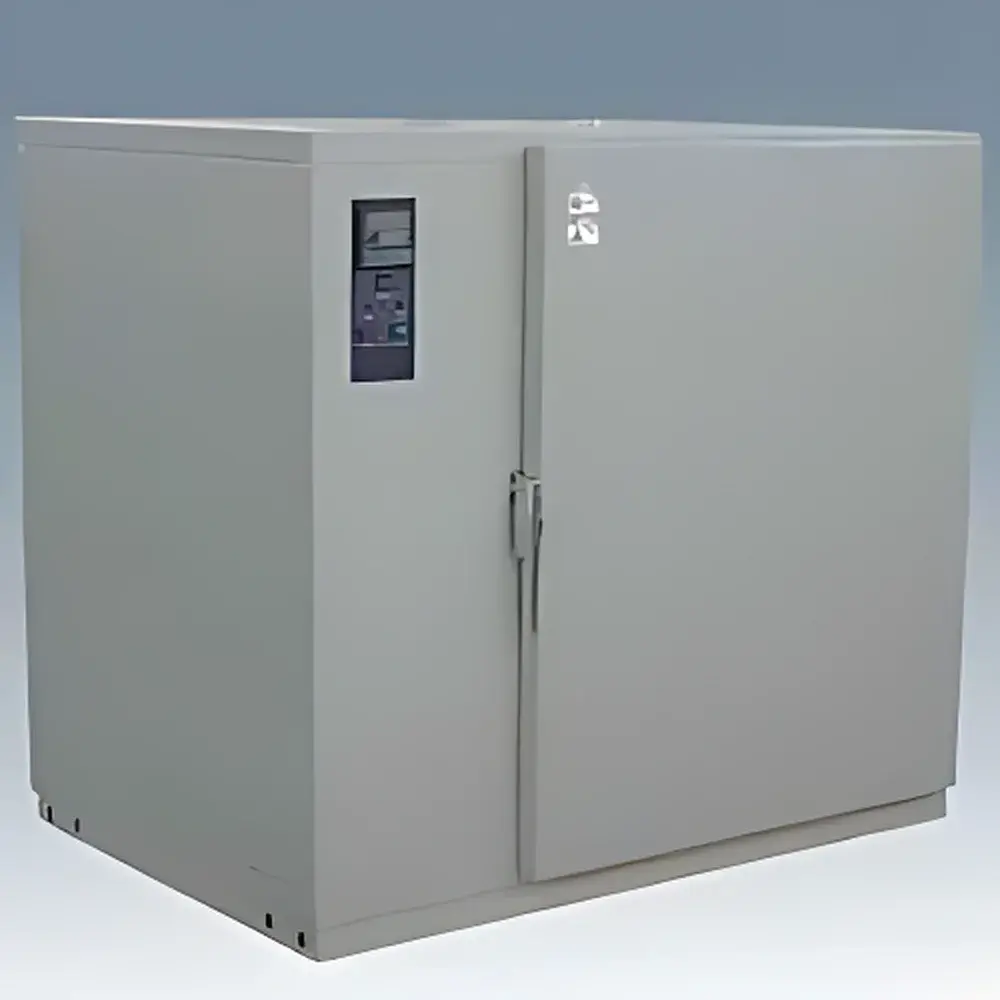
LabCompanion WGS Series High-Temperature Environmental Test Chamber for Inductor, Resistor & Thermometer Thermal Characterization
| Brand | LabCompanion |
|---|---|
| Model | WGS Series |
| Origin | Guangdong, China |
| Manufacturer Type | Direct Manufacturer |
| Category | Domestic |
| Temperature Range | R.T.+20°C to 300°C |
| Temperature Uniformity | ±1.0°C @ +100°C, ±2.0°C @ +300°C |
| Temperature Stability | ≤±0.4°C |
| Heating Rate | ~70 min (to 300°C) |
| Internal Volume | 91–216 L |
| Construction | Cold-rolled steel cabinet with epoxy powder coating, SUS304 stainless steel chamber, rock wool insulation |
| Air Circulation | Four-sided forced-air duct system |
| Heating System | Ni-Cr alloy heaters |
| Control | Microcomputer-based PID controller with PT100 sensor, LED digital display, fixed-setpoint operation |
| Safety | Independent overtemperature cut-off, thermal circuit breaker |
| Power Supply | AC220V/380V, 50 Hz |
| Standard Accessories | 1 cable port cover, 2 adjustable shelves, user manual |
| Optional | Programmable temperature controller, additional shelves, observation window, RS232/RS485 interface |
| Compliance | GB/T 11158–1989, GB/T 2423.2–1989 (Test B), IEC 60068-2-2 (Test B) |
Overview
The LabCompanion WGS Series High-Temperature Environmental Test Chamber is an engineered thermal characterization platform designed specifically for precision evaluation of passive electronic components—including inductors, resistors, and resistance temperature detectors (RTDs)—under controlled, stable, and repeatable elevated-temperature conditions. Operating on the principle of forced convection thermal regulation, the chamber maintains a highly uniform and stable thermal field across its working volume via a four-sided air circulation duct system. Unlike general-purpose ovens or drying cabinets, the WGS series is calibrated and validated for metrological-grade thermal stability (≤±0.4°C fluctuation) and spatial uniformity (±1.0°C at 100°C; ±2.0°C at 300°C), making it suitable not only for accelerated aging and thermal endurance testing but also as a traceable constant-temperature source for resistance vs. temperature (R–T) curve mapping, inductance drift analysis, and thermistor calibration workflows. Its design adheres to fundamental requirements for laboratory-grade environmental simulation: minimal thermal lag, low hysteresis control response, and robust mechanical integrity under sustained high-temperature operation.
Key Features
- Four-directional forced-air circulation architecture ensures superior temperature uniformity across the entire test volume—critical for multi-sample comparative studies and sensor calibration consistency.
- Microprocessor-based PID temperature controller with expert tuning algorithm eliminates overshoot and delivers stable setpoint maintenance without manual recalibration.
- Dual-layer safety architecture: primary control loop backed by an independent mechanical overtemperature cut-off switch and thermal circuit breaker—fully compliant with IEC 61000-4-5 surge immunity and functional safety expectations for Class II laboratory equipment.
- Chamber construction features 304 stainless steel interior (corrosion-resistant, non-outgassing), cold-rolled steel exterior with epoxy powder coating (scratch- and chemical-resistant), and high-density rock wool insulation (low thermal conductivity, non-combustible).
- Standard configuration includes two adjustable stainless steel shelves, one sealed cable entry port with removable cover (for external probe routing), and full documentation per ISO/IEC 17025 traceability guidelines.
- Modular electrical design supports dual voltage input (AC220V or AC380V, 50 Hz), enabling flexible integration into regional lab power infrastructures without custom transformers.
Sample Compatibility & Compliance
The WGS chamber accommodates non-volatile, non-explosive, and non-corrosive solid-state components—including axial/radial leaded resistors, SMD inductors, wire-wound RTDs, platinum resistance thermometers (PRTs), and ceramic-based temperature sensors. It is explicitly unsuitable for volatile solvents, lithium-based batteries, or organic polymers undergoing thermal decomposition. All models meet the structural, thermal, and performance criteria defined in GB/T 11158–1989 (Technical Requirements for High-Temperature Test Chambers), GB/T 2423.2–1989 (Environmental Testing – Part 2: Tests – Test B: Dry Heat), and IEC 60068-2-2 (Environmental Testing – Part 2-2: Tests – Test B: Dry Heat). While not certified to UL or CE for standalone safety marking, its subsystem-level compliance with IEC 61000-6-2 (immunity) and IEC 61000-6-4 (emissions) supports integration into GLP- and GMP-aligned validation protocols when paired with documented IQ/OQ/PQ procedures.
Software & Data Management
The base model operates in fixed-setpoint mode with local LED readout and manual parameter adjustment. For automated thermal profiling and data logging, optional RS232 or RS485 interfaces enable bidirectional communication with third-party SCADA systems, LabVIEW environments, or custom Python-based acquisition frameworks. When equipped with the programmable controller option, users can define up to 99 segments of ramp-hold cycles, store ≥100 programs, and export timestamped temperature logs in CSV format. Audit trail functionality—including operator ID tagging, parameter change history, and alarm event timestamps—is available under the enhanced controller variant, supporting FDA 21 CFR Part 11 compliance when deployed with appropriate electronic signature and access control policies.
Applications
- Temperature coefficient of resistance (TCR) measurement for thin-film and bulk metal film resistors.
- Inductance–temperature dependency characterization of ferrite-core and air-core inductors under static thermal soak conditions.
- Calibration and linearity verification of Pt100, Pt1000, and Ni1000 RTDs against NIST-traceable reference standards.
- Thermal aging studies of encapsulated passive components per IPC-9701A and JEDEC JESD22-A108F.
- Preconditioning of test fixtures, calibration shunts, and reference resistors prior to metrological evaluation.
- Supporting ASTM E220–22 (Standard Test Method for Calibration of Thermocouples by Comparison Techniques) as a stable thermal bath alternative for secondary standard verification.
FAQ
What is the maximum continuous operating temperature for the WGS302 model?
The WGS302 is rated for continuous operation up to +300°C, verified under no-load conditions at ambient 23°C ±2°C and 65% RH ±20%. Derating is recommended for long-term exposure above 280°C to extend heater and seal service life.
Can this chamber be used for thermal shock testing?
No—the WGS series is a single-zone, steady-state high-temperature chamber. It does not support rapid transition between extreme temperatures. For thermal shock applications, refer to LabCompanion’s dedicated TSE Series dual- or tri-compartment thermal shock chambers.
Is the internal volume usable space fully accessible for large fixtures?
Yes—the listed internal dimensions (e.g., 600 × 600 × 600 mm for WGS302) reflect unobstructed cavity space. No internal structural members intrude into the working volume, and the four-side airflow design avoids central obstructions.
Does the standard configuration include data logging capability?
No—real-time temperature logging requires the optional programmable controller or external DAQ system connected via RS232/RS485. The base unit provides only local LED display and manual setpoint control.
Are calibration certificates provided with shipment?
Factory calibration reports (including as-found/as-left data at three points: 100°C, 200°C, and 300°C) are included. Full ISO/IEC 17025-accredited calibration is available upon request as a value-added service with lead-time extension.



