
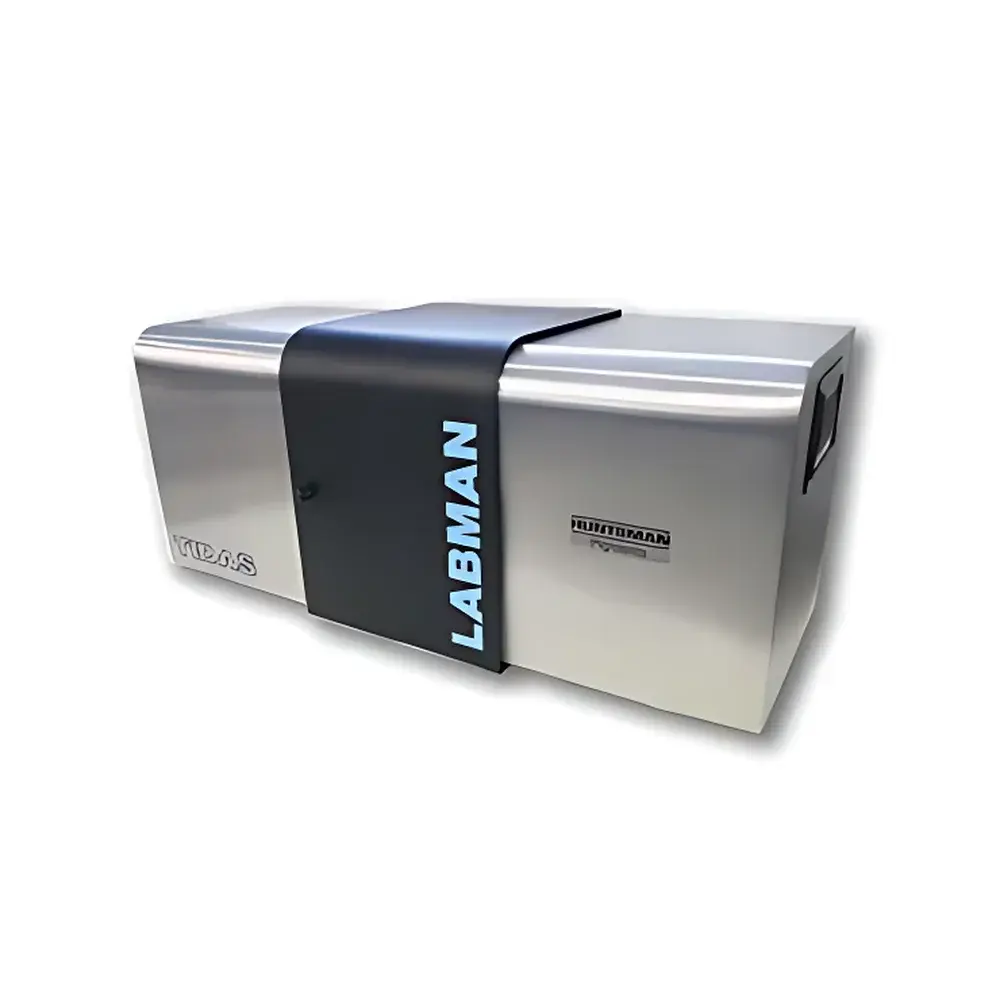
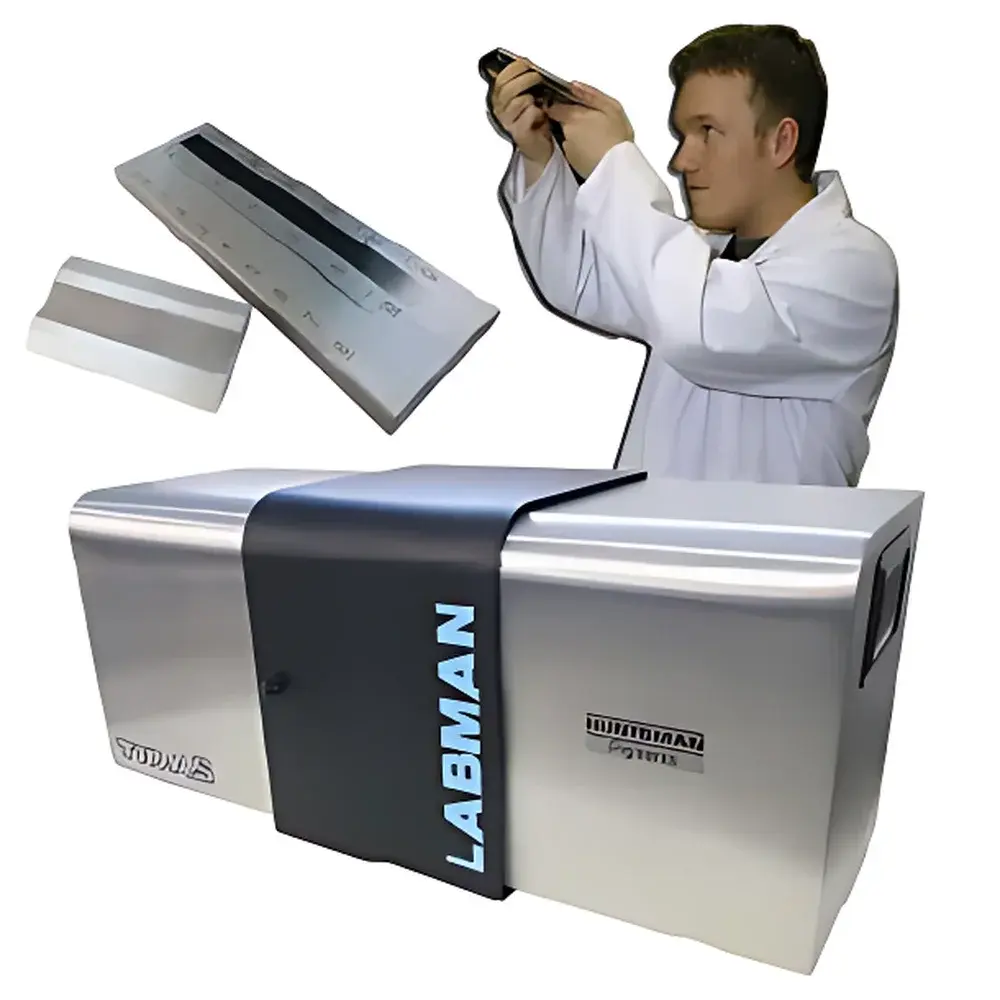
Labman TIDAS Automated Paint Grind Gauge Analyzer
| Brand | Labman |
|---|---|
| Origin | Germany |
| Model | TIDAS |
| Measurement Principle | Hegman-type grind gauge imaging analysis |
| Sample Application | Liquid dispersions (paints, inks, coatings, slurries) |
| Plate Range Compatibility | 0–15 µm, 0–25 µm, 0–50 µm, 100 µm, 250 µm (custom plates available) |
| Imaging Resolution | High-definition digital capture |
| Analysis Time | ≤1 s per image |
| Total Cycle Time | ~15 s (including auto-coating) |
| Software Platform | Windows 7/8/10 native |
| Data Output | Histograms, particle size distribution profiles, pass/fail grading per ISO 1524 or ASTM D1316 |
| Compliance Support | Audit-trail ready, GLP/GMP-compatible metadata logging |
| Interface | USB 2.0 |
| System Lifespan | ≥12 years (field-validated) |
Overview
The Labman TIDAS Automated Paint Grind Gauge Analyzer is an industrial-grade instrument engineered for objective, reproducible assessment of particle dispersion fineness in liquid media—primarily paints, printing inks, varnishes, and pigment dispersions. It implements the standardized Hegman grind gauge principle through fully automated mechanical coating and high-resolution digital imaging, eliminating subjective visual interpretation and operator-dependent variability inherent in manual methods. First introduced in 1997 and continuously refined through serial production, the TIDAS system delivers quantitative data on the largest discrete particles present in a sample, expressed as a numerical grade aligned with ISO 1524 (Paints and varnishes — Determination of fineness of grind) and ASTM D1316 (Standard Test Method for Fineness of Grind of Printing Inks). Its core architecture integrates precision motorized coating, calibrated optical imaging, and deterministic image segmentation algorithms to generate statistically robust particle size distribution histograms—not merely a single “grind number,” but a traceable, exportable profile suitable for process validation and quality documentation.
Key Features
- Fully automated sample application: Motor-driven, repeatable draw-down across standardized Hegman-style grind gauge plates ensures consistent film thickness and shear history—critical for inter-laboratory comparability.
- High-fidelity digital imaging: Integrated industrial camera captures full-resolution grayscale images of the coated plate under controlled illumination, enabling pixel-level analysis of particle contrast, shape, and spatial distribution.
- Deterministic image processing engine: Proprietary algorithm discriminates between true particulate contaminants, micro-bubbles, and bubble clusters based on morphological thresholds and intensity gradients—reducing false positives common in generic threshold-based tools.
- Configurable grading logic: Supports user-defined pass/fail criteria per industry standard (e.g., maximum allowable particle count above 25 µm), with configurable histogram binning and statistical summary outputs (mean, median, D90).
- Robust hardware platform: Sealed optical path, vibration-damped stage, and maintenance-free linear actuators contribute to >12-year operational lifespan under routine QC lab conditions.
- USB-native interface: Direct plug-and-play connectivity to Windows 7/8/10 hosts without proprietary drivers; no external frame grabbers or PCI cards required.
Sample Compatibility & Compliance
The TIDAS accommodates viscous and low-viscosity dispersions across a broad rheological range—including solvent-borne, water-borne, and high-solids formulations—without dilution or pre-treatment. Standard compatibility extends to all commercially available Hegman-style plates (0–15 µm, 0–25 µm, 0–50 µm, 100 µm, 250 µm); non-standard geometries and custom scale calibrations are supported upon request. From a regulatory standpoint, the system generates timestamped, operator-annotated image archives with embedded metadata (plate ID, date/time, environmental temperature/humidity if externally logged), satisfying audit requirements under ISO/IEC 17025, FDA 21 CFR Part 11 (when deployed with validated electronic signature workflows), and internal GLP/GMP documentation protocols. Raw and processed images are stored separately in lossless TIFF format, ensuring full traceability for root cause investigations or third-party review.
Software & Data Management
The TIDAS software suite operates natively on standard Windows platforms and provides hierarchical data management: each measurement session auto-generates a structured folder containing raw image (.tiff), processed image (.png), histogram CSV, and XML metadata. All files are named using ISO 8601 timestamps and configurable project/sample IDs. The database supports bidirectional linking between analytical records and physical sample libraries via barcode or alphanumeric identifiers. Optional add-ons include batch reporting templates compliant with ASTM E29 (Standard Practice for Using Significant Digits), automated PDF certificate generation, and API-accessible data export for integration into LIMS or MES environments. Audit trails record every user action—including parameter changes, reprocessing events, and report exports—with immutable timestamps.
Applications
- QC release testing of incoming pigments and final coatings per ISO 1524 pass/fail specifications.
- Process optimization in dispersion milling: correlating grind time, media charge, and energy input with quantitative fineness metrics.
- Stability assessment of suspensions over shelf life: detecting agglomeration onset via longitudinal histogram trend analysis.
- Supplier qualification and technical service support: generating standardized, defensible reports for cross-site comparisons.
- R&D formulation screening: rapid evaluation of dispersant efficacy across multiple candidate chemistries.
FAQ
Does the TIDAS require calibration with certified reference standards?
Yes—annual verification using NIST-traceable step-height standards or certified grind gauge reference plates is recommended and supported by Labman’s calibration service package.
Can the system analyze opaque or highly pigmented samples?
Yes—the imaging algorithm is optimized for high-contrast detection in both light-scattering and light-absorbing matrices; no UV or fluorescence excitation is required.
Is remote operation or network deployment possible?
While the base system connects via USB, optional Ethernet-to-USB bridge modules enable centralized control from a lab network, subject to local IT security policy approval.
What happens if a bubble is misclassified as a particle?
The algorithm applies multi-parameter filtering (circularity, solidity, intensity variance) to suppress bubble artifacts; users may adjust sensitivity thresholds or apply post-hoc manual masking in the review mode.
How is data integrity ensured during power interruption?
All critical operations are transaction-logged prior to write; unsaved measurements are retained in volatile memory until explicit save confirmation or graceful shutdown.



