
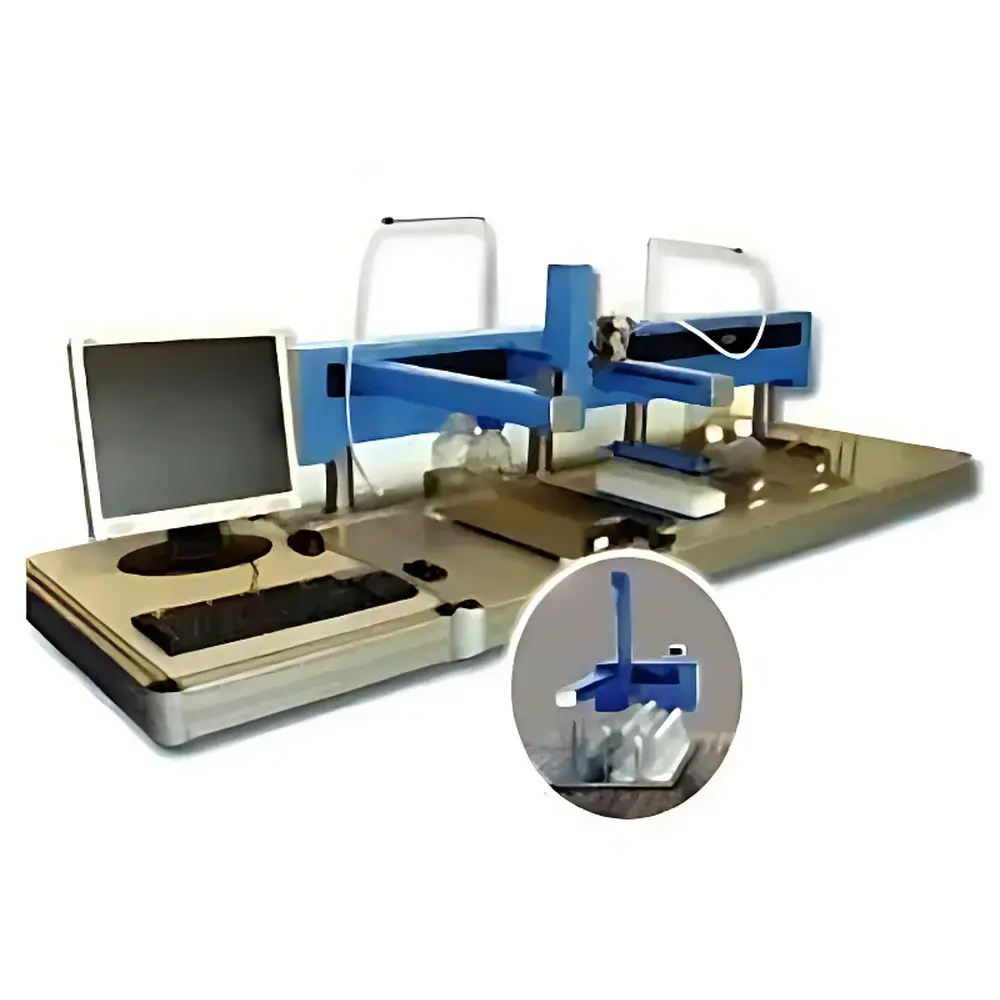
Labomatic LH3000 Preparative Multifunctional Liquid Handling Platform
| Brand | Labomatic |
|---|---|
| Origin | Switzerland |
| Model | LH3000 |
| Instrument Type | HPLC Autosampler |
| X-axis Travel Range | 160–2800 mm (customizable) |
| Y-axis Travel Range | 70–670 mm (single arm) |
| Z-axis Height Range | 130–780 mm (fixed base height), max vertical stroke: 400 mm |
| Compliance | Designed for GLP/GMP environments |
Overview
The Labomatic LH3000 Preparative Multifunctional Liquid Handling Platform is an industrial-grade, modular robotic automation system engineered for high-precision liquid manipulation in chromatographic and preparative chemistry workflows. Unlike conventional autosamplers limited to fixed injection sequences, the LH3000 implements a true Cartesian coordinate-based motion architecture—featuring independently programmable X, Y, and Z axes—to enable dynamic reconfiguration across diverse laboratory unit operations. Its core design principle centers on mechanical adaptability: rather than purchasing separate instruments for sample introduction, fraction collection, solvent extraction, or reagent mixing, users deploy a single platform whose physical footprint and functional scope are defined by application-specific module integration. This architecture is particularly suited for method development labs, QC/QA facilities supporting multiple HPLC/UHPLC systems, and contract manufacturing organizations requiring flexible, audit-ready automation under GLP or GMP frameworks.
Key Features
- Three-axis (XYZ) fully programmable motion control with customizable travel ranges: X-axis up to 2800 mm, Y-axis up to 670 mm (per arm), Z-axis stroke up to 400 mm
- Dual-Y-arm configuration option enabling simultaneous independent operation—e.g., one arm aspirating from vial racks while the other dispenses into fraction collector tubes
- Modular tool-mounting interface compatible with standard 96-well, 384-well, and custom-format labware; supports syringe pumps, positive displacement pipettors, UV flow cells, and fraction-triggered valves
- Integrated 7-inch capacitive touchscreen HMI for standalone protocol editing, real-time status monitoring, and manual jog control—no PC required for basic operation
- Comprehensive PC-based control software with scripting engine (Python-compatible API), method import/export, and full event logging including timestamped motion commands and sensor feedback
- Structural aluminum frame with precision linear guides and stepper/servo motor drive—designed for long-term repeatability (±0.1 mm positional accuracy over full travel)
- Configurable safety interlocks, emergency stop circuitry, and optional enclosure integration for ISO Class 5 cleanroom compatibility
Sample Compatibility & Compliance
The LH3000 accommodates a broad spectrum of sample containers—from 0.2 mL microcentrifuge tubes and 2 mL HPLC vials to 1 L solvent reservoirs and stacked 96-deep-well plates—without hardware modification. Its open-system architecture permits integration with third-party detectors, fraction collectors, and mass spectrometers via TTL, RS-232, or Ethernet/IP protocols. From a regulatory perspective, the platform’s deterministic motion control, non-volatile parameter storage, and software-enforced access levels align with foundational requirements for data integrity under FDA 21 CFR Part 11. When deployed with validated software modules—including user authentication, electronic signatures, and immutable audit trails—the LH3000 meets essential criteria for use in pharmaceutical release testing, stability studies, and extractables/leachables analysis governed by ICH Q5, Q9, and USP .
Software & Data Management
Control is managed through Labomatic’s LH-Suite software, a Windows-based application supporting both graphical workflow builders and text-based scripting. All motion paths, dwell times, aspiration/dispense volumes, and conditional logic (e.g., “if UV absorbance > threshold, divert to waste”) are stored as version-controlled XML files. Raw logs capture every command execution with microsecond timestamps, motor current feedback, and end-effector status—exportable in CSV or SQL formats for LIMS integration. The software includes built-in calibration wizards for tip alignment, liquid level sensing, and pressure-based volume verification. Optional add-ons provide IQ/OQ documentation templates, change control tracking, and automated report generation compliant with ALCOA+ principles.
Applications
- Preparative HPLC/UHPLC autosampling with multi-vial tray indexing and column-switching support
- Time- or peak-triggered fraction collection synchronized with UV/ELSD/CAD detector outputs
- Automated liquid-liquid extraction workflows using dual-tip aspiration/dispense sequences
- High-throughput dilution series generation and buffer blending with gravimetric or volumetric verification
- Method scouting platforms combining gradient elution, fraction rerouting, and offline MS analysis preparation
- Stability-indicating assays requiring repeated sampling from multiple time-point vials under ambient or controlled temperature conditions
FAQ
Can the LH3000 operate without a connected PC?
Yes—the integrated touchscreen HMI supports full protocol creation, execution, and diagnostics without external computing hardware.
Is it possible to integrate the LH3000 with third-party chromatography data systems (CDS)?
Yes—via standardized communication protocols including ASCII over TCP/IP, Modbus TCP, and vendor-specific APIs (e.g., Agilent OpenLab, Waters Empower).
What validation documentation is available?
Labomatic provides factory test reports, mechanical drawings, electrical schematics, and IQ/OQ templates aligned with ASTM E2500 and ISPE GAMP5 guidelines.
Does the system support temperature-controlled sample handling?
Not natively—but the platform’s open chassis design allows integration of aftermarket Peltier-cooled racks or environmental enclosures with independent climate control.
How is maintenance performed, and what is the expected service interval?
Linear guide lubrication and belt tension verification are recommended every 6 months; motor encoder calibration is advised annually. Full preventive maintenance kits and certified technician dispatch services are available directly from Labomatic’s European service network.





