
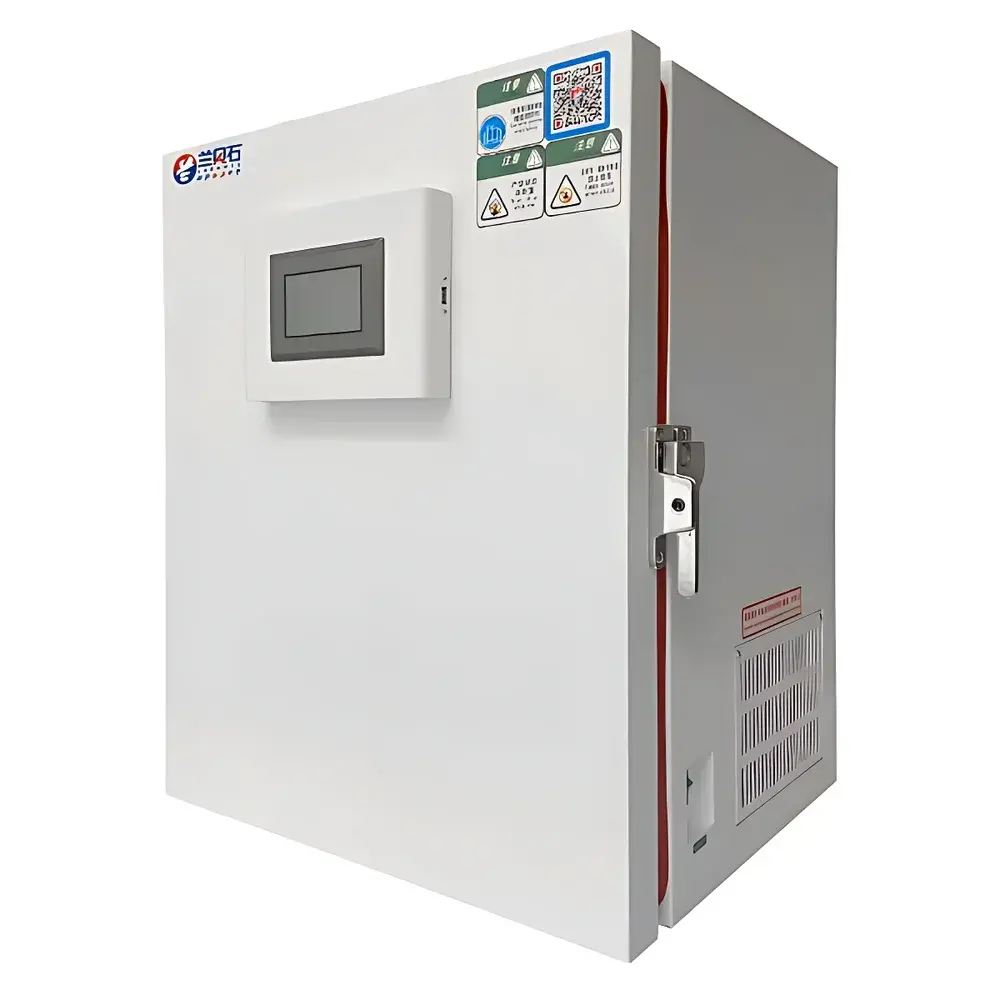
Labonce Labonce-12CT-S Pharmaceutical Stability Testing Chamber
| Brand | Labonce |
|---|---|
| Origin | Beijing, China |
| Manufacturer Type | Direct Manufacturer |
| Country of Origin | China |
| Model | Labonce-12CT-S |
| Temperature Range | 10–50 °C |
| Chamber Volume | 12 L |
| Internal Dimensions (W×D×H) | 290×160×260 mm |
| External Dimensions (W×D×H) | 410×315×590 mm |
| Power Consumption | 0.42 kW |
| Cooling Method | Semiconductor-based Thermoelectric Cooling |
| Temperature Uniformity | ≤2.0 °C |
| Temperature Fluctuation | <±0.5 °C |
| Temperature Deviation | <±1.0 °C |
| Construction | Exterior – Powder-coated Steel |
| Control System | Programmable Color Touchscreen Controller with Three-Tier User Permissions and Audit Trail Functionality |
| Data Storage | Onboard Electronic Logging with USB Export Capability |
| Safety Features | Independent Over-Temperature Protection Circuit |
| Dual-Door Design | Outer Solid Insulated Door + Inner Tempered Glass Door |
| Compliance Reference | GB/T 10586–2006 “Technical Specifications for Damp Heat Test Chambers” |
Overview
The Labonce Labonce-12CT-S Pharmaceutical Stability Testing Chamber is a compact, precision-engineered environmental test system designed specifically for small-batch stability studies, accelerated degradation testing, and packaging compatibility evaluation under controlled thermal conditions. It operates on the principle of thermoelectric (Peltier) cooling combined with forced-air convection to achieve stable, repeatable temperature control across its 12-liter working volume. Unlike compressor-based systems, the semiconductor cooling architecture eliminates refrigerant use, reduces mechanical wear, and enables rapid thermal response—critical for ICH Q1–Q5 compliant stability protocols where precise time–temperature profiles must be maintained over extended durations. The chamber meets the performance requirements outlined in GB/T 10586–2006 for damp heat test equipment, including specifications for temperature uniformity (≤2.0 °C), fluctuation (<±0.5 °C), and deviation (<±1.0 °C) across the working space—parameters directly aligned with WHO and ICH guidelines for real-time and accelerated stability storage conditions.
Key Features
- Compact footprint (410 × 315 × 590 mm) optimized for benchtop deployment in QC labs, formulation development suites, or regulatory submission support environments.
- Thermoelectric cooling module delivering silent, oil-free, maintenance-light operation with no refrigerant handling or disposal concerns—ideal for GLP-compliant facilities seeking simplified HVAC integration.
- Dual-door configuration: outer insulated solid door minimizes ambient thermal exchange; inner tempered glass door permits non-intrusive visual monitoring without compromising chamber integrity or introducing thermal lag.
- Programmable color touchscreen controller supporting multi-step temperature profiles, real-time graphing, and event-triggered logging—engineered for compliance with FDA 21 CFR Part 11 Annex 11 requirements via configurable audit trail and electronic signature support.
- Three-tier user access control (Operator / Supervisor / Administrator) ensures role-based data integrity and procedural accountability during stability study execution.
- Independent hardware-based over-temperature protection circuit provides fail-safe thermal cutoff independent of the main control logic—safeguarding both sample integrity and instrument longevity.
Sample Compatibility & Compliance
The Labonce-12CT-S accommodates vials, blister packs, syringes, ampoules, and primary/secondary packaging components up to 260 mm in height. Its stainless-steel interior and smooth, crevice-free corners facilitate cleaning validation per ISO 14644–1 Class 7 cleanroom practices. While not rated for humidity control, its thermal performance aligns with ICH Q1A(R2) recommended storage conditions for long-term (25 °C/60% RH) and intermediate (30 °C/65% RH) stability testing when paired with validated desiccant or saturated salt reference systems. The unit supports qualification documentation (IQ/OQ/PQ) and is routinely deployed in laboratories undergoing MHRA, PMDA, or ANVISA inspections where traceable calibration records and electronic data integrity are mandatory.
Software & Data Management
Onboard firmware logs timestamped temperature readings at user-defined intervals (1–60 min), storing ≥12 months of continuous data internally. All entries include operator ID, parameter changes, alarm events, and system status flags. Data export is performed via standard USB 2.0 interface using encrypted CSV files compatible with LIMS platforms such as LabWare, STARLIMS, or Thermo Fisher SampleManager. Audit trail records capture who changed what, when, and why—including modifications to setpoints, profile sequences, or user permissions—meeting ALCOA+ principles (Attributable, Legible, Contemporaneous, Original, Accurate, Complete, Consistent, Enduring, Available) required under GxP frameworks.
Applications
- Accelerated stability assessment of APIs and finished dosage forms per ICH Q1B (photostability excluded).
- Thermal stress testing of pharmaceutical packaging materials (e.g., HDPE bottles, aluminum blisters, cold-form foil) per USP .
- Real-time stability monitoring of reference standards, impurity stock solutions, and analytical calibration standards.
- Pre-validation chamber mapping studies prior to commissioning larger-volume stability chambers.
- Small-scale excipient compatibility screening under elevated temperature conditions.
FAQ
Does the Labonce-12CT-S support humidity control?
No. This model is a temperature-only chamber. For combined temperature/humidity stability testing, consider the Labonce-CT series with optional humidification modules.
Is the unit suitable for GMP-regulated environments?
Yes—when operated with documented SOPs, calibrated against NIST-traceable references, and integrated into a validated data management workflow, it fulfills core requirements for Annex 11 and EU GMP Chapter 4 compliance.
What is the maximum allowable load weight inside the chamber?
The standard shelf load capacity is 5 kg per shelf. Total internal payload should not exceed 10 kg to maintain specified thermal uniformity.
Can temperature profiles be exported and re-imported between instruments?
Yes. Profile definitions (.prf files) are portable across Labonce CT-series controllers using the same firmware revision.
Is remote monitoring supported?
Not natively. However, the USB data export functionality enables integration with third-party SCADA or cloud-based environmental monitoring systems via post-acquisition file ingestion.






