
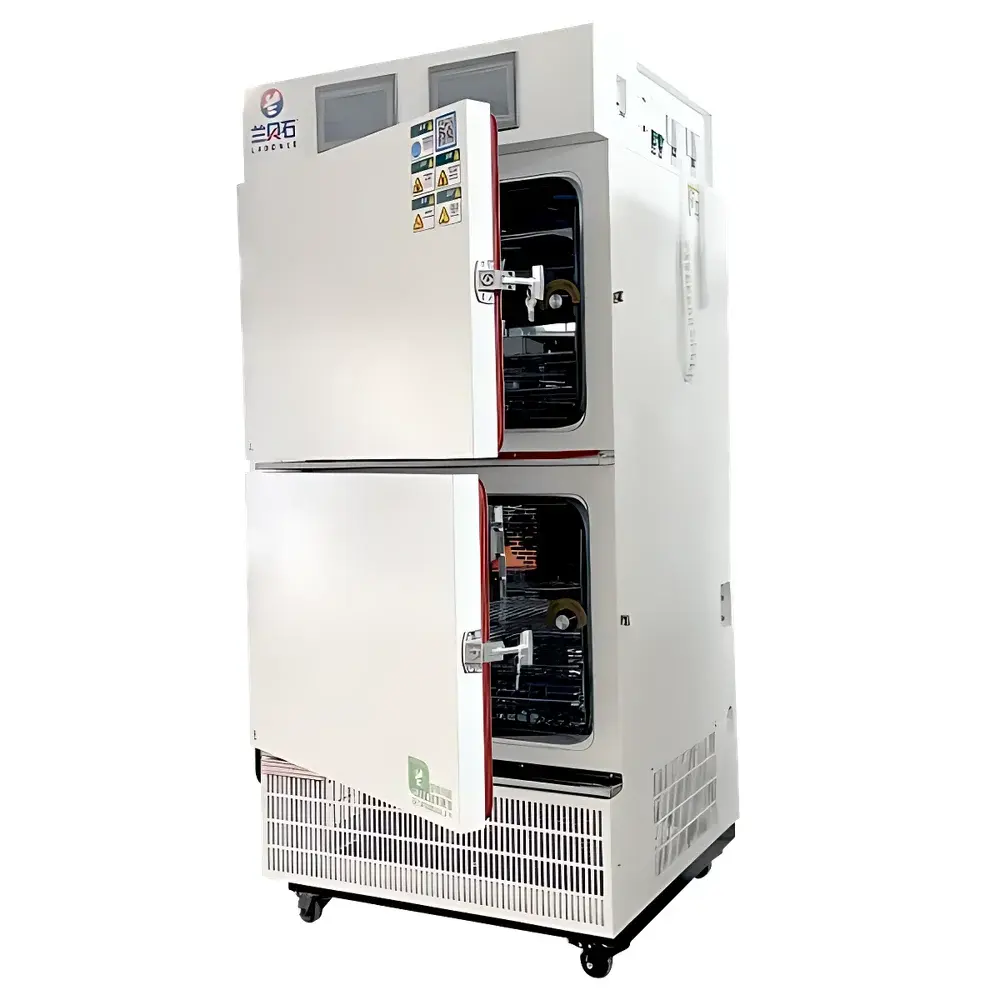
Labonce Labonce-320CGS-FC Dual-Chamber Drug Stability Testing Chamber
| Brand | Labonce |
|---|---|
| Origin | Beijing, China |
| Manufacturer Type | Direct Manufacturer |
| Product Origin | Domestic (China) |
| Model | Labonce-320CGS-FC |
| Pricing | Upon Request |
Overview
The Labonce Labonce-320CGS-FC Dual-Chamber Drug Stability Testing Chamber is an ICH Q1-compliant, GMP-aligned environmental simulation system engineered for accelerated and long-term stability studies of pharmaceutical products in accordance with the Chinese Pharmacopoeia (2020 Edition), ICH Guideline Q1A(R3), Q1B, and Q5C. Unlike single- or triple-chamber alternatives, this dual-zone configuration separates temperature-humidity conditioning (Chamber B) from photostability testing (Chamber A), enabling simultaneous, independent operation under strictly defined conditions—critical for concurrent ICH Q1B photostability protocols and Q1A storage condition assessments. Chamber A integrates calibrated visible light (100–6000 lux) and near-UV irradiation (0.84–1.0 W/m²), with real-time sensor feedback and automatic data logging to ensure compliance with the minimum cumulative exposure requirements: ≥1.2 × 10⁶ lux·hr (visible) and ≥200 W·hr/m² (near-UV). The chamber’s thermodynamic architecture employs a hermetically sealed, inverter-driven compressor system—reducing energy and water consumption by >50% versus conventional fixed-speed units—while maintaining thermal stability within ±0.5 °C fluctuation and ±1.0 °C deviation (dark conditions), and humidity control within ±2% RH fluctuation and ±3% RH deviation.
Key Features
- Inverter-driven, imported hermetic compressor system for precise, energy-efficient temperature control and reduced thermal cycling stress on samples
- Dual independent chambers: Chamber A (temperature + humidity + visible light + near-UV) and Chamber B (temperature + humidity only), eliminating cross-condition interference
- 7-inch full-color programmable touchscreen controller with real-time display of inverter output ratio, setpoint tracking, and dynamic PID tuning
- Triple-tier user access control (Administrator, Supervisor, Operator) with role-based permissions, password authentication, and session timeout enforcement
- Audit trail functionality compliant with FDA 21 CFR Part 11 expectations: immutable timestamped records of all parameter changes, alarm events, login/logout actions, and calibration interventions—exportable via USB in read-only format
- High-density polyurethane foam insulation (≥120 mm thickness) with seamless foaming process ensures superior thermal retention and moisture barrier integrity
- Interior constructed from electropolished AISI 304 stainless steel (mirror finish); exterior coated with corrosion-resistant epoxy-polyester powder coating
- Capacitive humidity sensors (imported, factory-calibrated) offering long-term stability (<±0.5% RH/year drift), zero maintenance, and traceable NIST-compatible calibration
- Redundant safety systems: independent overtemperature cutoff, compressor overheat/overpressure protection, low-water and dry-burn prevention, and door-open alarm
- Multi-modal alerting: local audible alarm, visual status indicators, and optional remote SMS notification upon temperature/humidity deviation or power failure
Sample Compatibility & Compliance
The Labonce-320CGS-FC accommodates standard pharmaceutical packaging formats—including blister packs, vials, ampoules, bottles, and sachets—on adjustable 304 stainless steel shelves (2 standard, 5 maximum). Its chamber dimensions (680 × 500 × 460 mm internal) support ISO/IEC 17025-compliant sensor placement per ICH Q1B Annex 3. All operational parameters are validated per ASTM E2500-13 (Guide for Specification, Design, and Verification of Pharmaceutical and Biopharmaceutical Manufacturing Systems) and aligned with WHO Technical Report Series No. 992 (Annex 10) for stability testing infrastructure. The system meets essential requirements for GLP and cGMP environments, including electronic record integrity, operator accountability, and environmental condition traceability—enabling successful regulatory inspections under CFDA, NMPA, EMA, and FDA audit frameworks.
Software & Data Management
Data acquisition and reporting are managed through embedded firmware supporting continuous logging at user-defined intervals (1–60 min). Internal memory retains ≥12 months of high-resolution environmental data (temperature, humidity, light intensity, UV irradiance) with microsecond-level timestamps. Integrated thermal line printer provides immediate hard-copy output of current conditions, alarms, and daily summary reports—formatted to match USP documentation conventions. Exported USB files conform to CSV and PDF/A-1b standards for archival integrity; metadata includes instrument ID, operator ID, test protocol reference, and digital signature hash. Optional Ethernet/Wi-Fi connectivity enables integration into centralized LIMS or MES platforms via Modbus TCP or OPC UA protocols—supporting automated data aggregation for trend analysis and statistical process control (SPC).
Applications
- ICH Q1A(R3)-mandated long-term (25 °C/60% RH) and accelerated (40 °C/75% RH) stability studies
- ICH Q1B photostability testing under Option 1 (open container) and Option 2 (closed container) protocols
- Forced degradation studies requiring controlled oxidative, thermal, and photolytic stress conditions
- Stability assessment of biologics, lyophilized products, and combination products under variable humidity profiles
- Validation of packaging integrity under cyclic humidity conditions (e.g., 25 °C ↔ 40 °C with 30–75% RH ramping)
- Reference standard storage under ICH Q5C-specified conditions (5 °C ± 3 °C, protected from light)
FAQ
Does the Labonce-320CGS-FC comply with FDA 21 CFR Part 11 requirements for electronic records and signatures?
Yes—the system implements role-based access control, audit trail logging with immutable timestamps, electronic signature capability (via password re-authentication), and exportable read-only records meeting Part 11 Subpart B technical controls.
Can Chamber A and Chamber B operate at different temperature and humidity setpoints simultaneously?
Yes—each chamber features independent PID-controlled refrigeration, humidification, and dehumidification subsystems, allowing concurrent execution of distinct ICH protocols (e.g., 25 °C/60% RH in Chamber B while running ICH Q1B photostability at 40 °C/25% RH in Chamber A).
What photometric validation is performed prior to shipment?
Each unit undergoes factory photometric verification using NIST-traceable lux and UV-A radiometers; calibration certificates—including spatial uniformity maps and spectral irradiance curves—are supplied with delivery documentation.
Is remote monitoring supported out-of-the-box?
Standard configuration includes RS485 Modbus RTU; optional Ethernet module enables secure HTTPS-based web interface, SNMP alerts, and integration with enterprise SCADA or cloud-based monitoring platforms.
How is humidity uniformity verified across the working volume?
Per ISO 14644-3 Annex B methodology, 9-point mapping (3×3 grid at mid-height) is conducted during IQ/OQ; typical uniformity is ≤±1.5% RH across the loaded chamber volume at 60% RH setpoint.






