
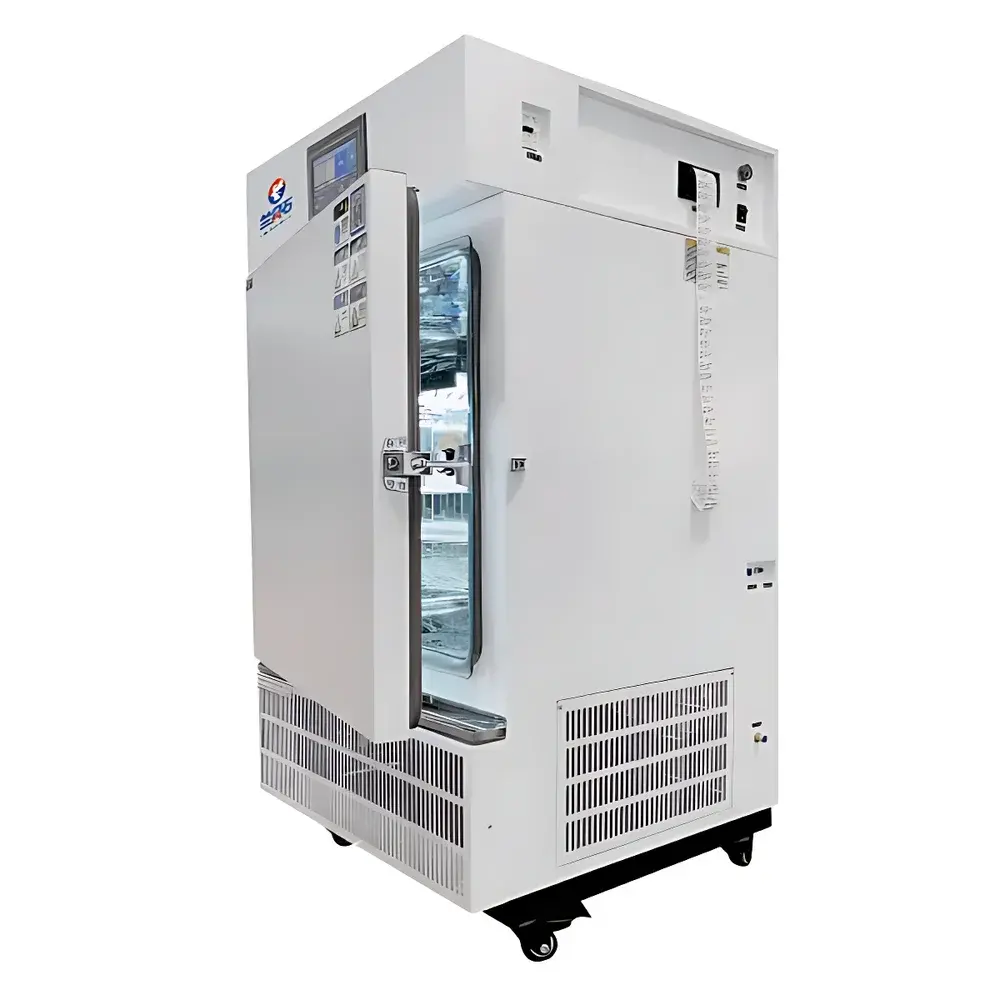
Labonce Labonce-400CGS-FC Pharmaceutical Stability Chamber with Visible Light and Near-Ultraviolet Irradiation
| Brand | Labonce |
|---|---|
| Origin | Beijing, China |
| Manufacturer Type | Direct Manufacturer |
| Country of Origin | China |
| Model | Labonce-400CGS-FC |
| Quotation | Upon Request |
| Temperature Range | 15–65 °C |
| Humidity Range | 20–95 % RH |
| Chamber Volume | 400 L |
| Internal Dimensions (W×D×H) | 600×700×950 mm |
| External Dimensions (W×D×H) | 780×1060×1750 mm |
| Power Consumption | 2.0 kW |
| Standard Shelves | 3 (adjustable), up to 10 total |
| Temperature Uniformity | ≤2.0 °C (dark condition) |
| Temperature Fluctuation | <±0.5 °C |
| Temperature Deviation | <±1.0 °C |
| Humidity Fluctuation | <±2 % RH |
| Humidity Deviation | <±3 % RH |
| Visible Light Intensity Range | 100–8000 lux |
| Illumination Accuracy | 4500±500 lux |
| Total Illumination Dose | ≥1.2×10⁶ lux·h |
| Near-UV Irradiance Range | 0.84–5 W/m² |
| Near-UV Energy Dose | ≥200 W·h/m² |
| Cooling System | Imported hermetic inverter compressor |
| Humidity Sensor | Imported capacitive type |
| Control Interface | ≥7-inch programmable color touchscreen |
| User Access Levels | Three-tier authentication (administrator/operator/user) |
| Audit Trail | Time-stamped, tamper-proof operation and alarm logs exportable via USB in read-only format |
| Data Output | Integrated dot-matrix printer + internal electronic storage |
| Safety Protections | Compressor overheat/overpressure, dry-run prevention, independent overtemperature cutoff, water shortage detection |
| Dual-door Structure | Outer insulated solid door |
| Ambient Operating Temperature | +5 to +35 °C |
| Power Supply | AC 220 V ±10%, 50 Hz |
Overview
The Labonce Labonce-400CGS-FC Pharmaceutical Stability Chamber is a fully integrated environmental test system engineered to meet the stringent requirements of ICH Q1A(R2), Q1B, Q5C, and Chinese Pharmacopoeia (2020 Edition) for long-term, accelerated, and photostability testing of pharmaceutical products. It combines precise temperature and humidity control with calibrated visible light and near-ultraviolet (NUV) irradiation modules—enabling concurrent or independent execution of ICH-compliant stress conditions. The chamber employs a hermetic inverter-driven refrigeration system for energy-efficient, low-vibration thermal regulation and utilizes high-density polyurethane foam insulation (≥120 mm thickness) to ensure thermal and hygric stability during extended 24/7 operation. Its all-304 stainless steel interior eliminates particulate shedding and supports routine cleaning under GMP/GLP environments.
Key Features
- Triple-mode environmental control: independent or synchronized regulation of temperature (15–65 °C), relative humidity (20–95 % RH), visible light (100–8000 lux), and near-UV irradiance (0.84–5 W/m²)
- Inverter-based cooling architecture delivering >50% energy and water savings versus fixed-speed systems, with continuous capacity modulation across full operating range
- Capacitive humidity sensor (imported, factory-calibrated) ensuring long-term drift <0.5 % RH/year and zero maintenance over 5+ years
- Three-tier user permission framework compliant with FDA 21 CFR Part 11 Annex 11 expectations: administrator-level configuration, operator-level run control, and user-level data viewing only
- Audit trail system capturing timestamped records of all parameter changes, user logins, alarm events, and manual interventions—exportable in immutable .csv or .pdf formats via USB interface
- Dual-door design: outer insulated panel minimizes ambient heat exchange; inner tempered glass door permits real-time sample observation without measurable chamber disturbance (validated ΔT <0.3 °C, ΔRH <1.2 % RH over 30 s door-open interval)
- Integrated dot-matrix printer and onboard flash memory for simultaneous hardcopy and digital archival of test profiles, setpoints, deviations, and irradiance dose accumulation
Sample Compatibility & Compliance
The Labonce-400CGS-FC accommodates standard ICH-compliant sample configurations—including open petri dishes, blister packs, vials, ampoules, and secondary packaging—within its 400 L working volume. Internal dimensions (600×700×950 mm) support up to ten adjustable stainless steel shelves (standard: three), each rated for 15 kg uniform load. All materials contacting the test environment conform to USP and ISO 10993-5 biocompatibility guidelines. The system satisfies design qualification (DQ), installation qualification (IQ), operational qualification (OQ), and performance qualification (PQ) protocols per ASTM E2500 and EU GMP Annex 15. Photometric calibration is traceable to NIM (National Institute of Metrology, China) standards, with annual verification supported by on-site service contracts.
Software & Data Management
The embedded controller runs a deterministic real-time OS with deterministic loop timing (<100 ms). The 7-inch capacitive touchscreen provides intuitive navigation through multi-segment programmable cycles (up to 99 steps), with dynamic visualization of current vs. target values for all four parameters. All data—including irradiance integrals (lux·h, W·h/m²), deviation alarms, and sensor diagnostics—are time-synchronized and stored with microsecond resolution. Electronic records include digital signatures, session IDs, and cryptographic checksums. Optional Ethernet/WiFi connectivity enables remote monitoring via secure HTTPS web interface and integration with LIMS or MES platforms using Modbus TCP or OPC UA protocols.
Applications
- ICH Q1A(R2) long-term (25 °C/60 % RH) and accelerated (40 °C/75 % RH) stability studies
- ICH Q1B photostability testing: Option 1 (visible light only), Option 2 (visible + NUV), and forced degradation under controlled irradiance
- Bracketing and matrixing study designs per ICH Q5C
- Excipient compatibility screening under variable humidity and light exposure
- Biologics and mRNA vaccine stability assessment requiring strict cold-humidified hold conditions
- Environmental stress testing of medical device packaging per ISO 11607-1
FAQ
Does the Labonce-400CGS-FC comply with FDA 21 CFR Part 11 requirements for electronic records?
Yes—the system implements role-based access control, audit-trail logging with immutable export, electronic signatures for critical operations, and data integrity safeguards aligned with Part 11 Subpart B expectations.
Can irradiance levels be validated and re-certified in-house?
Yes—integrated visible and NUV sensors are field-calibratable using NIST-traceable reference meters; calibration certificates and SOP templates are provided with delivery.
What is the maximum allowable door-open duration without violating ICH temperature/humidity tolerances?
Validation data confirms that opening the inner glass door for ≤45 seconds introduces no measurable excursion beyond ±0.5 °C or ±2 % RH under nominal operating conditions (25 °C/60 % RH).
Is remote monitoring and alarm notification supported?
Yes—via optional GSM module enabling SMS alerts for temperature/humidity deviation, power failure, door ajar, and sensor fault conditions.
How is humidity maintained at low-temperature setpoints (e.g., 15 °C)?
The system uses a dedicated steam humidification system with PID-controlled ultrasonic mist generation and condensate recovery—ensuring stable RH control down to 15 °C without condensation on samples or chamber walls.



