
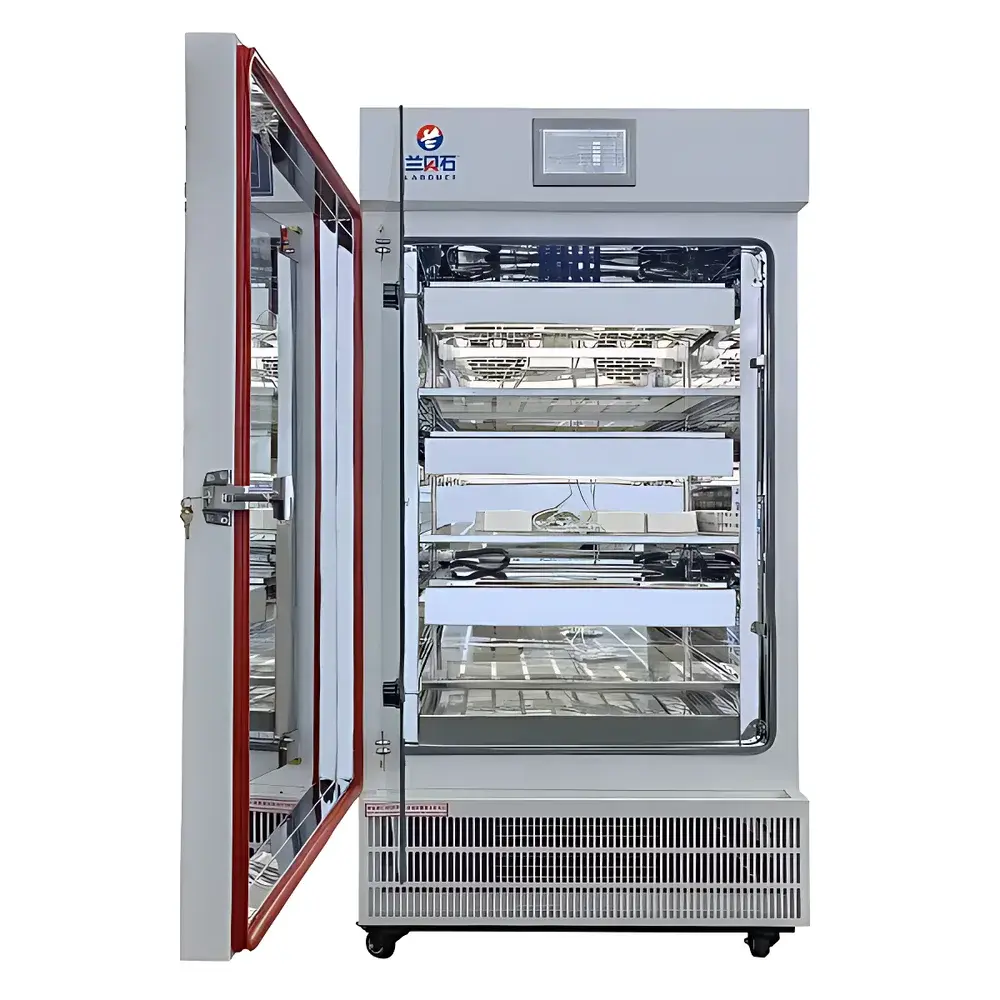
Labonce Labonce-500TPS-2 Pharmaceutical Photostability Testing Chamber
| Brand | Labonce |
|---|---|
| Origin | Beijing, China |
| Manufacturer Type | Direct Manufacturer |
| Model | Labonce-500TPS-2 |
| Temperature Range | 15–50°C |
| Chamber Volume | 500 L |
| Internal Dimensions (W×D×H) | 680×680×1080 mm |
| External Dimensions (W×D×H) | 860×1050×1850 mm |
| Power Consumption | 2.0 kW |
| Visible Light Range | 100–8000 Lux (settable, ±500 Lux deviation at 4500 Lux target) |
| Near-Ultraviolet Irradiance | 0.84–5 W/m² |
| Photostability Compliance | ICH Q1B, Chinese Pharmacopoeia 2020 Edition |
| Illumination Uniformity | ≤±10% across shelf surface |
| Temperature Stability (light ON) | ±1.0°C |
| Temperature Uniformity (per shelf) | ±2.0°C |
| Ambient Operating Temperature | +5 to +35°C |
| Power Supply | AC 220 V ±10%, 50 Hz |
| User Access Control | Three-tier permission system with audit trail |
| Data Output | Integrated thermal printer + internal electronic storage + USB export capability |
| Safety Systems | Independent overtemperature cutoff, compressor overheat/overpressure protection, remote SMS alert for temperature deviation and power failure |
| Dual-door Design | Inner tempered glass door + outer insulated solid door |
| Construction | Exterior – powder-coated steel |
| Insulation | High-density polyurethane foam (≥80 mm thickness) |
| Cooling System | Imported hermetic compressor |
| Controller | ≥7-inch programmable color touchscreen |
Overview
The Labonce Labonce-500TPS-2 Pharmaceutical Photostability Testing Chamber is an engineered environmental simulation system designed specifically for compliance-driven photostability assessment of drug substances and products under ICH Q1B and Chinese Pharmacopoeia 2020 requirements. It implements controlled irradiation using two independently regulated light sources—visible light (D65-spectrum equivalent, 100–8000 Lux) and near-ultraviolet radiation (320–400 nm, 0.84–5 W/m²)—to replicate the photochemical stress conditions specified in regulatory guidelines. The chamber maintains precise thermal stability (±1.0°C fluctuation during illumination, ±2.0°C uniformity per shelf) while delivering high spatial irradiance uniformity across its dual-shelf configuration (500 L total volume), ensuring reproducible exposure profiles critical for forced degradation studies, bracketing protocols, and long-term stability data packages submitted to FDA, EMA, and NMPA.
Key Features
- Independent dual-light-source control: Separate regulation of visible (D65-compliant) and near-UV (320–400 nm) irradiance, both directly settable and auto-compensated in real time
- Dual-door architecture: Inner tempered glass door enables non-intrusive observation without compromising internal temperature or humidity; outer insulated door minimizes thermal leakage and external light ingress
- High-fidelity thermal management: Hermetic imported compressor with optimized refrigerant cycle ensures stable operation across ambient temperatures of +5°C to +35°C, supported by ≥80 mm thick high-density polyurethane insulation
- Regulatory-grade software infrastructure: 7-inch full-color touchscreen controller with three-level user permissions (Administrator, Supervisor, Operator), full audit trail (ALCOA+ compliant), and timestamped event logging
- Robust mechanical construction: Exterior powder-coated carbon steel frame; interior chamber lined with electropolished AISI 304 stainless steel—non-reactive, corrosion-resistant, and cleanroom-compatible
- Integrated data integrity systems: Onboard thermal printer for immediate hardcopy output; internal flash memory with cyclic overwrite protection; USB 2.0 port for secure, encrypted data export in CSV format
- Comprehensive safety redundancy: Dual independent overtemperature cutoffs (chamber and sensor), compressor thermal/pressure fault detection, and configurable SMS alerts for power interruption or parameter deviation
Sample Compatibility & Compliance
The Labonce-500TPS-2 accommodates standard pharmaceutical packaging formats—including blister packs, vials, ampoules, and HDPE bottles—on two fully illuminated shelves (680 × 680 mm each). Illuminance mapping per ICH Q1B Annex 1 confirms ≤±10% spatial variation across shelf surfaces, validated using calibrated photometric sensors traceable to NIM (National Institute of Metrology, China). The system meets all photostability test conditions defined in ICH Q1B Option 1 (end-point evaluation) and Option 2 (time-point sampling), including minimum cumulative exposure thresholds: ≥1.2 × 10⁶ Lux·hr for visible light and ≥200 W·hr/m² for near-UV irradiation. Its design supports GLP and GMP-aligned workflows, with full alignment to 21 CFR Part 11 requirements for electronic records and signatures via configurable audit trail depth, user authentication, and immutable log archiving.
Software & Data Management
The embedded controller firmware supports multi-segment programmable cycles (up to 99 steps), with independent scheduling for temperature, humidity (optional add-on), visible light intensity, and near-UV irradiance. All operational parameters—including real-time Lux and W/m² readings, chamber temperature/humidity history, alarm events, and user actions—are timestamped and stored with digital signatures. Audit logs retain full operator identity, action type, timestamp, and pre-/post-change values for all critical parameters. Data export via USB adheres to ISO/IEC 17025 traceability standards: files include metadata headers (instrument ID, calibration due date, operator ID, test protocol reference), and are structured for direct import into LIMS or statistical analysis platforms (e.g., JMP, Minitab). No cloud connectivity is implemented—ensuring full data sovereignty and compliance with on-premise data governance policies.
Applications
- ICH Q1B-compliant photostability testing of active pharmaceutical ingredients (APIs) and finished dosage forms
- Forced degradation studies to identify photolytic degradation pathways and impurity profiles
- Package compatibility assessment under accelerated light exposure (e.g., amber vs. clear vials, foil overwraps)
- Validation of light-protective labeling claims and storage condition specifications
- Support for regulatory submissions to FDA (IND/NDA), EMA (MAA), PMDA, and NMPA requiring documented photostability data packages
- Method development and transfer for stability-indicating assays requiring photodegradation reference standards
FAQ
Does the Labonce-500TPS-2 comply with 21 CFR Part 11 for electronic records?
Yes—the system implements role-based access control, electronic signatures, and immutable audit trails meeting ALCOA+ principles. All data exports include cryptographic hash verification metadata.
Can irradiance be validated per ICH Q1B Annex 1 requirements?
Yes—integrated calibrated sensors enable in-chamber irradiance mapping. Full validation documentation (IQ/OQ/PQ templates) and third-party calibration certificates are available upon request.
Is humidity control available as an option?
Humidity control is not integrated in the TPS series but can be added via external RH conditioning modules compatible with the chamber’s auxiliary ports.
What is the maximum allowable sample load per shelf without compromising irradiance uniformity?
Maximum recommended load is 70% shelf area coverage (≤0.48 m² per shelf); exceeding this may require revalidation of irradiance distribution per ICH guidance.
How frequently must the light sources be recalibrated?
Visible and near-UV lamps require annual radiometric recalibration using NIST-traceable reference meters; lamp replacement intervals are tracked automatically in the audit log.






