
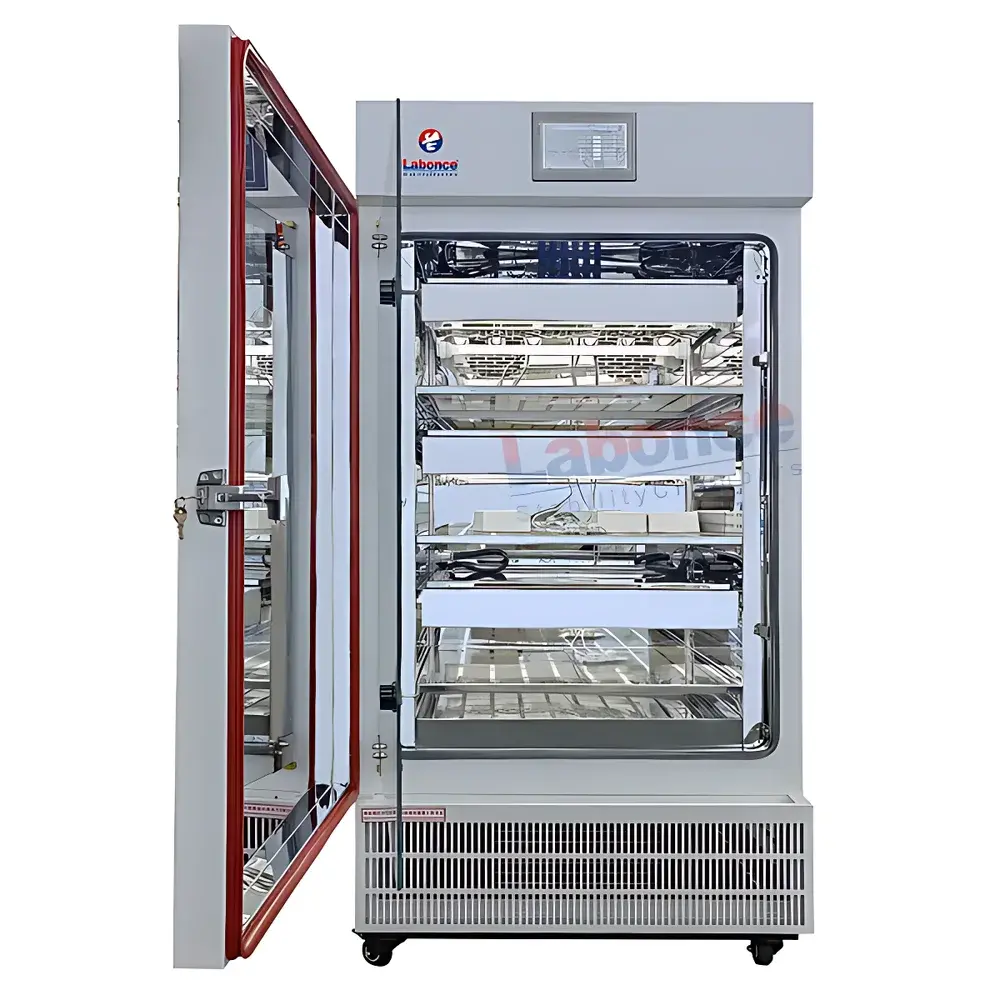
Labonce Labonce-500TPS-3 Photostability Testing Chamber for Pharmaceuticals
| Brand | Labonce |
|---|---|
| Model | Labonce-500TPS-3 |
| Temperature Range | 15–50°C |
| Humidity Control | Not Specified (Non-Humidity-Controlled) |
| Internal Volume | 500 L |
| Illumination Sources | D65-simulated visible light (100–8000 lux, setpoint 4500 ± 500 lux) and near-UV (320–400 nm, 0.84–5 W/m²) |
| Illumination Layers | 3 independently controlled layers |
| Compliance | ICH Q1B, Chinese Pharmacopoeia 2020 Edition |
| Data Logging | Real-time irradiance & illuminance recording with audit trail, USB export, thermal printer |
| Safety | Dual independent overtemperature protection, compressor overheat/overpressure cutoff, remote SMS alert on power failure or deviation |
| Power Supply | AC 220 V ±10%, 50 Hz |
| Ambient Operating Range | +5 to +35°C |
| Total Light Exposure Requirement | ≥1.2 × 10⁶ lux·h (visible), ≥200 W·h/m² (near-UV) |
Overview
The Labonce Labonce-500TPS-3 Photostability Testing Chamber is an engineered environmental test system designed exclusively for pharmaceutical photostability studies in accordance with ICH Q1B and the Chinese Pharmacopoeia (2020 Edition). It operates on the principle of controlled, reproducible photoirradiation under standardized visible (D65-simulated) and near-ultraviolet (320–400 nm) spectral bands, enabling rigorous assessment of drug substance and product degradation pathways induced by light exposure. Unlike general-purpose climate chambers, the Labonce-500TPS-3 prioritizes optical fidelity and thermal stability during illumination: it maintains temperature uniformity of ±2.0°C across each illuminated shelf while limiting short-term fluctuations to <±1.0°C during active irradiation—critical for isolating photolytic effects from thermal artifacts. Its non-humidity-controlled architecture reflects the ICH Q1B requirement for dry, ambient-relative humidity conditions during forced degradation testing, ensuring that observed changes are attributable solely to photon energy absorption rather than moisture-mediated reactions.
Key Features
- Triple-layer independent illumination control: Each of the three internal shelves features separately addressable D65-visible and near-UV lamp arrays, enabling gradient exposure studies or concurrent multi-condition testing without cross-contamination of spectral profiles.
- D65-compliant visible light source: Calibrated to deliver 4500 ± 500 lux at sample level, traceable to CIE standard illuminant D65, with real-time lux monitoring and automatic feedback regulation.
- Near-UV emission (320–400 nm): Radiant flux adjustable from 0.84 to 5 W/m², measured via integrated broadband UV sensor; spectral output validated against ICH Q1B minimum energy threshold of ≥200 W·h/m².
- Audit-ready control architecture: 7-inch color touchscreen controller with role-based access (three-tier user permissions), full electronic audit trail per FDA 21 CFR Part 11 and GLP requirements—including timestamped operator actions, parameter changes, alarm events, and calibration logs.
- Thermally robust chamber design: High-density polyurethane foam insulation (≥100 mm thickness) minimizes thermal bridging; interior constructed entirely of mirror-finish AISI 304 stainless steel to eliminate organic outgassing and support aseptic cleaning protocols.
- Fail-safe thermal management: Dual redundant overtemperature protection circuits (mechanical and digital), refrigeration system powered by imported hermetic compressor with low-noise, high-efficiency operation and extended service life.
- Remote monitoring capability: Optional GSM module enables SMS alerts for temperature excursions, power interruption, door-open events, or system faults—ensuring continuous oversight during unattended 24/7 operation.
Sample Compatibility & Compliance
The Labonce-500TPS-3 accommodates standard pharmaceutical packaging formats including blister cards, HDPE bottles, glass vials, and aluminum pouches on its 680 × 680 × 1080 mm internal chamber volume. Its double-door structure—comprising an outer insulated steel door and inner tempered glass observation door—preserves chamber integrity during visual inspection: opening only the inner door limits humidity and temperature perturbation to <0.5°C over 30 seconds. All materials contacting the test environment comply with USP and ISO 10993-5 cytotoxicity standards. The system satisfies full traceability requirements for regulatory submissions under ICH Q5C (stability testing of biotechnological/biological products) and supports validation documentation packages aligned with Annex 15 (Qualification and Validation) of the EU GMP Guidelines.
Software & Data Management
Data acquisition is performed continuously at 1-second intervals for both illuminance (lux) and near-UV irradiance (W/m²), stored internally with time-stamped metadata. Export is supported via USB 2.0 interface in CSV format compatible with LIMS, ELN, and statistical analysis platforms (e.g., JMP, Minitab). Integrated thermal printer provides hard-copy verification of start/end timestamps, cumulative exposure totals, and deviation alerts—meeting ALCOA+ data integrity principles (Attributable, Legible, Contemporaneous, Original, Accurate, Complete, Consistent, Enduring, Available). Electronic records include cryptographic hash signatures to prevent post-acquisition modification, fulfilling FDA 21 CFR Part 11 electronic signature requirements.
Applications
- ICH Q1B photostability protocol execution for new drug applications (NDAs), marketing authorization applications (MAAs), and generic drug filings.
- Forced degradation studies to identify photolabile functional groups and establish degradation pathways under oxidative, hydrolytic, and photolytic stress.
- Light screening of excipients and primary packaging materials for UV-induced leachables or colorant migration.
- Stability-indicating method development support, where photodegradants serve as specificity markers for HPLC/UPLC assay validation.
- Comparative photostability assessment across batch-to-batch manufacturing variations or formulation iterations.
FAQ
Does the Labonce-500TPS-3 meet ICH Q1B irradiance uniformity requirements?
Yes. Optical mapping confirms ≤±15% irradiance variation across any single shelf surface (per ICH Q1B Annex 1), achieved through optimized top-mounted lamp geometry and reflective chamber walls.
Can the system be qualified per GMP Annex 15?
Yes. Full IQ/OQ/PQ documentation templates—including sensor calibration certificates (NIST-traceable lux and UV meters), temperature mapping reports, and irradiance uniformity validation protocols—are available upon request.
Is humidity control available as an option?
No. The TPS-series is intentionally non-hygrometric to align with ICH Q1B’s specification of “exposure under ambient relative humidity” during photostability testing. For combined temp/humidity/light stress, Labonce offers the LTPS variant series.
What is the maximum allowable sample load per shelf without compromising irradiance uniformity?
Up to 80% shelf area coverage is permitted, provided samples do not exceed 100 mm height and maintain ≥25 mm clearance from lamp arrays and chamber walls.
How frequently must the lamps be recalibrated or replaced?
Lamp spectral output and intensity decay are monitored automatically; replacement is recommended after 1000 hours of cumulative operation or upon detection of >10% deviation from baseline irradiance—whichever occurs first. Calibration certificates are issued with each lamp set.



