
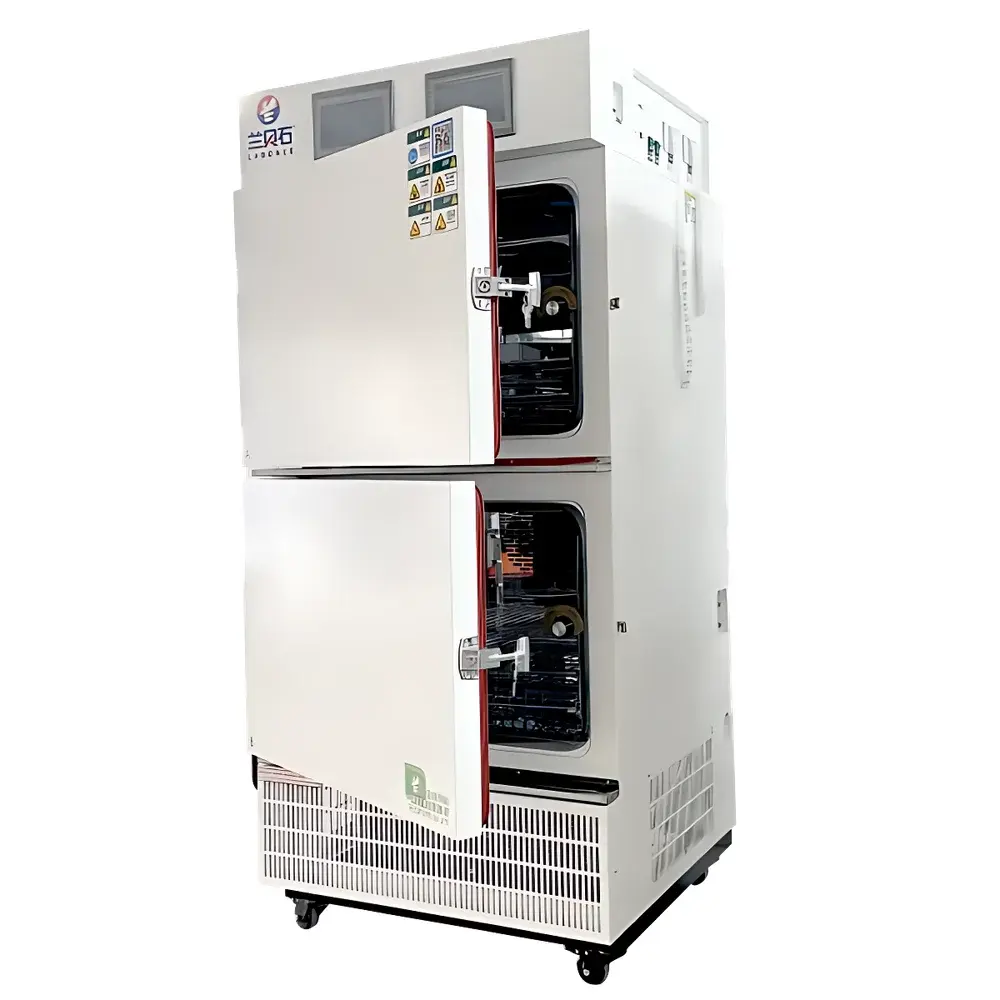
Labonce Labonce-520CGS-FC Dual-Chamber Drug Stability Testing Chamber
| Brand | Labonce |
|---|---|
| Origin | Beijing, China |
| Manufacturer Type | Direct Manufacturer |
| Model | Labonce-520CGS-FC |
| Temperature Range | 15–65°C |
| Humidity Range | 20–95% RH |
| Chamber Volume | 250 L (A Chamber: 250 L, B Chamber: 250 L) |
| Internal Dimensions (W×D×H) | 600×500×830 mm |
| External Dimensions (W×D×H) | 1610×870×1650 mm |
| Power Consumption | 3.0 kW |
| Standard Shelves | 3 (left A chamber), 7 (right B chamber) |
| Illumination | Visible light (100–6000 Lux |
| Temperature Uniformity | ±0.5°C fluctuation, ±1.0°C deviation (dark condition) |
| Humidity Uniformity | ±2% RH fluctuation, ±3% RH deviation (dark condition) |
| Ambient Operating Range | +5 to +35°C |
| Power Supply | AC 220 V ±10%, 50 Hz |
| Insulation | High-density polyurethane foam |
| Interior Material | Mirror-finish AISI 304 stainless steel |
| Exterior Material | Powder-coated cold-rolled steel |
| Compressor | Imported hermetic variable-frequency scroll compressor |
| Humidity Sensor | Imported capacitive humidity sensor (low drift, maintenance-free) |
| Controller | 7-inch color programmable touchscreen with real-time inverter output ratio display |
| User Access Control | Three-tier role-based authentication (admin/operator/user) |
| Audit Trail | Time-stamped, tamper-evident operation and alarm logs exportable via USB in read-only format |
| Data Output | Built-in thermal line printer + internal electronic storage (≥1 year at 1-min intervals) |
| Safety Systems | Independent overtemperature protection, compressor overheat/overpressure cutoff, low-water and dry-run prevention, dual-stage door interlock |
| Alarm Modes | Local audible alarm + remote SMS alert for temperature/humidity deviation and power failure |
| Door Design | Double-door structure — outer solid insulated door, inner tempered glass observation door (minimizes environmental disturbance during sampling) |
| Optional Ports | Ø50 mm test port with silicone plug, casters, mechanical door lock |
Overview
The Labonce Labonce-520CGS-FC Dual-Chamber Drug Stability Testing Chamber is an ICH Q1-compliant, GMP-aligned environmental simulation system engineered specifically for long-term, accelerated, and intermediate stability studies of pharmaceutical products under controlled temperature, humidity, and photostability conditions. Unlike single-chamber systems, the 520CGS-FC implements a physically segregated dual-zone architecture: the left chamber (A) integrates temperature, humidity, visible light (100–6000 Lux), and near-ultraviolet irradiation (0.84–1.0 W/m²), while the right chamber (B) provides independent temperature and humidity control without illumination. This configuration enables concurrent execution of ICH Q1B photostability protocols alongside Q1A/Q1B climatic condition testing—critical for regulatory submissions to FDA, EMA, PMDA, and NMPA. The chamber’s thermal and hygric performance adheres strictly to USP , ICH Q5C, and Chinese Pharmacopoeia 2020 Edition requirements, with validated uniformity (±0.5°C temp fluctuation, ±2% RH humidity fluctuation) across the full working volume.
Key Features
- Variable-frequency refrigeration system using an imported hermetic scroll compressor—reducing energy consumption and water usage by >50% versus fixed-speed equivalents while maintaining stable thermal load response under dynamic setpoint transitions.
- Capacitive humidity sensing technology with factory-calibrated traceability, delivering long-term accuracy (<±3% RH deviation) without field recalibration or consumable replacement.
- Three-tier user permission architecture compliant with 21 CFR Part 11 Annex 11 expectations: administrator-level configuration access, operator-level run control, and user-level viewing rights—enforced via encrypted username/password authentication.
- Audit trail functionality records all critical events—including parameter changes, door openings, alarm triggers, and user logins—with immutable timestamps and export capability via USB in PDF or CSV format (read-only, non-editable).
- Dual-door design featuring an outer insulated solid door and an inner tempered glass observation door—ensuring minimal thermal and moisture exchange (<0.3°C/0.8% RH perturbation within 30 s of brief inspection) during routine sample checks.
- Integrated photometric subsystem with calibrated visible-light and near-UV sensors, automatically logging and printing cumulative exposure metrics (Lux·hr and W·hr/m²) per ICH Q1B thresholds—eliminating manual integration errors.
Sample Compatibility & Compliance
The Labonce-520CGS-FC accommodates a broad range of pharmaceutical dosage forms—including tablets, capsules, injectables in vials, ointments, and lyophilized powders—within its 250 L A and B chambers. Each chamber supports up to seven adjustable stainless-steel shelves (3 in A, 7 in B), accommodating standard ISO trays and stability protocol-compliant packaging configurations. All materials contacting the test environment meet USP Class VI biocompatibility standards: interior surfaces are mirror-polished AISI 304 stainless steel (electropolished finish, Ra ≤ 0.4 µm), and insulation consists of CFC-free, high-density polyurethane foam (thermal conductivity ≤ 0.022 W/m·K). The system is designed for compliance with ISO 14644-1 Class 8 cleanroom-compatible installation environments and supports full qualification (IQ/OQ/PQ) documentation packages aligned with EU GMP Annex 15 and WHO TRS 986.
Software & Data Management
The embedded 7-inch color touchscreen controller runs a deterministic real-time OS with deterministic loop update rates (<100 ms). It supports up to 20 programmable profiles, each with 99 segments (ramp/soak), and displays live inverter output percentage—enabling predictive maintenance assessment. Electronic data is stored internally for ≥12 months at 1-minute logging intervals (temperature, humidity, light intensity, alarms, user actions). Data export includes time-synchronized CSV files and thermal-printed hard copies (via integrated needle printer). All exported files contain digital signatures verifying integrity and origin. The system supports optional Ethernet connectivity for integration into centralized Laboratory Information Management Systems (LIMS) or MES platforms, with configurable MODBUS TCP or OPC UA interfaces.
Applications
- ICH Q1A(R2) long-term (25°C/60% RH) and accelerated (40°C/75% RH) stability testing of APIs and finished products.
- ICH Q1B photostability assessment per Option 1 (optionally Option 2) including visible light and near-UV exposure quantification.
- Bracketing and matrixing study designs per ICH Q5C for multi-product or multi-batch evaluations.
- Stability-indicating method development support through controlled degradation generation under defined stress conditions.
- GMP-compliant storage validation for retained samples, reference standards, and stability batches per FDA Guidance for Industry (2022) and EU Guidelines on Declaration of Storage Conditions.
FAQ
Does the Labonce-520CGS-FC meet ICH Q1B photostability requirements for both visible light and near-UV exposure?
Yes—the A chamber integrates independently calibrated visible-light (4500 ± 500 Lux) and near-UV (0.84–1.0 W/m²) sources with real-time monitoring and automatic cumulative dose calculation per ICH Q1B thresholds.
Is audit trail functionality compliant with 21 CFR Part 11 and EU Annex 11?
Yes—user authentication, parameter modification history, alarm logs, and data exports are time-stamped, electronically signed, and exportable in non-modifiable formats with full traceability.
What is the validation support package available for IQ/OQ/PQ execution?
Labonce provides comprehensive qualification templates—including URS, FRS, DQ documentation, as well as pre-validated test protocols and acceptance criteria aligned with ASTM E2500 and ISPE Baseline Guide Vol. 5.
Can the system operate continuously under GMP-controlled utility conditions?
Yes—it is rated for uninterrupted 24/7 operation within ambient conditions of +5 to +35°C and supports redundant power input options (optional UPS interface) and remote monitoring via SMS/email alerts.
How is humidity uniformity maintained across the full chamber volume during low-RH operation?
The system employs a dual-mode humidification/dehumidification strategy: steam injection combined with precise variable-speed refrigerant bypass control ensures ±2% RH fluctuation even at 20% RH setpoints.




