
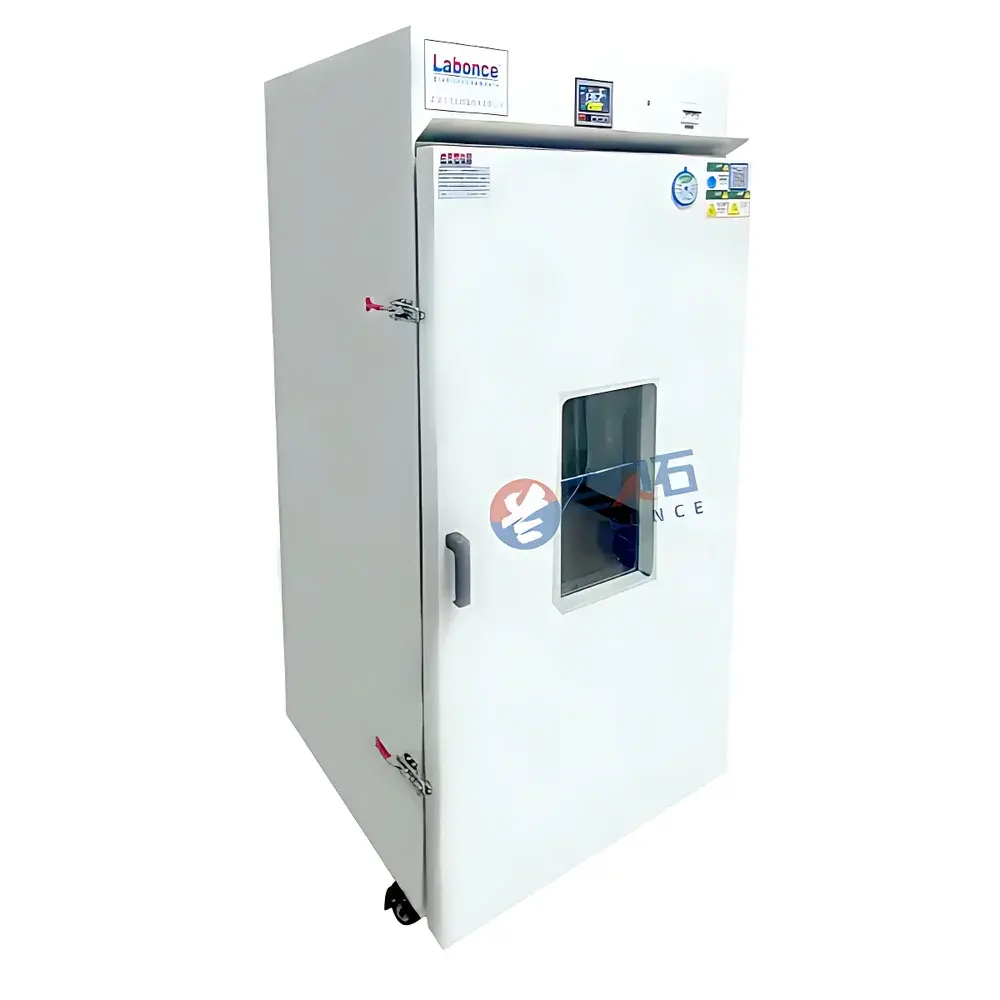
Labonce Labonce-925JMH Precision Forced-Air Drying Oven (300°C)
| Brand | Labonce |
|---|---|
| Model | Labonce-925JMH |
| Temperature Range | RT+20°C to 300°C |
| Chamber Volume | 1000 L |
| Interior Dimensions (W×D×H) | 1000×600×1600 mm |
| Exterior Dimensions (W×D×H) | 1140×800×2150 mm |
| Power Supply | AC 220V±10% / 380V±10%, 50 Hz |
| Rated Power | 5.2 kW |
| Temperature Uniformity | ±3.0°C (at ≤200°C) |
| Temperature Fluctuation | ±1.0°C |
| Standard Shelving | 4 stainless steel shelves (adjustable), max. 8 optional |
| Construction | External cold-rolled steel with epoxy-polyester powder coating |
| Air Circulation | Horizontal forced-air convection with optimized duct system |
| Safety | Independent over-temperature protection circuit (mechanical backup) |
Overview
The Labonce Labonce-925JMH Precision Forced-Air Drying Oven is an industrial-grade, high-capacity benchtop-to-floor-standing thermal processing instrument engineered for reproducible, uniform heat treatment of materials, components, and samples in R&D laboratories, quality control environments, and manufacturing facilities. Operating on the principle of horizontal forced-air convection, the oven utilizes a precisely balanced blower-driven airflow system that ensures consistent thermal distribution across its 1000-liter working chamber—critical for applications requiring strict adherence to temperature stability and spatial homogeneity per ISO 17025, ASTM E145, and IEC 60068-2-2 test standards. Designed for sustained operation up to 300°C, the Labonce-925JMH supports both accelerated drying, pre-conditioning, curing, and thermal aging protocols under controlled ambient conditions.
Key Features
- Robust dual-voltage compatibility: configurable for either AC 220V±10% (single-phase) or AC 380V±10% (three-phase) input—enabling flexible integration into diverse laboratory power infrastructures.
- Optimized horizontal airflow architecture: engineered duct layout minimizes turbulence and dead zones, achieving ≤±3.5°C temperature uniformity at 300°C (measured per ISO 17025-compliant point mapping at 9 locations).
- Dual-layer thermal insulation: high-density ceramic fiber lining combined with air-gap cavity design reduces external surface temperature rise and improves energy efficiency during extended high-temperature cycles.
- Stainless steel 304 chamber construction: corrosion-resistant interior with seamless welding and rounded corners facilitates cleaning, prevents residue accumulation, and complies with GLP hygiene requirements.
- Independent mechanical over-temperature cut-off: redundant safety circuit interrupts heating if controller failure or sensor drift exceeds preset threshold—meeting IEC 61000-4-2 and EN 61010-1 safety directives.
- Digitally calibrated microprocessor controller: 0.1°C resolution setpoint adjustment, real-time PID tuning capability, and programmable ramp-soak profiles (up to 9 segments) support method-defined thermal protocols.
Sample Compatibility & Compliance
The Labonce-925JMH accommodates large-format samples—including printed circuit boards, polymer composites, metal substrates, pharmaceutical packaging trays, and bulk chemical containers—without compromising thermal fidelity. Its spacious 1000 L chamber and four standard adjustable stainless steel shelves (load capacity: 15 kg/shelf) allow vertical stacking while maintaining unobstructed airflow. The unit conforms to key international regulatory frameworks: it is CE-marked per Machinery Directive 2006/42/EC and Low Voltage Directive 2014/35/EU; its temperature performance validation protocol aligns with ISO/IEC 17025:2017 Clause 6.4.3 for equipment calibration traceability; and its documentation structure supports FDA 21 CFR Part 11 readiness when paired with compliant data logging software.
Software & Data Management
While the standard configuration features a stand-alone digital controller with local display and manual parameter entry, optional RS485 Modbus RTU interface enables integration with centralized lab management systems (LIMS) or SCADA platforms. When used with Labonce’s certified data acquisition module (sold separately), users can export time-stamped temperature logs (.CSV), generate audit trails with user authentication, and apply electronic signatures—fulfilling ALCOA+ principles for data integrity in GMP-regulated environments. All firmware updates are delivered via secure USB-based patching, with version history retained in non-volatile memory.
Applications
- Thermal aging of elastomers, adhesives, and thermoset resins per ASTM D573 and ISO 188.
- Moisture removal from hygroscopic powders, granules, and active pharmaceutical ingredients (APIs) prior to tablet compression.
- Baking and curing of conformal coatings on PCB assemblies per IPC-CC-830B.
- Pre-drying of filter media, catalyst supports, and ceramic green bodies before sintering.
- Stability testing of medical device packaging per ISO 11607-1 accelerated shelf-life protocols.
- Conditioning of reference standards and calibration artifacts in metrology labs.
FAQ
What is the maximum continuous operating temperature?
The Labonce-925JMH is rated for continuous operation at 300°C. For optimal long-term reliability, Labonce recommends limiting sustained use above 280°C to ≤4 hours per cycle.
Does the oven include validation documentation for IQ/OQ/PQ?
Yes—factory-supplied as-delivered documentation includes Factory Acceptance Test (FAT) reports, calibration certificates traceable to NIM (China National Institute of Metrology), and a User Requirement Specification (URS) cross-reference matrix.
Can the shelving configuration be customized?
Standard units ship with four adjustable 304 stainless steel shelves. Optional accessories include reinforced heavy-duty shelves (30 kg capacity), perforated trays for enhanced airflow, and Teflon-coated inserts for acid-sensitive samples.
Is remote monitoring supported out of the box?
No—remote monitoring requires the optional RS485 communication module and third-party SCADA or LabVIEW-compatible drivers. Local data logging is available via optional USB logger.
What maintenance intervals are recommended?
Blower motor lubrication every 12 months; airflow duct inspection and chamber cleaning every 6 months; temperature sensor verification annually or after 500 operational hours—whichever occurs first.



