
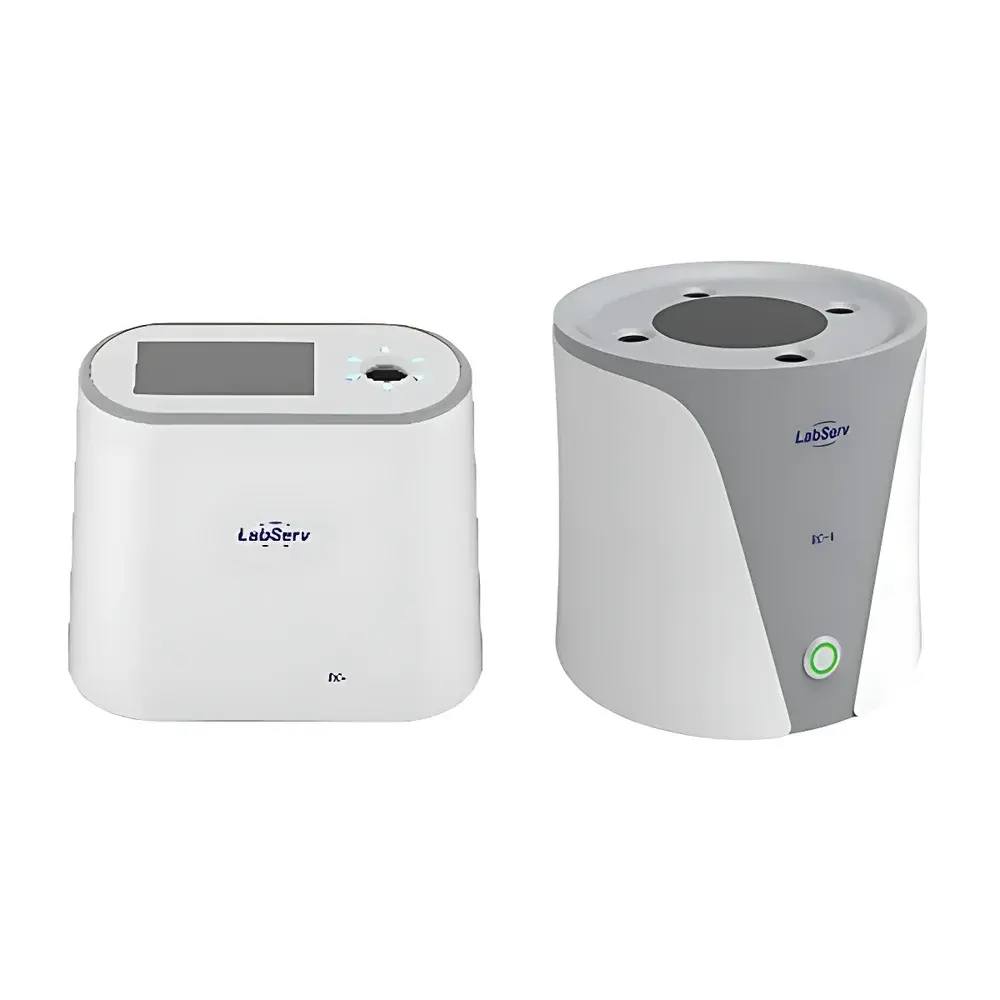
LabServ™ RC Series Intelligent Cell Thawing Instrument
| Brand | LabServ |
|---|---|
| Origin | Shanghai, China |
| Model | LabServ RC-1 (Single Position) / LabServ RC-4 (Quad Position) |
| Thawing Method | Dry Heat Air Bath |
| Temperature Uniformity | ±0.5°C (4-point measurement: 2 thermistors + 1 digital IR sensor on tube wall + 1 air stream sensor) |
| Programmable Profiles | Up to 6 user-defined thawing protocols |
| Compliance | Designed for GMP, GLP, and FDA 21 CFR Part 11–ready data integrity workflows |
| Optional Accessories | Barcode scanner for cryovial identification, customizable cryovial adapters |
Overview
The LabServ™ RC Series Intelligent Cell Thawing Instrument is a purpose-engineered dry heat air bath system designed to deliver precise, reproducible, and auditable cell thawing under controlled thermal conditions. Unlike traditional water bath thawing—where cross-contamination risk, temperature drift, and manual intervention compromise consistency—the RC Series employs a calibrated forced-air convection architecture to ensure uniform thermal energy transfer directly to the cryovial surface. This method eliminates immersion media, prevents microbial ingress, and maintains strict environmental separation between samples and heating source—critical for aseptic processing in biopharmaceutical manufacturing, ATMP (Advanced Therapy Medicinal Product) development, and clinical-grade cell banking. The instrument operates on a fundamental principle of convective heat transfer optimized for cryopreserved biological matrices, with real-time dual-mode temperature monitoring (air stream and vial wall) enabling closed-loop thermal regulation aligned with ISO 20387:2018 (biobanking) and USP <1043> (cryopreservation of cells).
Key Features
- Dual-sensor thermal monitoring: Two platinum resistance thermistors measure air stream temperature at inlet and outlet; one digital infrared (IR) sensor non-invasively tracks vial wall surface temperature—enabling four-point spatial validation of thermal uniformity within ±0.5°C across all positions.
- GMP-aligned software architecture: Role-based access control (RBAC) with up to four hierarchical user levels (Admin, Supervisor, Operator, Viewer); all actions—including profile edits, start/stop commands, and parameter adjustments—generate immutable audit trails compliant with FDA 21 CFR Part 11 requirements.
- Barcode-integrated workflow: Optional high-resolution cryovial barcode scanner synchronizes thawing event metadata (vial ID, lot number, operator, timestamp) directly into the local database—eliminating transcription errors and ensuring full traceability from thaw to downstream assay.
- Flexible protocol management: Six programmable thawing profiles stored locally; each supports independent ramp rate, hold temperature, dwell time, and fan speed settings—optimized for diverse cryoprotectants (e.g., DMSO vs. trehalose), vial formats (1.8 mL, 2.0 mL, 5.0 mL external thread), and freezing rates (-1°C/min vs. -10°C/min).
- Standalone operability: 7-inch HD capacitive touchscreen interface displays real-time temperature curves, protocol status, alarm logs, and calibration history—no PC or network dependency required for routine operation or qualification.
Sample Compatibility & Compliance
The RC Series accommodates standard externally threaded cryovials (Nunc, Corning, Greiner Bio-One) and internally threaded formats via field-replaceable adapter plates—customizable for 1.2 mL, 2.0 mL, 5.0 mL, and controlled-rate freezing vials. All thermal profiles are validated per IQ/OQ/PQ protocols against ASTM E2294-22 (Standard Practice for Validation of Thermal Processing Equipment) and ISO 13485:2016 Annex A.2 (medical device quality systems). Data export supports CSV and PDF report generation with embedded digital signatures, meeting EU Annex 11 and ICH GCP E6(R3) documentation standards for clinical trial material handling.
Software & Data Management
Embedded firmware includes built-in electronic logbook with automatic timestamping, operator authentication, and tamper-evident hashing of all critical parameters. Data retention is configurable (default: 12 months local storage); export options include encrypted USB transfer or secure SFTP push to LIMS or QMS platforms. Audit trail entries capture WHO (user ID), WHAT (action), WHEN (UTC timestamp), WHERE (instrument serial), and WHY (associated protocol ID)—fully satisfying ALCOA+ principles (Attributable, Legible, Contemporaneous, Original, Accurate, Complete, Consistent, Enduring, Available).
Applications
- Biomanufacturing: Thawing of master cell banks (MCBs), working cell banks (WCBs), and final drug substance for monoclonal antibody and recombinant protein production.
- Cell therapy: Controlled recovery of CAR-T, NK, and MSC products prior to formulation, QC testing, or infusion—reducing post-thaw viability loss and preserving phenotypic stability.
- Academic & government research: Standardized thawing for reproducible single-cell RNA-seq, flow cytometry, and functional assays across multi-site collaborations.
- Regulatory submissions: Documentation-ready output supporting IND/IMPD dossiers, especially where thawing variability must be quantified per ICH Q5D and Q5A(R2).
FAQ
Does the RC Series support IQ/OQ/PQ documentation packages?
Yes—LabServ provides vendor-qualified 3Q kits including protocol templates, acceptance criteria, raw data worksheets, and summary reports aligned with ASTM E2500-22 and ISPE Baseline Guide Vol. 5.
Can thawing data be integrated into our existing LIMS?
Yes—via configurable RESTful API or scheduled SFTP export; JSON and XML schema mappings are provided upon request.
Is the IR sensor calibrated traceable to NIST standards?
Yes—each unit ships with a certificate of calibration for the IR sensor, traceable to NIST SRM 1900, with annual recalibration recommended.
What freeze-thaw cycle validation support is available?
LabServ offers application-specific thawing validation services—including viability, recovery yield, and functional marker retention testing—using ISO 20387-compliant reference materials.
How is firmware updated, and does it affect data integrity?
Firmware updates are performed via signed USB image; the system preserves all audit logs and database integrity during update—no data loss or timestamp reset occurs.
Related Products



