
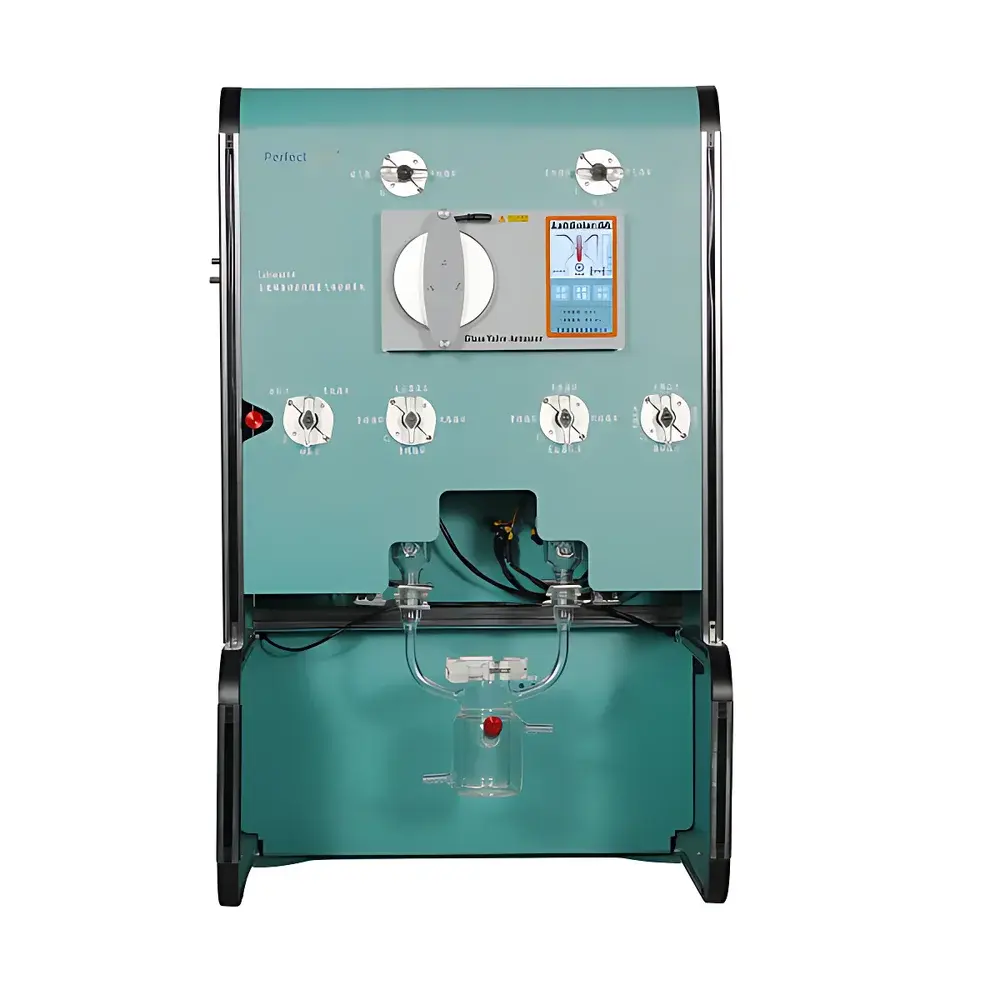
Labsolar-6A All-Glass Automated Online Trace Gas Analysis System
| Brand | PerfectLight |
|---|---|
| Origin | Beijing, China |
| Model | Labsolar-6A Online Photocatalytic Analysis System |
| Reaction Vessel Count | 1 |
| Reaction Volume | 65 mL |
| Vacuum Tightness | ≤1 μmol/24 h (O₂) |
| Gas Mixing Time (H₂/O₂/CH₄/CO) | <10 min |
| Quantitative Loop Options | 0.6 mL or 2 mL |
| System Tubing Volume | 65 mL |
| Absolute Vacuum Level | ≤1.5 kPa |
| Operating Pressure Range | 0 kPa to atmospheric |
| Valve Count | 7 |
| Tubing Material | High-Borosilicate Glass |
| Temperature Control Range (Tubing & Sampling Lines) | Up to 200 °C (10-segment programmable, ±0.1 °C accuracy) |
| Detection Limits (� | mol): H₂: 0.05 |
| O₂ | 0.1 |
| CH₄/CO | 0.0005 |
| Repeatability (RSD) | <3% for quadruplicate injections |
| Linearity (H₂, 100 � | L–10 mL): R² > 0.9995 |
| Exhaust Volume per Cycle | 6 mL |
| Pump Type | Passive Magnetic-Drive Plunger Pump (wire-free, no H₂ evolution risk, unidirectional flow) |
| Sampling Method | Fixed-volume loop integrated in multi-port glass sampling valve (non-chromatographic) |
| Condenser | Spherical or coiled type |
| Enclosure | Metal safety cabinet with portable light-shielding hood |
| Software | 32-bit control suite + 4.5″ TFT color touchscreen |
Overview
The Labsolar-6A All-Glass Automated Online Trace Gas Analysis System is a purpose-built, ultra-high-integrity platform engineered for quantitative kinetic analysis of low-yield gaseous products in heterogeneous photocatalytic, photoelectrochemical (PEC), photothermal, and electrocatalytic reactions. Its core architecture implements a closed-loop, all-glass gas circulation manifold—constructed entirely from high-borosilicate glass with precision lapped glass valves—to eliminate surface adsorption, metal ion leaching, and organic contamination common in stainless-steel or polymer-based systems. The system operates on the principle of iterative gas-phase sampling via a fixed-volume loop coupled with external gas chromatography (GC) detection, enabling stoichiometric quantification of H₂, O₂, CH₄, CO, and other trace species at sub-micromole levels. Designed explicitly for fundamental catalyst activity assessment, it mitigates product re-adsorption artifacts and reverse reaction interference through rapid, turbulent gas mixing (<10 min homogenization) and unidirectional magnetic-drive pumping—eliminating electrolytic hydrogen generation and spark hazards associated with electrically driven components.
Key Features
- All-glass fluidic path (high-borosilicate, DIN-standard joints) ensures chemical inertness, thermal stability (−40 °C to 200 °C), and negligible gas adsorption—critical for accurate O₂ evolution and quantum yield measurements.
- Seven precision-ground glass valves with imported Dow Corning vacuum grease (vapor pressure <1×10⁻⁶ Torr, service range −40 °C to 200 °C) guarantee long-term leak integrity: ≤1 μmol O₂ loss per 24 hours under static vacuum.
- Passive magnetic-drive plunger pump delivers 6 mL/cycle displacement with zero electrical wiring in the gas stream—fully intrinsically safe for H₂-rich environments and compatible with GLP/GMP-controlled laboratories.
- Programmable 10-segment temperature control (±0.1 °C accuracy) applied independently to circulation tubing and sampling lines enables precise management of condensable byproducts (e.g., water vapor) and prevents GC column contamination.
- Integrated 4.5″ TFT touchscreen interface with 32-bit embedded software provides full sequence automation: valve actuation, GC trigger, vacuum pump duty cycling, real-time pressure telemetry, and vacuum grease lifetime estimation.
- Dual quantitative loop options (0.6 mL and 2 mL) allow dynamic adjustment of detection sensitivity without hardware modification—supporting both high-precision low-turnover studies and high-throughput screening.
Sample Compatibility & Compliance
The Labsolar-6A accommodates modular reactor configurations—including top-irradiated quartz photoreactors, three-electrode PEC cells, resistively heated photothermal reactors, and custom-designed electrocatalytic cells—enabling seamless transition across reaction modalities without cross-contamination. Its all-glass construction complies with ISO 8573-1 (compressed air purity classes) for inert gas handling and meets ASTM E2913-21 requirements for trace gas quantification in catalytic testing. The system supports audit-ready operation under FDA 21 CFR Part 11 when paired with validated GC data systems, offering electronic signatures, method versioning, and immutable event logs. Vacuum integrity performance (≤1.5 kPa absolute) satisfies USP criteria for residual solvent analysis infrastructure, while the metal safety enclosure and detachable light-shielding hood conform to IEC 61000-4-3 electromagnetic compatibility and ISO 15387 optical isolation standards.
Software & Data Management
The embedded control software implements a hierarchical security model: operator-level access permits routine method execution and real-time monitoring; administrator-level credentials unlock secondary debugging mode for advanced calibration, valve timing optimization, and firmware diagnostics. All instrument actions—including valve rotation sequences, pump activation cycles, and pressure ramp profiles—are timestamped and logged with CRC-32 checksum validation. Raw telemetry (system pressure, ambient temperature, valve status) exports directly to CSV or HDF5 formats for integration into LIMS or MATLAB-based kinetic modeling pipelines. Preconfigured ASTM E2913-compliant methods are stored onboard for H₂/O₂ dual-detection protocols, including automatic baseline correction, retention time alignment, and peak area integration using Savitzky-Golay smoothing. Vacuum grease replacement alerts are triggered based on cumulative operating hours and temperature exposure history—ensuring sustained seal performance across extended campaigns.
Applications
- Photocatalytic water splitting (H₂ and O₂ co-evolution kinetics, apparent quantum efficiency mapping)
- Full water decomposition stoichiometry verification (2:1 H₂:O₂ ratio validation under inert atmosphere)
- CO₂ photoreduction pathway analysis (CH₄, CO, C₂H₄ selectivity tracking over time)
- Photoelectrochemical (PEC) bias-dependent Faradaic efficiency determination
- Photothermal catalysis under controlled negative-to-atmospheric pressure gradients
- Electrocatalytic HER/OER/CO₂RR gas evolution quantification with in situ pressure compensation
- Isotope-labeled tracer studies (e.g., ¹⁸O₂ evolution from H₂¹⁸O) leveraging ultra-low background O₂ detection (0.1 μmol LOD)
FAQ
Does the Labsolar-6A require external gas chromatography instrumentation?
Yes—the system is designed as a front-end automated sampling and conditioning platform; final quantification relies on integration with a standard GC equipped with TCD or PDHID detectors.
Can the system operate under vacuum and positive pressure simultaneously?
It maintains stable operation across 0 kPa (absolute) to ambient pressure; however, simultaneous differential pressure application across subsystems is not supported.
What maintenance intervals are recommended for vacuum grease and condenser coolant?
Dow Corning high-vacuum grease should be inspected every 500 operational hours and replaced if discoloration or viscosity loss is observed; condenser water should be refreshed weekly in continuous-use scenarios.
Is remote monitoring supported via Ethernet or USB?
The embedded controller supports USB-C data export and serial command protocol (RS-232); Ethernet connectivity requires optional industrial gateway integration.
How is calibration traceability established for gas concentration measurements?
Users perform daily span calibration using certified standard gas mixtures (NIST-traceable); the software stores calibration coefficients with date/time stamps and operator ID for full audit trail compliance.
Related Products



