
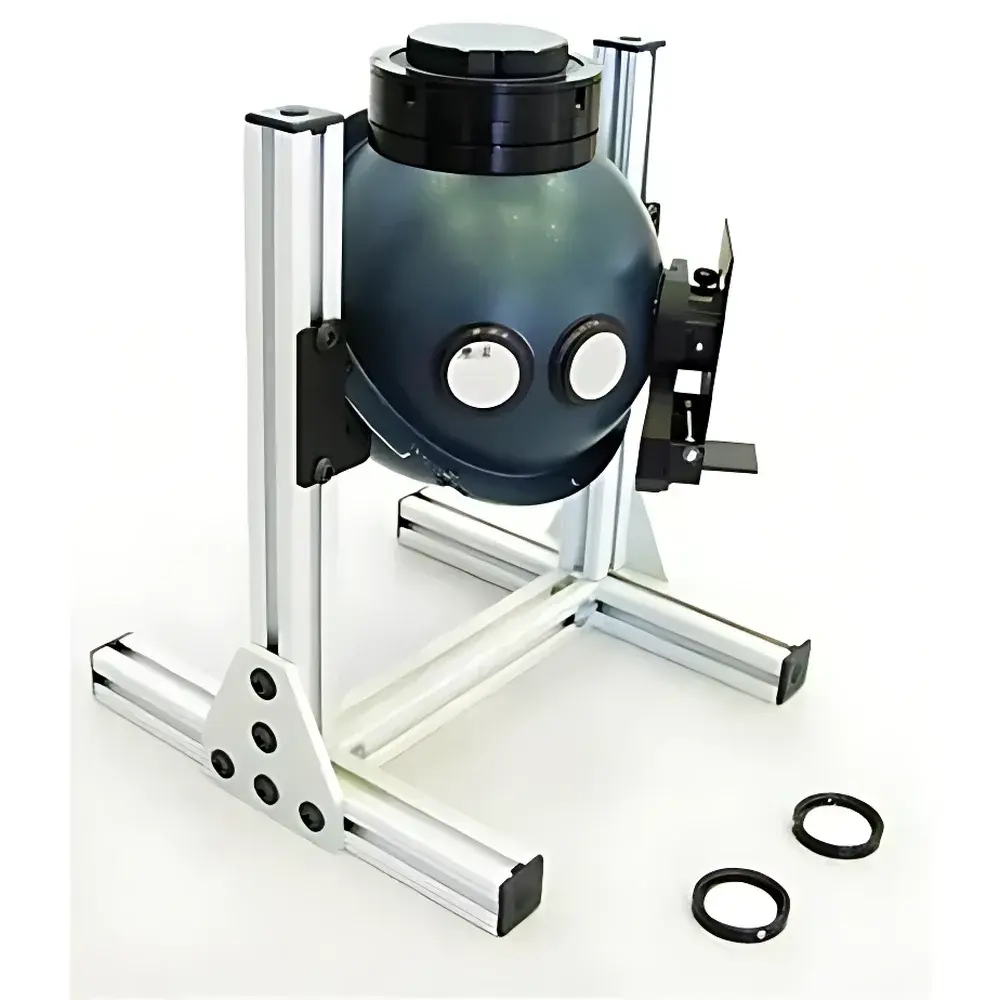
Labsphere RT-060-SF Reflectance/Transmittance Integrating Sphere
| Brand | Labsphere |
|---|---|
| Origin | USA |
| Model | RT-060-SF |
| Coating | Spectraflect® |
| Spectral Range | 250–2500 nm |
| Sphere Diameter | 6 inches |
| Detector Port | 0.5 inch |
| Sample/Reference Ports | Five 1-inch ports |
| Mirror Trap | Included |
| Mounting | 1/4-20 threaded stud with adjustable rod-and-base stand |
| Compliance | ASTM E1331, ISO 9050, CIE S 014, USP <857> (for optical characterization) |
Overview
The Labsphere RT-060-SF Reflectance/Transmittance Integrating Sphere is an engineered optical measurement platform designed for high-fidelity, spectrally resolved quantification of diffuse and total reflectance and transmittance across the ultraviolet, visible, and near-infrared (UV-VIS-NIR) spectral range (250–2500 nm). Based on the fundamental principle of spatial integration via multiple diffuse reflections within a highly uniform, Lambertian-coated cavity, the RT-060-SF enables accurate radiometric and photometric characterization of materials whose optical behavior deviates from ideal specular or collimated transmission—such as turbid liquids, powdered solids, coated substrates, diffusers, and low-gloss surfaces. Its 6-inch internal diameter, combined with Spectraflect® coating (≥98% hemispherical reflectance over 300–2400 nm), ensures excellent signal-to-noise ratio and long-term photometric stability. The sphere’s five 1-inch ports support flexible optical configuration—including 9°/d (diffuse-only) and 9°/h (hemispherical) geometries per ASTM E1331—while the integrated mirror trap enables precise exclusion of specular components for true diffuse reflectance determination.
Key Features
- 6-inch internal diameter integrating sphere with Spectraflect® coating for uniform, high-reflectance (>98% @ 400–1800 nm) diffuse scattering
- Five standardized 1-inch optical ports enabling dual-beam referencing, sample insertion, detector coupling, and auxiliary illumination
- Dedicated 0.5-inch top-mounted detector port with field-limiting baffle to minimize direct stray light and ensure geometrically defined solid-angle acceptance
- Integrated specular light trap for reliable separation of specular and diffuse reflectance components in compliance with ISO 9050 and ASTM E1331
- Knife-edge port geometry minimizing vignetting and maximizing collection efficiency for wide-angle scattered radiation
- Adjustable 1/4-20 threaded mounting system with vertical rod-and-base stand for precise height and angular alignment
- Total port area 99% theoretical sphere efficiency per CIE S 014 guidelines
Sample Compatibility & Compliance
The RT-060-SF accommodates rigid, semi-rigid, and thin-film samples up to 1″ × 2″ × 0.38″ using optional jaw-type sample holders (AS-02702-000). It supports quantitative measurement of both opaque and semi-transparent media—including pigmented polymers, ceramic glazes, biological tissues, aerosol filters, and optical coatings—under standardized geometries required by regulatory and industrial test methods. The system complies with ASTM E1331 (for reflectance/transmittance of solid materials), ISO 9050 (optical properties of glazing), CIE S 014 (integrating sphere fundamentals), and USP (photometric testing of pharmaceutical packaging and excipients). When paired with NIST-traceable reflectance standards (e.g., AS-02484-100) and calibrated spectroradiometers (e.g., SC 6000 series), it meets GLP audit requirements for data integrity, including full traceability of calibration history and instrument configuration logs.
Software & Data Management
While the RT-060-SF is a passive optical component, its integration into automated measurement workflows is facilitated through compatibility with industry-standard spectroradiometric platforms—including Ocean Insight, Avantes, and StellarNet spectrometers—and associated software environments such as OceanView, AvaSoft, or custom LabVIEW/VB.NET applications. All configurations support spectral data export in CSV, ASCII, or XML formats compliant with ASTM E1777 and ISO/IEC 17025 reporting requirements. When used with FDA 21 CFR Part 11–compliant systems (e.g., validated SC 6000 + SpectraSuite), full electronic audit trails—including operator ID, timestamp, instrument settings, and raw spectral files—are retained for regulated quality control laboratories.
Applications
- Diffuse reflectance spectroscopy of powdered pharmaceuticals and excipients per USP
- Colorimetric analysis (CIE L*a*b*, Yxy) of painted surfaces, textiles, and display materials
- Quantitative transmittance assessment of frosted glass, polymer films, and medical-grade tubing
- Characterization of solar control coatings and architectural glazing under ISO 9050
- Calibration transfer validation between spectrophotometers using certified reflectance standards
- Development and verification of BRDF/BTDF models for non-Lambertian surfaces
- Optical property benchmarking of additive-manufactured polymers and composites
FAQ
What spectral range is supported by the RT-060-SF model?
The RT-060-SF uses Spectraflect® coating and is optimized for 250–2500 nm; for extended IR coverage (0.7–20 µm), the RT-060-IG variant with Infragold® coating is recommended.
Can this sphere measure both reflectance and transmittance in a single setup?
Yes—using appropriate port allocation and beam routing, the RT-060-SF supports sequential or simultaneous reflectance and transmittance measurements under identical illumination conditions.
Is the mirror trap removable or fixed?
The mirror trap is a modular, user-installable accessory (included standard); it can be repositioned or omitted depending on whether specular-included or specular-excluded geometry is required.
How is geometric accuracy maintained during multi-angle measurements?
For variable-angle work, the RTc-060-SF variant (with center-mounted sample stage) is required; the base RT-060-SF supports only fixed 9° incidence per ASTM E1331.
Are NIST-traceable calibration standards available for this sphere?
Yes—Labsphere offers AS-02484-100 (Spectraflect®-coated reflectance standard) and AS-02509-100 (Köhler illuminator kit) for end-to-end system validation and inter-laboratory reproducibility.





