
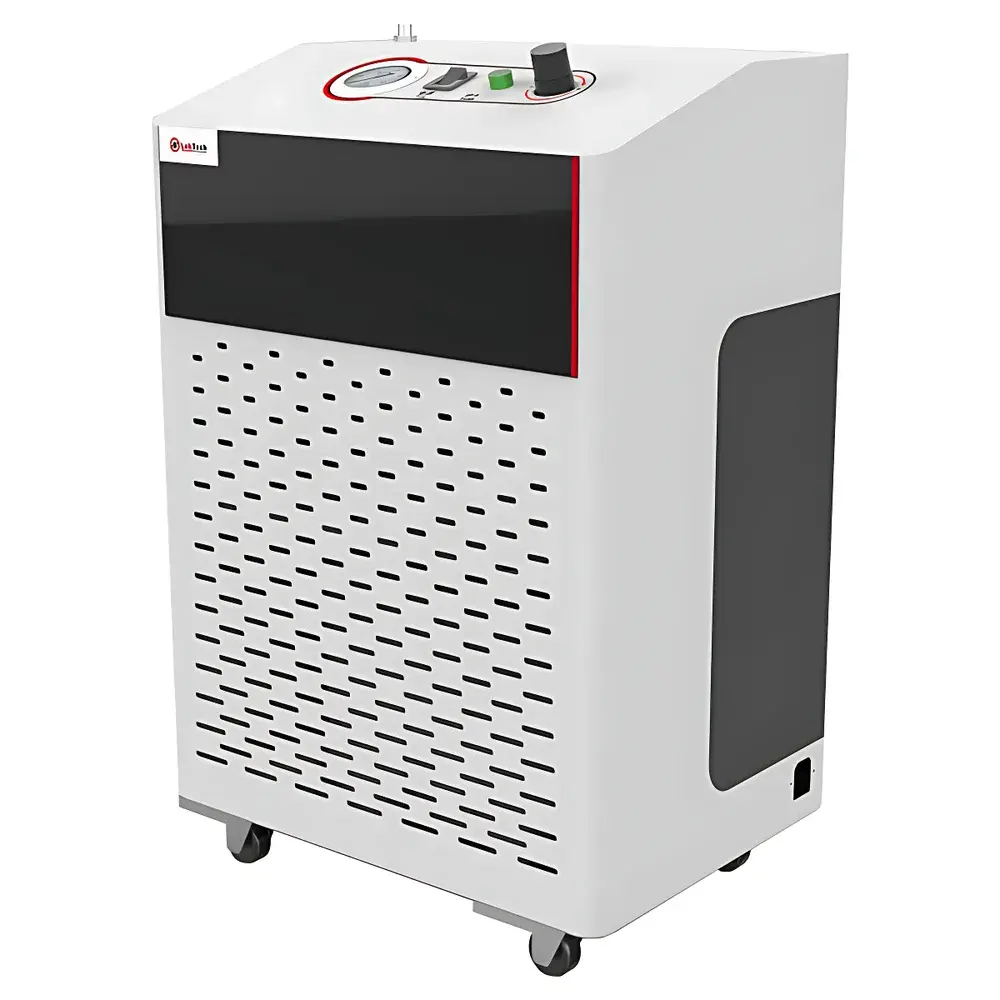
LabTech AIR Series Oil-Free Air Compressor
| Brand | LabTech |
|---|---|
| Model | AIR Series |
| Origin | Beijing, China |
| Manufacturer | LabTech (Producer) |
| Type | Laboratory-Grade Oil-Free Scroll/Scroll-Derived Compressor System |
| Compression Principle | Positive Displacement (Scroll-Type, Oil-Free) |
| Flow Rate | Configurable per model (Typical Range: 5–30 L/min @ 7 bar) |
| Operating Pressure | Adjustable up to 8 bar (g) |
| Dew Point | ≤ –20 °C (at 7 bar, via integrated centrifugal + electronic desiccant-assisted drying) |
| Particulate Filtration | ≤ 0.01 µm (Class 1, ISO 8573-1:2010) |
| Noise Level | ≤ 48 dB(A) |
| Power Supply | 220 V AC, 50 Hz |
| Safety Compliance | Overpressure Protection (Mechanical + Electronic), Thermal Cut-off, IP20 Enclosure |
Overview
The LabTech AIR Series is a laboratory-engineered oil-free air compressor system designed to deliver continuous, high-purity compressed air for sensitive analytical instrumentation—including gas chromatographs (GC), GC-MS systems, FTIR spectrometers, nitrogen generators, and pneumatic sample handling modules. Unlike lubricated piston or rotary screw compressors, the AIR Series employs a hermetically sealed scroll compression mechanism with ceramic-coated orbiting and fixed scrolls, eliminating hydrocarbon contamination at the source. Integrated multi-stage air treatment—comprising centrifugal moisture separation, thermoelectric condensate removal, and ultrafine particulate filtration—ensures compliance with ISO 8573-1:2010 Class 1 (0.01 µm particles, ≤ –20 °C pressure dew point). The system operates within a fully enclosed, acoustically damped chassis lined with wave-pattern acoustic foam, achieving sound pressure levels below 48 dB(A) at 1 m—enabling deployment in shared lab environments without acoustic interference.
Key Features
- Oil-free scroll compression architecture: No lubricants, no carbon buildup, no downstream oil carryover—critical for GC carrier gas integrity and mass spectrometer ion source longevity.
- Integrated dual-mode drying: Centrifugal phase separation removes bulk liquid water; Peltier-cooled electronic condensate trap captures sub-micron aerosols and vapor down to –20 °C pressure dew point.
- Automatic condensate management: Microprocessor-controlled float-level sensor triggers timed drainage of the stainless-steel moisture separator—no manual intervention required.
- Stabilized output pressure: 20 L stainless-steel ASME-coded receiver tank dampens pulsation and maintains ±0.2 bar pressure stability under dynamic load conditions.
- Compact footprint & corrosion-resistant construction: Powder-coated steel frame, electropolished stainless-steel air path components, and vibration-isolated mounting minimize spatial demand and extend service life in humid or saline lab environments.
- Embedded safety architecture: Dual redundant pressure transducers, mechanical relief valve (set at 8.5 bar), thermal cutoff at 110 °C, and real-time fault logging accessible via front-panel LED interface.
Sample Compatibility & Compliance
The AIR Series is validated for continuous operation with gas-consuming instruments requiring Class 1 compressed air per ISO 8573-1:2010 and ASTM D6349-21 specifications. It meets essential requirements for GLP and GMP-aligned laboratories: full audit trail capability (via optional RS-485/Modbus RTU interface), configurable alarm thresholds with relay outputs for building management systems (BMS), and compatibility with 21 CFR Part 11-compliant data acquisition platforms when paired with LabTech’s optional AirLog™ monitoring module. All wetted materials—316L stainless steel, FDA-grade EPDM seals, and sintered stainless filters—are certified per USP and EU Pharmacopoeia 5.1.2.
Software & Data Management
While the base AIR Series operates as a stand-alone unit with local LED status display, optional connectivity enables integration into centralized lab infrastructure. The AirLog™ add-on module provides real-time monitoring of inlet/outlet pressure, dew point, runtime hours, filter saturation status, and thermal load via Ethernet or USB-C. Logged data is timestamped, exportable in CSV/Excel format, and supports configurable email/SNMP alerts for maintenance scheduling or out-of-spec events. All firmware updates are performed via signed binary packages to ensure traceability and cybersecurity compliance per IEC 62443-3-3.
Applications
- Carrier gas supply for capillary GC and GC-MS systems where hydrocarbon contamination compromises baseline stability and column lifetime.
- Pneumatic actuation in automated sample introduction systems (e.g., autosamplers, purge-and-trap concentrators).
- Instrument air for FTIR beam path purging, especially in high-humidity regions where residual moisture causes spectral artifacts.
- Feed gas for membrane-based nitrogen generators requiring consistent inlet pressure and low dew point.
- Lab-wide utility air network for cleanroom-compatible tools, including optical alignment stations and precision weighing enclosures.
FAQ
Is the AIR Series suitable for use with mass spectrometry instruments requiring ultra-high-purity air?
Yes—the oil-free scroll design, combined with sub-0.01 µm filtration and –20 °C dew point performance, meets or exceeds OEM-specified air quality requirements for most benchtop and triple-quadrupole MS systems.
Can the AIR Series be integrated into a facility-wide compressed air monitoring system?
Yes—via optional RS-485 Modbus RTU or Ethernet/IP interface, enabling real-time telemetry and alarm forwarding to SCADA or LabVantage LIMS platforms.
What is the recommended maintenance interval for filters and desiccant elements?
The primary coalescing filter requires replacement every 2,000 operating hours; the sintered stainless particulate filter is washable and rated for ≥10,000 hours; the Peltier condensate module has no consumables but benefits from quarterly visual inspection of heat sink integrity.
Does the system support variable flow control for instruments with fluctuating demand?
Yes—integrated PID-controlled unloading valve modulates displacement in response to real-time pressure feedback, maintaining setpoint accuracy within ±0.15 bar across 20–100% flow range.
Is validation documentation (IQ/OQ/PQ protocols) available for regulated environments?
LabTech provides customizable IQ/OQ templates compliant with ISO/IEC 17025 and ASTM E2500-22, including test scripts for dew point verification, particle count validation, and pressure decay leak testing.



