
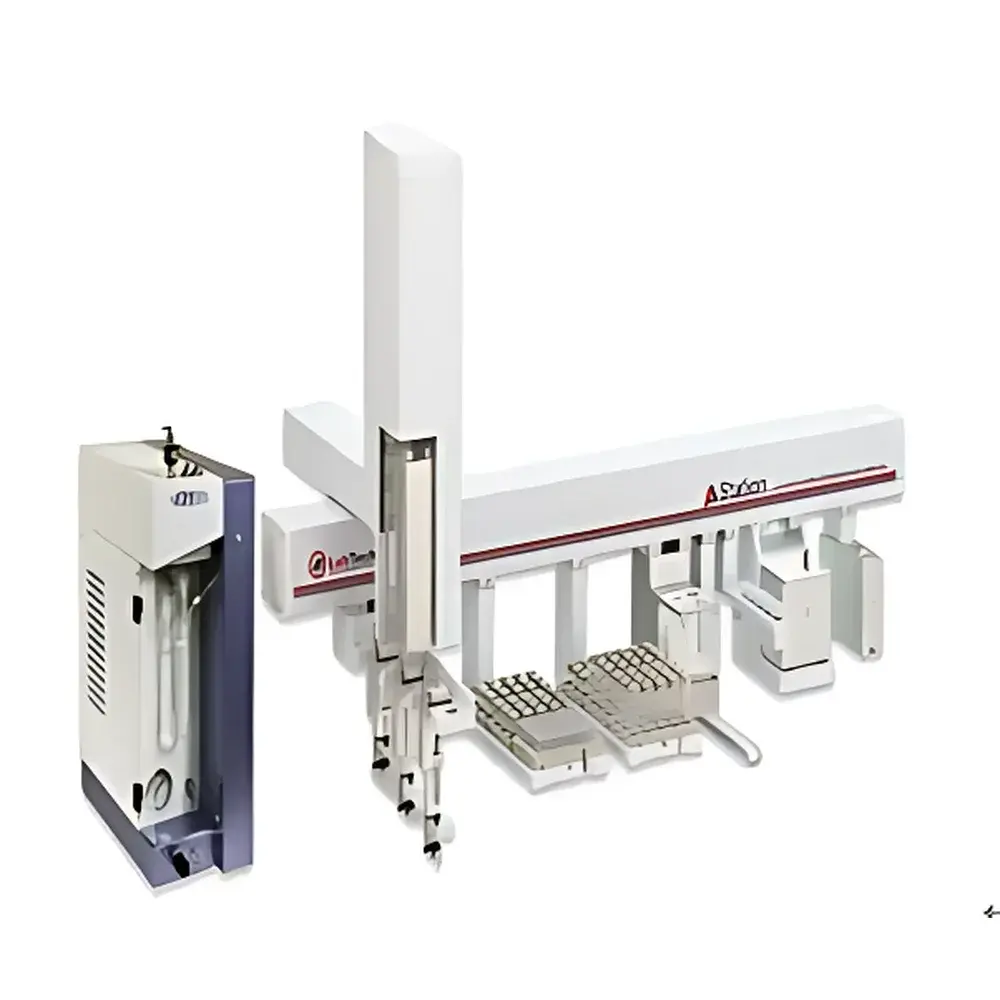
LabTech Astation Multifunctional Automated Sample Preparation and Introduction Platform
| Brand | LabTech |
|---|---|
| Origin | Switzerland |
| Manufacturer | LabTech Instruments AG |
| Product Type | Multifunctional Autosampler for GC/GC-MS/LC/LC-MS |
| Core Techniques | Purge-and-Trap, Static/Dynamic Headspace, Solid-Phase Microextraction (SPME), Thermal Desorption, Pyrolysis, Large-Volume Injection, Gel Permeation Chromatography (GPC) Cleanup, µSPE, Vortex Mixing, Liquid-Liquid Extraction, Derivatization, Cap Piercing, Pipetting |
| Platform Compatibility | GC, GC-MS, LC, LC-MS/MS (vendor-neutral interface) |
| Structural Design | Modular, Rack-Mounted, Instrument-Integrated Platform |
| Configurable Footprint | 534 mm to 1600 mm linear rail length |
| Automation Level | Fully Unattended Operation with Inter-Module Tool Exchange |
Overview
The LabTech Astation is a modular, fully automated sample preparation and introduction platform engineered for laboratories requiring high-fidelity integration of multiple front-end analytical workflows prior to chromatographic analysis. Unlike conventional autosamplers limited to liquid injection, the Astation implements a unified robotic architecture that natively supports eight distinct sample introduction and pretreatment modalities—including purge-and-trap (P&T), static and dynamic headspace (HS), solid-phase microextraction (SPME), thermal desorption (TD), pyrolysis, large-volume liquid injection (LVI), gel permeation chromatography (GPC)-based cleanup, and micro-solid-phase extraction (µSPE). Its design adheres to the principle of “sample-to-data continuity”: all modules operate under a single control system, share a common sample carousel and robotic arm, and execute sequential or parallel workflows without manual intervention. The platform is physically and electronically interfaced with gas chromatographs (GC), GC-mass spectrometers (GC-MS), liquid chromatographs (LC), and LC-tandem mass spectrometers (LC-MS/MS) via standardized hardware triggers and software protocols (e.g., Agilent OpenLab, Thermo Chromeleon, Waters Empower, Shimadzu GCsolution). This ensures deterministic timing synchronization between sample conditioning steps and instrument acquisition cycles—critical for method robustness in regulated environments.
Key Features
- Modular tool exchange architecture: Robotic arm automatically selects and installs application-specific tools (e.g., SPME fiber holder, P&T trap oven, HS vial heater, pipette module) based on sequence definition—no manual reconfiguration required.
- Vendor-agnostic instrument integration: Supports simultaneous control of up to two GC systems or one GC plus multiple LC platforms via dual communication ports (RS-232, Ethernet, TTL I/O).
- Precision liquid handling: Integrated syringe-based pipetting module with active pressure sensing and vial-bottom detection ensures accurate aspiration and dispensing across viscosity ranges; compatible with volumes from 1 µL to 10 mL.
- Thermal management precision: All temperature-controlled modules (HS ovens, P&T traps, SPME desorption zones) maintain ±0.5 °C stability over full operating range (4–250 °C), validated per ASTM E2912 and ISO 17025 calibration protocols.
- Platform scalability: Linear rail lengths configurable from 534 mm to 1600 mm accommodate 48–384 sample positions; optional extension kits support custom lab bench layouts and walk-away operation for >72-hour unattended runs.
- GLP-compliant audit trail: System logs all hardware actions, method parameters, error events, and user interventions with timestamped, non-erasable entries compliant with FDA 21 CFR Part 11 requirements when paired with LabTech’s certified software suite.
Sample Compatibility & Compliance
The Astation accommodates standard 10–22 mL headspace vials, 1.5–2.0 mL GC/LC vials (with crimp, screw, or snap caps), SPME vial inserts, P&T trapping tubes (Tenax®, Carbopack™, etc.), and GPC columns. It handles aqueous, organic, semi-solid (slurries, soils, tissues), and volatile matrices without cross-contamination, enabled by integrated solvent wash stations with programmable rinse cycles (up to 3 solvents per needle). Regulatory alignment includes full traceability for ISO/IEC 17025-accredited testing labs, compatibility with USP residual solvents methods, EPA Methods 502.2, 524.4, 8260D, and ISO 16000-6 for indoor air VOC analysis. All thermal modules are CE-marked and meet IEC 61000-6-2/6-3 EMC standards.
Software & Data Management
Control is executed via LabTech’s Astation Control Suite—a Windows-based application supporting method creation, sequence scheduling, real-time monitoring, and remote diagnostics. The software features drag-and-drop workflow builder for multi-step protocols (e.g., “HS → SPME → GC-MS injection”), embedded QC checks (vial presence verification, seal integrity detection, needle clog sensing), and export of raw metadata (temperature logs, motion trajectories, timing stamps) in CSV and XML formats. Data files are structured for seamless ingestion into LIMS environments via ODBC or REST API. Audit trail records include operator ID, method version hash, and digital signature—enabling full compliance with GLP and GMP documentation requirements.
Applications
The Astation serves environmental labs performing EPA-compliant water and soil VOC analysis (P&T + GC-MS); pharmaceutical QC labs executing residual solvent testing (static HS + GC-FID); food safety laboratories quantifying flavor compounds (dynamic HS + GC-MS/MS); forensic toxicology units conducting blood alcohol and drug screening (SPME + LC-MS/MS); and polymer R&D facilities analyzing extractables/leachables (thermal desorption + GC×GC-TOFMS). Its ability to interleave sample prep steps with instrument run times reduces total cycle time by up to 40% versus serial standalone systems—particularly impactful in high-throughput clinical or regulatory testing environments.
FAQ
Can the Astation be retrofitted to an existing GC or LC system?
Yes—the platform connects via standard analog/digital I/O interfaces and supports vendor-specific command sets for Agilent, Thermo Fisher, Shimadzu, Waters, and PerkinElmer instruments.
Does it support method validation per ICH Q2(R2)?
All hardware modules undergo factory performance qualification (PQ) per ISO/IEC 17025; users may perform IQ/OQ/PQ using LabTech’s documented protocols and reference standards.
How is carryover minimized during high-concentration sample analysis?
Triple-solvent needle wash (with heated drying), vial septum piercing depth optimization, and programmable post-injection dwell time reduce carryover to <0.01% for target analytes across matrix types.
Is remote monitoring supported?
Yes—via secure HTTPS web interface and SNMP-enabled network alerts for system status, queue progress, and fault conditions.
What maintenance is required for long-term reliability?
Scheduled quarterly calibration of temperature zones and robotic positioning; annual replacement of consumable seals, syringe barrels, and SPME fiber holders per usage log.



