
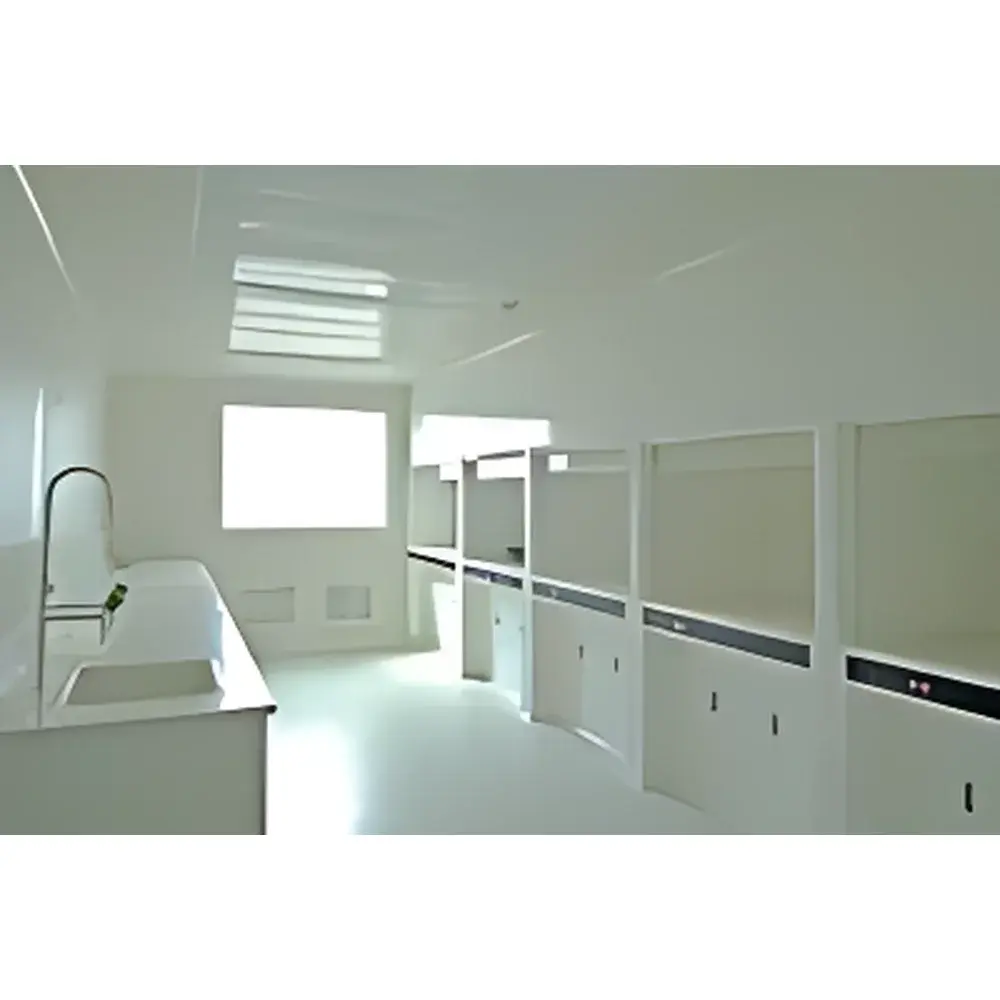
LabTech Cleanroom Engineering System for High-Resolution Mass Spectrometry Laboratories
| Brand | LabTech |
|---|---|
| Origin | Beijing, China |
| Manufacturer Type | Direct Manufacturer |
| Country of Origin | China |
| Model | Ultra-Clean Engineering System |
| Pricing | Available Upon Request |
Overview
The LabTech Cleanroom Engineering System is a purpose-built integrated cleanroom solution engineered specifically for high-sensitivity mass spectrometry laboratories. Unlike general-purpose cleanrooms, this system addresses the stringent environmental requirements of ultra-trace elemental and isotopic analysis—where sub-picoampere current stability, femtogram-level contamination control, and thermal-mechanical isolation are non-negotiable. It operates on the principles of unidirectional laminar airflow (ISO Class 5–7 per ISO 14644-1), differential pressure zoning (typically +15–25 Pa between adjacent zones), and low-outgassing material science to suppress background interference from airborne particulates, volatile organic compounds (VOCs), radon progeny, and metallic aerosols. Designed for compatibility with HR-ICP-MS, HR-MC-ICP-MS, TIMS, GD-MS, ICP-MS, and gas-source IRMS platforms—including Thermo Fisher MAT 253, Delta XP, and Delta AD—the system ensures that environmental variables remain within instrument-specified operating envelopes defined by ASTM E2937, ISO/IEC 17025, and USP Analytical Instrument Qualification guidelines.
Key Features
- Modular cleanroom architecture with welded stainless steel (316L) structural framework and electropolished surfaces for ultra-low particle shedding
- Multi-stage HVAC system featuring HEPA H14 (≥99.995% @ 0.1 µm) and ULPA U15 (≥99.9995% @ 0.12 µm) filtration, coupled with redundant VFD-controlled air handling units
- Zoned pressure cascade design: anteroom (+15 Pa), sample prep zone (+20 Pa), instrument zone (+25 Pa), and exhaust buffer (-10 Pa) to prevent cross-contamination
- Low-background construction materials—including sulfur-free, halogen-free, and radon-impermeable wall panels; conductive epoxy flooring (10⁶–10⁸ Ω/sq) with copper grounding grid
- Dedicated utility infrastructure: dual-redundant 24/7 UPS-backed power (isolated neutral, ≤1% THD), nitrogen/helium gas lines with point-of-use purification (≤0.1 ppb O₂/H₂O), and Type I ultrapure water distribution (18.2 MΩ·cm, TOC <1 ppb)
- Integrated environmental monitoring system (EMS) logging temperature (±0.2°C), relative humidity (±2% RH), differential pressure (±0.5 Pa), and particle counts (0.1–5.0 µm) at 1-min intervals with audit-trail capability compliant with FDA 21 CFR Part 11
Sample Compatibility & Compliance
The system supports all critical pre-analytical workflows required for mass spectrometry: acid digestion (HF/HNO₃), ultrapure reagent dispensing, microgram-scale gravimetric weighing (0.1 µg resolution balances), and clean-bench-assisted sample loading. All interior finishes comply with ISO 14644-8 (cleanroom materials testing), ASTM D2859 (flammability), and IEC 61000-6-4 (EMC immunity). The design adheres to GLP/GMP facility qualification protocols (IQ/OQ/PQ), including smoke visualization studies, airflow velocity mapping, and particle challenge testing. It meets the spatial and environmental prerequisites outlined in ISO/IEC 17025:2017 Clause 6.3 (Facilities and Environmental Conditions) and supports accreditation readiness for CNAS, UKAS, and A2LA.
Software & Data Management
The embedded EMS includes a web-accessible SCADA interface with configurable alarm thresholds, automated report generation (PDF/CSV), and secure role-based access control. All environmental data are timestamped, digitally signed, and stored for ≥36 months—fully traceable to NIST-traceable calibration certificates for sensors. Audit logs capture user actions, configuration changes, and alarm acknowledgments, satisfying FDA 21 CFR Part 11 electronic record requirements. Optional integration with LIMS (e.g., LabWare, STARLIMS) enables automatic linkage of environmental metadata to analytical run records for full data lineage.
Applications
This engineering system is deployed in national metrology institutes, geological survey labs, nuclear forensics facilities, and pharmaceutical R&D centers conducting isotopic ratio measurements (e.g., Sr/Nd/Pb/U), ultra-trace metal analysis in biological matrices, and reference material certification. Its design mitigates memory effects in multi-collector systems, reduces oxide formation rates in plasma sources, and extends detector lifetime in Faraday cup and electron multiplier arrays by minimizing particulate-induced arcing and surface adsorption.
FAQ
Is this system compatible with existing laboratory infrastructure?
Yes—modular design allows retrofit installation into reinforced concrete or steel-framed buildings, with structural load analysis and vibration isolation assessment included in the site survey.
What validation documentation is provided?
Full IQ/OQ/PQ protocols, as-built drawings, filter certification reports, airflow visualization videos, and third-party ISO 14644-1 classification certificates are delivered prior to commissioning.
Can the system be expanded or reconfigured post-installation?
Yes—modular wall and ceiling panels support future expansion up to ±30% floor area without HVAC redesign, subject to static pressure recalibration.
Does LabTech provide ongoing maintenance and calibration services?
Yes—comprehensive service contracts include quarterly HEPA integrity testing, annual sensor recalibration, and 24/7 remote diagnostics with SLA-governed response times.
How does this system differ from standard ISO Class 5 cleanrooms?
It incorporates mass-spec-specific enhancements: radon suppression membranes, sub-ppq metallic particulate control, and electromagnetic shielding exceeding IEEE Std 299 for RF-sensitive detectors.



