
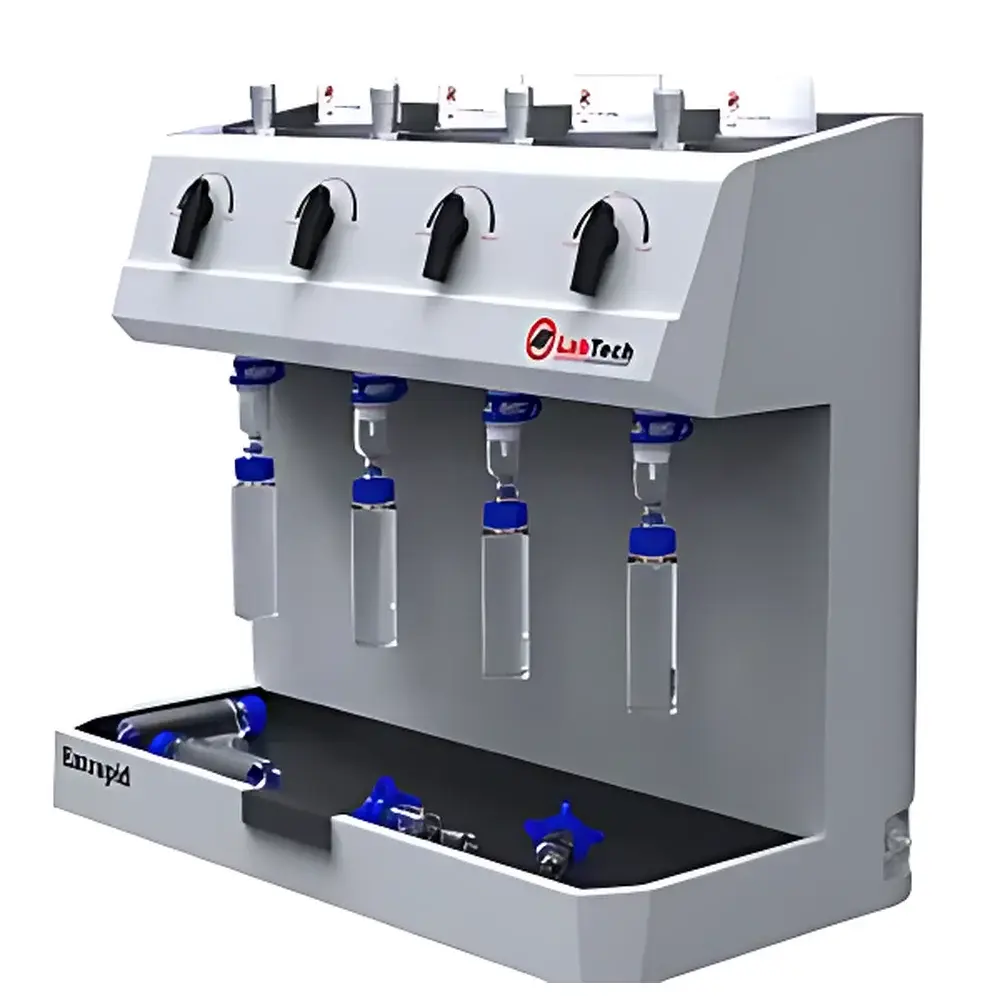
LabTech Extrapid Manual Column-Disc Solid Phase Extraction System
| Brand | LabTech |
|---|---|
| Origin | Beijing, China |
| Manufacturer Type | Manufacturer |
| Product Category | Domestic |
| Model | Extrapid |
| Automation Level | Manual |
| Number of Channels | 4 |
| Extraction Format | Column and Disc (Dual-Format) |
| Flow Rate Control | 1–45 mL/min (per channel, independently adjustable via precision PTFE micro-flow valves) |
| Solvent Reservoir Capacity | 8 independent solvent ports |
| Sample Throughput | Simultaneous processing of multiple samples |
| Maximum Sample Load Volume | Up to 20 L per channel |
| Wetted Materials | Borosilicate glass, PTFE, stainless steel (316) |
| Compliance | Compatible with ASTM D7279, ISO 16775, USP <621>, and GLP/GMP-aligned workflows |
Overview
The LabTech Extrapid Manual Column-Disc Solid Phase Extraction System is an engineered solution for robust, reproducible sample preparation in environmental, pharmaceutical, food safety, and clinical laboratories. It implements the fundamental principle of solid-phase extraction (SPE)—selective adsorption of analytes onto a solid sorbent followed by targeted elution—within a dual-format platform that supports both cartridge-based (column) and membrane-based (disc) configurations. Unlike fully automated systems, the Extrapid leverages manual vacuum-driven flow control to deliver high method flexibility without sacrificing precision. Its architecture eliminates mechanical complexity while maintaining strict adherence to validated SPE protocols, making it particularly suitable for labs requiring method development, regulatory-compliant batch processing, or routine QC where full automation is unnecessary or cost-prohibitive.
Key Features
- Dual-format compatibility: Accepts standard SPE cartridges (1 mL, 3 mL, and 6 mL volumes) and circular extraction discs (47 mm and 90 mm diameters), enabling seamless transition between high-capacity water analysis (disc mode) and low-volume biological or pharmaceutical matrices (column mode).
- Independent four-channel operation: Each channel features a dedicated vacuum line, solvent selector valve, and PTFE-coated micro-flow regulator—ensuring cross-contamination-free parallel processing and inter-channel reproducibility.
- Vacuum workflow optimization: Integrated manifold design allows continuous SPE progression—from conditioning and loading to washing and elution—without interrupting vacuum, repositioning collection vessels, or manually venting the system. This reduces operator-induced variability and improves method transfer fidelity.
- Chemically resistant fluid path: All solvent-contact surfaces consist of borosilicate glass, medical-grade PTFE, and passivated 316 stainless steel—validated for compatibility with aggressive solvents including dichloromethane, acetonitrile, methanol, ethyl acetate, and acidic/basic aqueous media.
- Modular solvent management: Eight independently plumbed solvent ports support gradient elution, multi-step wash protocols, and method-specific solvent sequencing—critical for complex matrices such as wastewater, plasma extracts, or herbal tinctures.
Sample Compatibility & Compliance
The Extrapid accommodates sample volumes ranging from 1 mL to 20 L, supporting trace-level enrichment of polar, semi-polar, and non-polar analytes—including PAHs, pesticides, pharmaceutical residues, endocrine disruptors, and mycotoxins. Its physical configuration meets the dimensional and pressure requirements specified in EPA Method 508.1, ASTM D7279 (for hydrophobic organic compounds in water), and ISO 16775 (water quality—determination of organic pollutants). When operated under documented SOPs with calibrated flow control and traceable consumables, the system supports data integrity frameworks aligned with FDA 21 CFR Part 11 (via external lab notebook integration) and GLP/GMP audit readiness.
Software & Data Management
As a manual platform, the Extrapid does not incorporate embedded software or digital control interfaces. Instead, it is designed for integration into paper-based or electronic laboratory notebook (ELN) workflows. Each channel includes engraved calibration markings and standardized port labeling to facilitate consistent method documentation. Users may pair the system with third-party LIMS or ELN platforms (e.g., LabWare, Benchling, or Veeva Vault) to record solvent sequences, flow rates, collection fractions, and analyst signatures—ensuring full traceability required for ISO/IEC 17025 accreditation or regulatory submissions.
Applications
- Environmental monitoring: Pre-concentration of ng/L-level contaminants (e.g., carbamates, organophosphates) from surface water, groundwater, and wastewater prior to GC-MS or LC-MS/MS analysis.
- Pharmaceutical QA/QC: Cleanup of tablet dissolution samples, stability-indicating assays, and residual solvent testing in active pharmaceutical ingredients (APIs).
- Food safety: Isolation of veterinary drug residues (e.g., sulfonamides, fluoroquinolones) from milk, honey, and muscle tissue homogenates.
- Clinical toxicology: Selective isolation of opioids, benzodiazepines, and stimulants from urine and serum using mixed-mode cation-exchange or reversed-phase discs.
- Method development labs: Rapid screening of sorbent chemistries (C18, SCX, Florisil, HLB) and solvent gradients across column and disc formats within a single instrument footprint.
FAQ
Is the Extrapid compatible with third-party SPE cartridges and discs?
Yes—mechanical dimensions and port interfaces conform to international SPE standards (ASTM D7279 Annex A1), ensuring interoperability with major suppliers including Waters, Agilent, Thermo Fisher, and Phenomenex.
Can flow rate be monitored in real time?
While no integrated flow sensor is included, each channel’s PTFE micro-valve provides stable, repeatable flow regulation across the 1–45 mL/min range; users may verify flow empirically using graduated cylinders and stopwatch timing per ASTM D7279 Section 9.2.
What maintenance is required for long-term reliability?
Routine cleaning of glass manifolds with appropriate solvents and periodic inspection of PTFE seals and vacuum tubing are sufficient; no lubrication or recalibration is necessary under normal use conditions.
Does the system support positive-pressure SPE?
No—the Extrapid operates exclusively under vacuum-driven flow; positive-pressure or nitrogen-purge configurations require external gas manifolds and are not part of the base system design.
How is method validation supported?
The system’s mechanical consistency, material compatibility, and channel independence enable rigorous assessment of recovery, precision, and carryover per ICH Q2(R2) guidelines when paired with certified reference materials and documented procedural controls.



