
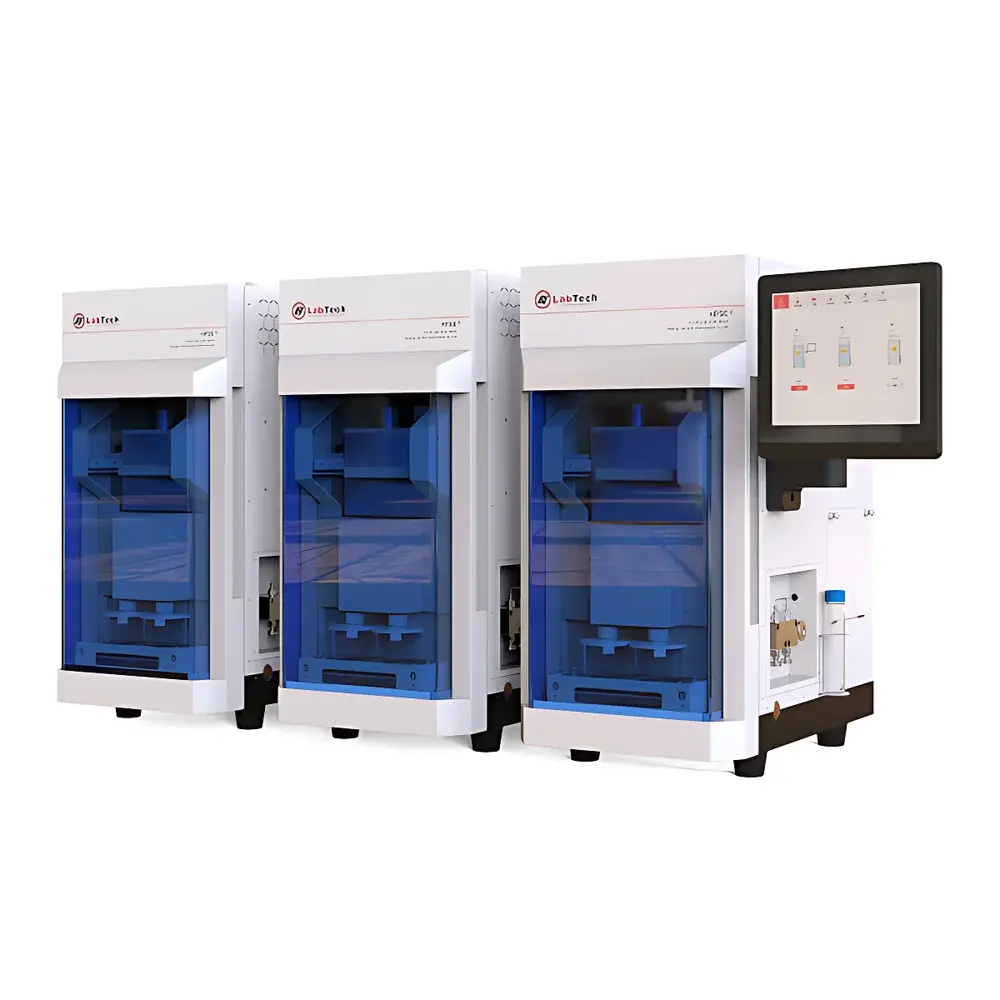
LabTech HPSE Series Accelerated Solvent Extractor
| Brand | LabTech |
|---|---|
| Origin | Beijing, China |
| Manufacturer Type | Original Equipment Manufacturer (OEM) |
| Product Category | Domestic |
| Model | HPSE |
| Instrument Type | Solid-Liquid Extraction System |
| Sample Throughput | Up to 6 parallel extraction cells |
| Extraction Vessel Capacity | Compatible with 1–100 mL vessels |
| Temperature Range | Programmable, typically 50–200 °C (application-dependent) |
| Pressure Range | Up to 20 MPa (3,000 psi), dynamically regulated |
| Pump Flow Rate | 100 mL/min |
| Sealing Mechanism | Auto-actuated force-assisted sealing |
| Enclosure | Fully sealed, ventilation-integrated chassis |
| Compliance | Designed for GLP-compliant workflows |
Overview
The LabTech HPSE Series Accelerated Solvent Extractor is an automated solid-liquid extraction system engineered for high-efficiency, reproducible recovery of organic analytes from solid and semi-solid matrices. It operates on the principle of accelerated solvent extraction (ASE®), wherein samples are subjected to elevated temperature and pressure in the presence of selected solvents—conditions that enhance solubility, mass transfer kinetics, and cell wall permeability while minimizing thermal degradation. Unlike conventional Soxhlet or ultrasonic extraction, the HPSE system delivers complete extractions in minutes rather than hours, with solvent consumption reduced by up to 90%. Its fully sealed architecture eliminates ambient exposure to volatile organic compounds (VOCs), supporting both operator safety and environmental compliance.
Key Features
- Modular multi-channel configuration: Supports 2-, 4-, or 6-vessel parallel operation—field-upgradable without hardware replacement.
- Universal vessel compatibility: Accepts extraction cells ranging from 1 mL to 100 mL, enabling method scalability across diverse sample types—from trace-level soil contaminants to gram-scale herbal powders.
- Dynamic pressure regulation: Integrated high-flow pump (100 mL/min) and real-time pressure feedback enable automatic adjustment across defined pressure zones (e.g., 5–15 MPa for polar matrices; 10–20 MPa for recalcitrant polymers), ensuring optimal solvent penetration without over-pressurization.
- Auto-sealing technology: Force-assisted, self-aligning sealing mechanism engages prior to pressurization—eliminating manual torque application and operator-induced variability. Sealing integrity is verified before each cycle via pressure-hold diagnostics.
- Integrated ventilation interface: Direct duct connection capability allows exhaust routing to centralized lab fume hoods or external scrubbers—no secondary containment required.
- Rugged industrial-grade construction: Stainless-steel fluid path, corrosion-resistant manifold, and IP54-rated electronics ensure long-term stability under routine QC/QA laboratory conditions.
Sample Compatibility & Compliance
The HPSE accommodates a broad spectrum of solid and semi-solid matrices, including but not limited to: soils, sediments, sludges, plant tissues, foodstuffs (grains, spices, dairy powders), pharmaceutical tablets, and polymer composites. It complies with core regulatory frameworks governing analytical extraction—including EPA Methods 3545A and 3546, ASTM D7689, ISO 14507, and Chinese national standards GB/T 29785 and HJ 782. When operated with validated protocols and version-controlled software, the system supports GLP and GMP documentation requirements, including full audit trails, user access control, and electronic signature functionality aligned with FDA 21 CFR Part 11.
Software & Data Management
The HPSE is controlled via LabTech’s proprietary ASE-Link™ software, a Windows-based platform offering method library management, real-time parameter monitoring, and cycle-by-cycle log export in CSV and PDF formats. All method parameters—including temperature ramp profiles, static/dynamic extraction time, flush volume, and purge duration—are stored with timestamps and operator IDs. Software validation packages (IQ/OQ/PQ documentation templates) are available upon request. Data export conforms to LIMS-compatible schemas, facilitating seamless integration with enterprise laboratory information management systems.
Applications
- Environmental analysis: Extraction of PAHs, PCBs, organochlorine pesticides, and dioxins from soil, sediment, and air filters.
- Food safety testing: Recovery of mycotoxins (e.g., aflatoxin B1), veterinary drug residues, and plasticizers from cereals, meat, and packaging materials.
- Phytochemical research: Isolation of alkaloids, flavonoids, and terpenoids from traditional Chinese medicinal herbs under controlled thermal profiles.
- Materials science: Leaching studies of additives (e.g., flame retardants, UV stabilizers) from polymeric matrices.
- Forensic toxicology: Solid-phase cleanup support for post-extraction residue concentration prior to GC-MS or LC-MS/MS analysis.
FAQ
What extraction solvents are compatible with the HPSE system?
Commonly used solvents include hexane, acetone, dichloromethane, ethyl acetate, methanol, and mixtures thereof. Solvent selection must consider thermal stability at operating temperatures and compatibility with stainless-steel wetted parts.
Can the HPSE be integrated into automated sample preparation workflows?
Yes—via optional robotic autosampler interfaces and Ethernet-enabled remote command protocols (TCP/IP), the HPSE supports unattended batch processing and synchronization with upstream digestion or downstream concentration modules.
Is method validation support available for regulatory submissions?
LabTech provides application notes, performance qualification checklists, and collaborative method transfer assistance aligned with ICH Q2(R2) guidelines.
How is maintenance tracked and documented?
The system logs all critical consumables (seal replacements, filter changes) and mechanical actuations (valve cycles, pump strokes); scheduled maintenance alerts are configurable within ASE-Link™ software.
Does the HPSE meet CE or UL safety certification requirements?
The instrument carries CE marking per Directive 2014/30/EU (EMC) and 2014/35/EU (LVD); UL listing is available for North American configurations upon request.



