
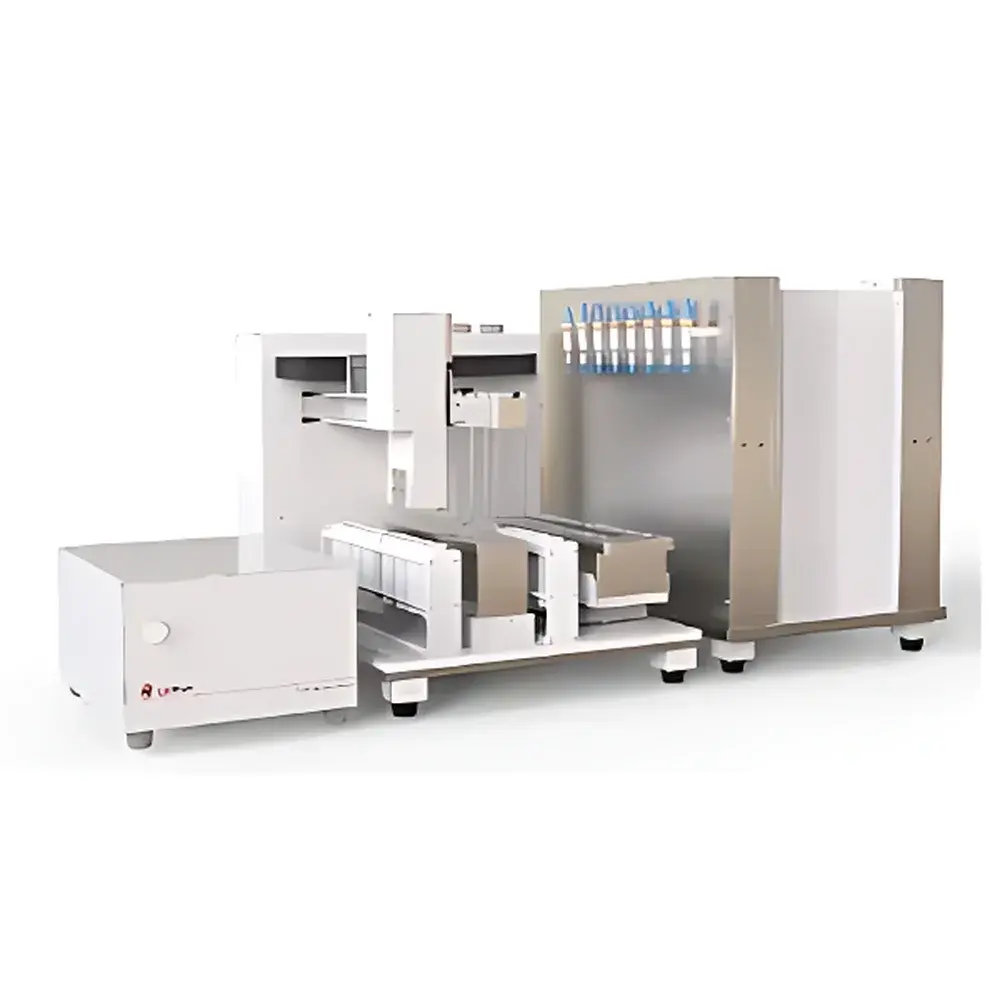
LabTech Isotope-S8-2 Fully Automated Radioisotope Solid-Phase Extraction System
| Brand | LabTech |
|---|---|
| Origin | USA |
| Manufacturer Type | Original Equipment Manufacturer (OEM) |
| Product Category | Imported Instrument |
| Model | Isotope-S8-2 |
| Pricing | Upon Request |
Overview
The LabTech Isotope-S8-2 is a fully automated, compact-footprint solid-phase extraction (SPE) system engineered specifically for the safe, precise, and reproducible isolation and purification of radioisotopes from aqueous environmental, nuclear fuel cycle, or radiopharmaceutical samples. It operates on a validated sequential fluidic principle—integrating programmable high-accuracy syringe pumps, corrosion-resistant fluidic manifolds, and pneumatically actuated multi-position valves—to execute complete SPE workflows without manual intervention. Designed for deployment both inside inert-atmosphere gloveboxes (e.g., argon- or nitrogen-purged) and standard laboratory fume hoods, the system minimizes operator radiation exposure by eliminating open handling steps and maintaining column hydration throughout the entire process. Its modular architecture separates the control unit from the fluidic processing module, enabling flexible installation in constrained spaces while preserving full functionality and regulatory traceability.
Key Features
- Eight independent parallel processing channels, each configurable via software to run simultaneously or selectively—supporting throughput scalability from single-sample validation to batched environmental monitoring.
- Integrated high-precision syringe pump modules with volumetric accuracy ≤±0.5% across 0.1–10 mL ranges; pump heads feature chemically resistant PTFE-coated stainless-steel plungers and custom-sealed housings rated for HNO₃, HCl, and HF-based eluents.
- PTFE-sheathed sampling needle assembly: inner lumen constructed from fluoropolymer tubing (ID 0.5 mm), outer needle fabricated from electropolished 316L stainless steel, and surface-treated with uniform PTFE coating for extended service life under aggressive radionuclide matrix conditions.
- Zero-air-introduction column hydration protocol: valve sequencing ensures continuous liquid contact with SPE sorbent beds during conditioning, loading, washing, and elution—preventing channeling, drying artifacts, and breakthrough losses.
- Complete sample loading via positive-displacement aspiration and direct column injection—achieving quantitative transfer (>99.8% recovery) with no dead-volume retention in transfer lines or vial residues.
- Dual-stage (2-level) and optional triple-stage (3-level) needle wash stations using solvent gradients (e.g., water → methanol → dilute acid), each with dedicated waste routing and real-time pressure monitoring to confirm cleaning efficacy and prevent carryover.
- Glovebox-compatible mechanical arm with linear motion precision ±0.1 mm and positional repeatability <0.05 mm—enabling reliable vial indexing, column positioning, and tip alignment under low-oxygen or radiological containment environments.
Sample Compatibility & Compliance
The Isotope-S8-2 supports a broad range of sample matrices including seawater, groundwater, urine, dissolved fuel rods, and spent nuclear reprocessing effluents. It accommodates standard 1-mL, 3-mL, and 6-mL SPE cartridges (e.g., TRU, TEVA, DGA, UTEVA resins from Eichrom/Triskem), as well as custom-packed columns up to 15 mm internal diameter. All wetted materials comply with ASTM F2647-21 (Standard Specification for Materials Used in Nuclear Applications) and meet USP requirements for extractables profiling. The system’s firmware and control software are designed to support audit trails, electronic signatures, and user-access hierarchy per FDA 21 CFR Part 11 and ISO/IEC 17025:2017 Annex A.2 for accredited testing laboratories.
Software & Data Management
The proprietary IsotopeControl™ software provides intuitive graphical workflow programming—including conditional logic loops, real-time pressure and flow-rate feedback integration, and dynamic parameter adjustment during run execution. Each method stores full metadata: timestamped valve actuation logs, pump displacement profiles, temperature-stabilized zone readings (for ambient or heated cartridge blocks), and error-event diagnostics. Raw data export is supported in CSV and XML formats compatible with LIMS integration (e.g., Thermo Fisher SampleManager, LabVantage). Software validation documentation (IQ/OQ/PQ protocols) and cybersecurity compliance reports (NIST SP 800-53 Rev. 5 controls) are available upon request.
Applications
- Pre-concentration and separation of actinides (²³⁸U, ²³⁹Pu, ²⁴¹Am) and fission products (⁹⁰Sr, ¹³⁷Cs, ⁹⁹Tc) from environmental surveillance samples per EPA Method 900.0 and ISO 10703.
- Routine analysis of uranium isotopic ratios (²³⁴U/²³⁸U, ²³⁵U/²³⁸U) in safeguards verification programs aligned with IAEA Technical Reports Series No. 433.
- Radiochemical purity assessment of ⁶⁸Ga, ¹⁷⁷Lu, and ²²⁵Ac-labeled radiopharmaceuticals prior to clinical administration (USP compliant).
- High-throughput screening of alpha-emitting nuclides in decommissioning waste streams under DOE Order 458.1 and NRC Regulatory Guide 4.14.
FAQ
Can the Isotope-S8-2 be installed inside an argon-filled glovebox?
Yes—the fluidic module is rated IP54 and features external cable feedthroughs compatible with standard KF40 or CF63 glovebox ports; control electronics remain outside for ease of maintenance and thermal management.
Does the system support method validation per GLP guidelines?
Yes—full electronic record retention, user role-based permissions, change control logs, and calibration certificate traceability to NIST standards are embedded in the software architecture.
What maintenance intervals are recommended for syringe pump seals and needle wash stations?
Syringe pump seals require replacement every 6 months under continuous operation; needle wash solvent filters should be inspected weekly and replaced biweekly in high-acid usage scenarios.
Is remote monitoring and troubleshooting supported?
Yes—optional secure TLS 1.3-enabled remote access allows authorized engineers to diagnose hardware status, review method execution history, and push firmware updates without physical presence.
Related Products



